
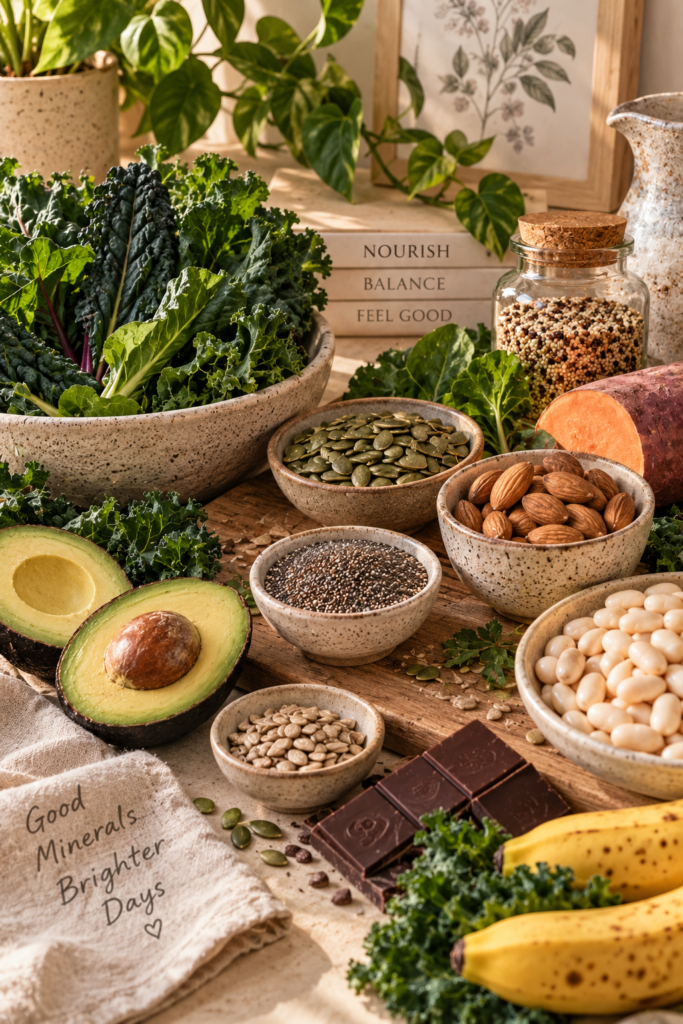
Before the supplement aisle gets involved: eating a mineral and absorbing a mineral are not exactly the same thing. Your digestive system has to release nutrients from food, move them across the intestinal lining and then regulate where they go. That whole journey is called bioavailability—which sounds like a finance term for spinach but is actually pretty useful.
The Anatomy of a Calm Gut · Part 3
Food does not teleport into your cells. Digestion breaks it down, the intestine absorbs what it can, and your body decides what to use, store or excrete.
This is the plate-to-cell story: stomach acid, nutrient absorption, magnesium, potassium, sodium, iodine and why “more” is not always the same as “more usable.”
Main ideaIntake ≠ absorption ≠ cellular use.
Myth to retireMore milligrams always means better.
Try firstBuild variety before chasing powders.

You can eat a beautiful bowl full of greens, beans, grains, fruit, seeds and the kind of garnish that makes you briefly feel like someone with matching storage containers.
Then your body has to do the actual work.
The digestive tract mechanically and chemically breaks food into smaller components. Once nutrients are in absorbable forms, most nutrient absorption occurs through the small intestine. Water and some remaining substances continue onward to the large intestine.1
That sounds straightforward until you ask the next question:
How much of what I ate actually becomes available to my body?
Welcome to bioavailability.
From Plate to Cell: The Four-Part Journey
Chewing, stomach mixing, acid and digestive enzymes help separate nutrients from the food matrix.
Nutrients cross the intestinal lining using different transport mechanisms depending on the nutrient and its chemical form.
The gut, liver, kidneys, hormones and other systems influence how much stays in circulation or is excreted.
Cells use minerals for electrical gradients, enzymes, muscle function, hormone production, fluid balance and other jobs.
The number on a nutrition label tells you what is in the food. It does not tell the entire story of what your body will absorb and use.
What “Bioavailability” Actually Means
Bioavailability refers to the proportion of a nutrient that becomes available for absorption and use in the body.
It can change based on:
Different forms of the same mineral can dissolve and absorb differently.
A nutrient may be bound inside plant or animal tissue and released differently during digestion.
Certain nutrients and plant compounds can enhance or reduce absorption of specific minerals.
GI disease, surgery, inflammation or chronic diarrhea can change nutrient absorption.
Some medications alter stomach acidity, bind minerals or change how the body handles them.
The body may regulate absorption and excretion differently depending on need and mineral stores.
Bioavailability does not mean you need to redo the nutrition label with a calculator.
Recommended intake values already account for ordinary differences in absorption within the populations they are designed for. You do not need to see “30% absorbed” and immediately triple a food or supplement dose.
That internet math can get weird fast.
What Does Stomach Acid Have to Do With Minerals?
Stomach acid helps create the acidic environment needed for normal digestion. It contributes to protein digestion and can help release or solubilize certain minerals from food and supplements before they reach the small intestine.1
But “more stomach acid = more nutrients” would be another oversimplification.
Different minerals use different absorption pathways. Some are highly absorbable across a wide range of conditions. Others are more sensitive to chemical form, solubility, intestinal conditions or competing compounds.
The internet version
Low stomach acid is secretly causing every mineral problem, so everyone needs vinegar, lemon water or acid supplements before meals.
The safer version
Normal gastric acidity supports digestion, and some medicines or diseases can affect micronutrient status. But symptoms alone cannot diagnose “low stomach acid,” and self-treating with acid is not appropriate for everyone.
If you take a proton-pump inhibitor, have had GI surgery, live with inflammatory bowel disease, celiac disease or another condition that affects absorption, nutrient monitoring may be part of medical care. That is different from diagnosing yourself because you felt bloated after tacos.
Four Minerals Worth Understanding
Your old Anatomy of a Calm Gut notes focused on magnesium, potassium, sodium and iodine, and they make a useful group because they show how different minerals can be.
A mineral with hundreds of cellular jobs
Magnesium participates in more than 300 enzyme systems and supports normal nerve and muscle function, protein synthesis, energy metabolism and many other biochemical reactions.2
Food sources include pumpkin seeds, chia seeds, almonds, legumes, whole grains, leafy greens, some fortified foods and certain waters. NIH estimates that roughly 30–40% of dietary magnesium is typically absorbed.2
Lifvyt note: this does not mean food is “wasting” the rest. The body regulates minerals dynamically, and intake recommendations account for ordinary absorption.
The mostly-inside-the-cell electrolyte
Potassium helps maintain intracellular fluid volume and electrical gradients across cell membranes. Those gradients matter for normal nerve transmission, muscle contraction and kidney function.3
Fruits, vegetables, potatoes, legumes, dairy, fish, meats and nuts can all contribute potassium. Fruit juice can contribute too. NIH notes that about 85–90% of dietary potassium is typically absorbed.3
Important: potassium supplements and potassium-based salt substitutes are not automatically safe for people with kidney disease or certain medications.
Necessary mineral, extremely enthusiastic food additive
Sodium is essential for extracellular fluid balance, nerve signaling and muscle function. The problem is not that sodium is “toxic.” It is that many modern diets deliver far more sodium than the body requires, largely through packaged and restaurant foods.
Sodium and potassium work on opposite sides of important cellular gradients. That relationship is one reason a diet rich in potassium-containing foods and moderate in sodium is emphasized in heart-health guidance.
Lifvyt note: “electrolytes” are not automatically better because the word appears in metallic lettering on a packet.
Tiny amount, very specific job
Iodine is an essential component of thyroid hormones, which help regulate metabolic activity and are especially important during fetal and infant development.4
Sources include iodized salt, seafood, dairy foods and eggs. Seaweed can contain very large and highly variable amounts, so “more seaweed” is not a universally safe iodine strategy.
Worth knowing: most salt used in processed food is not iodized, and many specialty salts are not either. “Fancy salt” and “iodine source” are not synonyms.
Why More Is Not Always More Bioavailable
This is one of the most useful nutrition concepts because it breaks the spell of giant supplement numbers.
A 2025 review comparing magnesium and potassium salts found good bioavailability for potassium chloride and citrate and for magnesium citrate and chloride, while magnesium oxide was less bioavailable, likely in part because of poorer solubility.5
So a label with a larger milligram number does not automatically mean your body receives more.
Form matters.
Dose matters.
Solubility matters.
And sometimes the best source is still the boring one: regular food eaten repeatedly.
Food has a trick supplements cannot fully copy
A bean is not “magnesium.” It is magnesium plus fiber, carbohydrate, protein, potassium, polyphenols and a food structure that interacts with digestion. A potato is not “potassium.” It is food.
That does not make supplements bad. It just means pills and food are not interchangeable objects with different packaging.
Do Plant Compounds Block Mineral Absorption?
Sometimes.
Plant foods contain compounds such as phytates and oxalates that can bind certain minerals and reduce their absorption. That is real chemistry. It is also commonly turned into a reason to fear beans, grains, nuts or vegetables.
A 2025 review notes that antinutritional factors can affect mineral bioavailability, while food processing methods such as soaking, fermentation, sprouting and cooking can modify some of these compounds.6
But the presence of phytate does not turn a lentil into nutritional decorative gravel.
People eat diets, not isolated chemistry experiments.
For most generally healthy adults, a varied diet can include beans, whole grains, nuts, seeds and vegetables comfortably. People with diagnosed deficiencies, restrictive diets or absorption disorders may need more individualized planning.

Food Color Is Not Just for Pretty Plates
We talked about color in Part 2 because varied plant foods give the microbiome different fibers and compounds. The same idea helps with micronutrients.
Leafy greens, herbs, broccoli and other green vegetables can contribute magnesium, potassium, folate and plant compounds.
Sweet potatoes, squash, citrus and mango can contribute potassium, carotenoids and vitamin C, depending on the food.
Tomatoes, watermelon, berries and peppers bring different combinations of potassium, vitamin C and pigments such as lycopene or anthocyanins.
Berries, grapes, plums and purple vegetables are known for anthocyanins and other polyphenols.
Oats, beans, lentils, nuts, seeds, yogurt, whole grains and potatoes may not win the color contest but can be mineral workhorses.
Potatoes, cauliflower, yogurt, milk, fish, eggs and many other pale foods still contribute useful nutrients.
You do not need every color at every meal.
Think across the week.
Your digestive system is not grading tonight’s plate against a rainbow worksheet.
Where Does Fruit Juice Fit?
Fruit juice is one of those foods that nutrition conversations manage to turn into either medicine or villainy.
It can just be juice.
100% fruit juice can contribute potassium, vitamin C and plant compounds, depending on the fruit. NIH lists fruit juice among important potassium sources in U.S. children’s diets.3
What it usually does not provide in the same amount is the intact fiber found in whole fruit.
So whole fruit and juice do different jobs.
A glass of orange juice with breakfast can fit. A smoothie usually retains more of the original fruit fiber because the whole edible portion is blended rather than strained. Water still matters. Whole fruit still matters.
No beverage needs to carry the entire nutritional department.
What Does a Mineral-Rich Balanced Meal Look Like?
No calculator required
Build a meal that has several chances to nourish you
- Protein: beans, lentils, eggs, fish, poultry, yogurt, tofu or another source that fits your diet.
- Fiber-rich carbohydrate: potatoes, oats, brown rice, quinoa, whole-grain bread, beans or another grain/starch.
- One or two plant foods: fruit, vegetables, herbs or a mixture you genuinely enjoy.
- Fat: nuts, seeds, avocado, olive oil, dairy or another source that makes the meal satisfying.
- Flavor: salt, spices, herbs, citrus, sauces and culturally familiar ingredients. Nutrition works better when the food is actually eaten.
Example: salmon, roasted potatoes, greens and a citrus dressing.
Or black beans, rice, avocado, peppers and salsa.
Or oatmeal with yogurt, berries, pumpkin seeds and a glass of 100% orange juice.
Or eggs, whole-grain toast, fruit and sautéed greens.
None of those meals is nutritionally perfect.
That is why you get another meal later.
Mineral Supplements: When Food Is Not the Whole Story
Supplements can be appropriate when someone has a diagnosed deficiency, increased needs, medication-related losses, a restrictive diet, malabsorption, pregnancy-related needs or another clinical reason.
But minerals are especially worth treating with respect because the body regulates them tightly and excess can be harmful.
Magnesium supplements can cause diarrhea and may interact with some antibiotics and osteoporosis medicines.2
Potassium supplements and salt substitutes can cause dangerous potassium elevations in people with impaired kidney function or certain medications.3
Excess iodine can disrupt thyroid function in susceptible people just as too little iodine can.4
And sodium needs can differ substantially for people with certain medical conditions, heavy sweat losses or specific medications.
Food-first does not mean food-only
Supplements can be useful and sometimes necessary. The goal is to use them for a reason, not because an algorithm made you suspicious of your cells.
A lab result needs context
Some minerals are difficult to assess from one routine blood value because most of the body’s stores are outside the bloodstream. Interpretation belongs with the clinical picture.
Your Gut Health Can Affect Nutrient Status—But Not Every Symptom Is a Deficiency
Persistent diarrhea, inflammatory disease, celiac disease, bowel surgery and other gastrointestinal conditions can impair absorption or increase losses of specific nutrients.
That does not mean fatigue, anxiety, headaches, muscle twitches or bloating automatically prove a mineral deficiency.
Those symptoms have many possible causes.
If there is a reason to suspect deficiency, testing and medical assessment are much more useful than guessing your way through four bottles of supplements.
We have an older Lifvyt article on mineral deficiencies, anxiety and fatigue; this newer series takes a more careful approach by separating what minerals do from what symptoms can—and cannot—tell you.
The Plate-to-Cell Takeaway
Food arrives.
Your digestive tract breaks it down.
Your small intestine absorbs what it can.
Your liver, kidneys, hormones and circulation help regulate what happens next.
And eventually, tiny mineral ions are doing very unglamorous but essential things inside and around your cells.
No detox.
No sparkle powder.
No requirement to become the kind of person who knows the magnesium content of every almond.
Eat a variety of foods.
Let color help you rotate produce.
Include beans, grains, nuts, seeds, proteins and mineral-rich staples.
Enjoy juice if it fits your day, while remembering whole fruit brings more fiber.
Use supplements when there is a reason.
And let nutrition be something your body receives—not another project you have to manage perfectly.

The Anatomy of a Calm Gut
Three parts, one less-overwhelming picture
Start with Part 1: The Vagus Nerve and Digestion, then read Part 2: Your Gut Is an Ecosystem.
The point of the series is not to give you more wellness rules. It is to make the biology easier to understand so food can go back to being food.
Sources & Further Reading
- National Institute of Diabetes and Digestive and Kidney Diseases. Your Digestive System & How It Works.
- NIH Office of Dietary Supplements. Magnesium: Fact Sheet for Health Professionals.
- NIH Office of Dietary Supplements. Potassium: Fact Sheet for Health Professionals.
- NIH Office of Dietary Supplements. Iodine: Fact Sheet for Health Professionals.
- Merschmann R, Burgmer C, Eckert GP, Wagner AE. Bioavailability of Magnesium and Potassium Salts Used as Potential Substitutes for Sodium Chloride in Human Nutrition—A Review. Molecular Nutrition & Food Research. 2025.
- Kheto A, et al. Anti-nutritional factors: Nutrient interactions, processing interventions, and health aspects. Food Chemistry. 2025.
- NIH Office of Dietary Supplements. Evidence-based dietary supplement information for health professionals.
This Lifvyt article is provided for general educational and informational purposes only. It is not medical advice, diagnosis, treatment, nutrition therapy or prescribing and does not establish a clinician–patient relationship. Information about mineral absorption, bioavailability, stomach acid, food sources and supplements should not be used to self-diagnose a mineral deficiency or digestive disorder.
Mineral needs and safe supplemental doses vary with age, pregnancy, kidney function, gastrointestinal disease, medications, surgery, fluid losses and other medical factors. Potassium, magnesium, iodine, sodium and other mineral supplements can cause side effects or clinically important medication interactions. People with kidney disease, thyroid disease, heart disease, gastrointestinal disorders, pregnancy, significant fluid losses or prescription medication use should seek individualized guidance from an appropriately qualified physician, pharmacist or registered dietitian before making therapeutic supplement or electrolyte changes.
Do not stop, replace or change prescribed medication because of this article. Seek appropriate medical care for severe, persistent, worsening or unusual symptoms rather than relying on a food, supplement, electrolyte product or this website.
The Sunday Soft Reset
A calmer start to your week.
Get Lifvyt’s weekly collection of gentle wellness reads, nervous-system resets and practical tools — plus the free 5-Minute Nervous System Reset Guide.
By signing up, you’ll receive the free guide and one gentle Lifvyt email each week. Unsubscribe anytime.