

You do not need a turntable, a rare pressing or an acoustically perfect living room to listen closely. You need one album, about 45 minutes and a plan that keeps “quickly checking something” from eating track four. This guide shows you how to listen to a whole album with a simple plan—plus a 15-minute version for days when your attention has already worked overtime.

Why listen to an album all the way through?
Playlists are brilliant for movement, errands and discovering a new song. An album asks for a different kind of attention. The track order, quiet transitions and change in mood can form a shape that disappears when every song is shuffled.
This is an activity, not a wellness prescription. Research on music and stress does not support promising that one listening session will calm everyone; results vary with the listener, the music and the setting. The useful goal here is simpler: spend a little time with one piece of art without doing six other things at once.
Choose the album without falling into a browsing hole
Use one of these decision rules. The first answer that works wins.
- The familiar-but-not-memorized pick: an album you like but have never heard in order.
- The one-question pick: choose the album that makes you wonder, “What is happening between the singles?”
- The length pick: select something between 30 and 50 minutes. Check the back cover, liner notes or track list before you start.
- The borrowed pick: ask a friend for one album, or check your library’s CD and digital-music catalog. Borrow first if collecting is not your thing.
Avoid choosing “the greatest album of all time” because you feel you should appreciate it. Curiosity is more useful than homework energy.
Use whatever format you already have
Vinyl
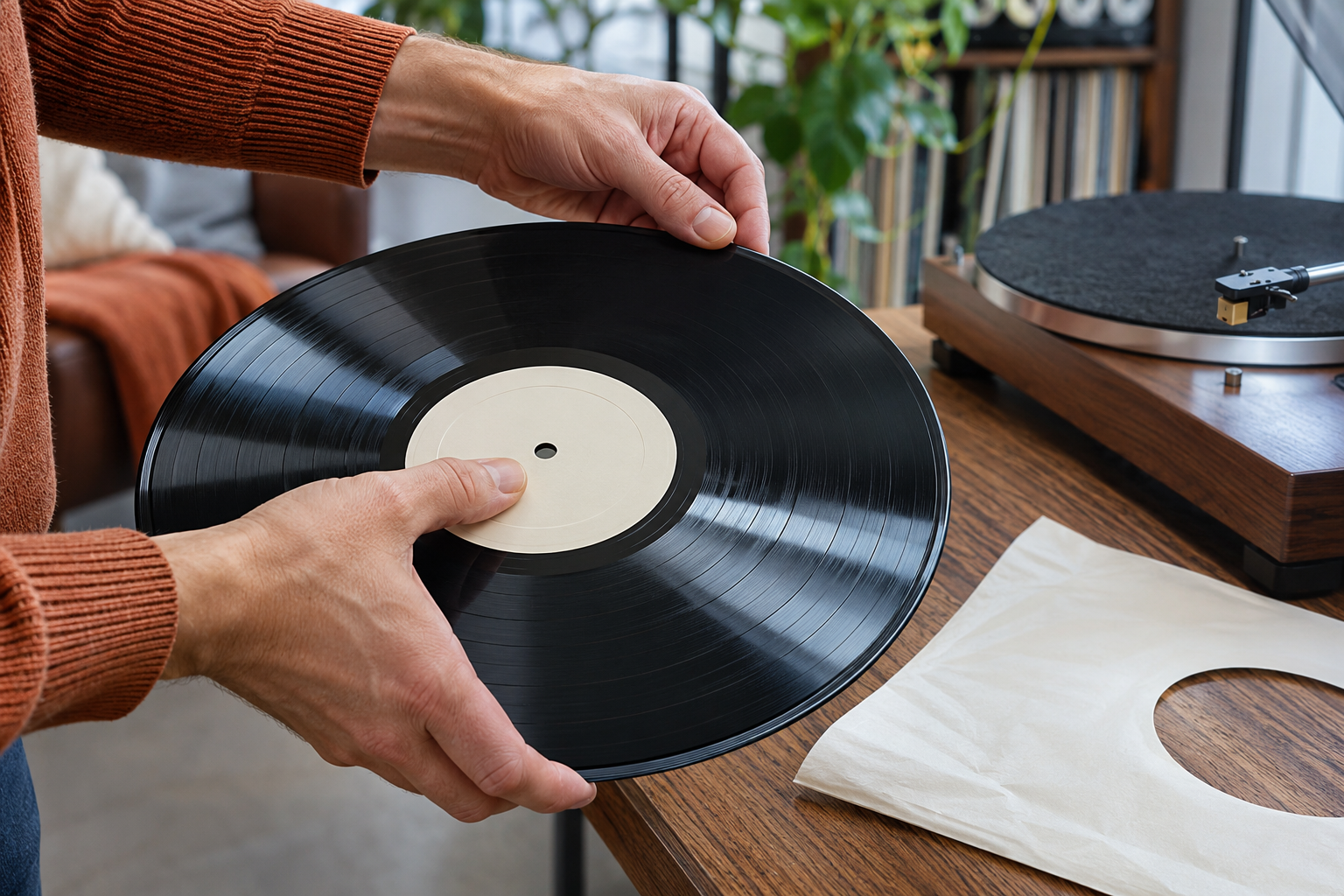
Built-in pause at the side change. Handle the disc carefully and keep drinks away from the player.
CD or cassette
Physical, easy to borrow and pleasantly free of notifications. A basic player is enough.
Digital
Queue one album, turn off shuffle and enable Do Not Disturb. Put the screen face down once playback begins.
The 5-minute setup
Make the choice final
Set out the record or disc, or queue the album. Turn off shuffle and crossfade so the intended sequence stays intact.
Choose speakers or headphones
Use the option that feels comfortable for the whole album. Set the volume where vocals are clear without feeling sharp; louder does not automatically mean more detailed.
Give the phone a parking spot
If the phone is the player, switch on Do Not Disturb and place it beyond easy reach. If it is not the player, leave it in another room or inside a drawer.
Pick one quiet companion
You may sit, stretch, doodle or do a simple repetitive craft. Skip chores with decisions—sorting mail and reorganizing a drawer will steal the center of attention.
Make a three-line listening note
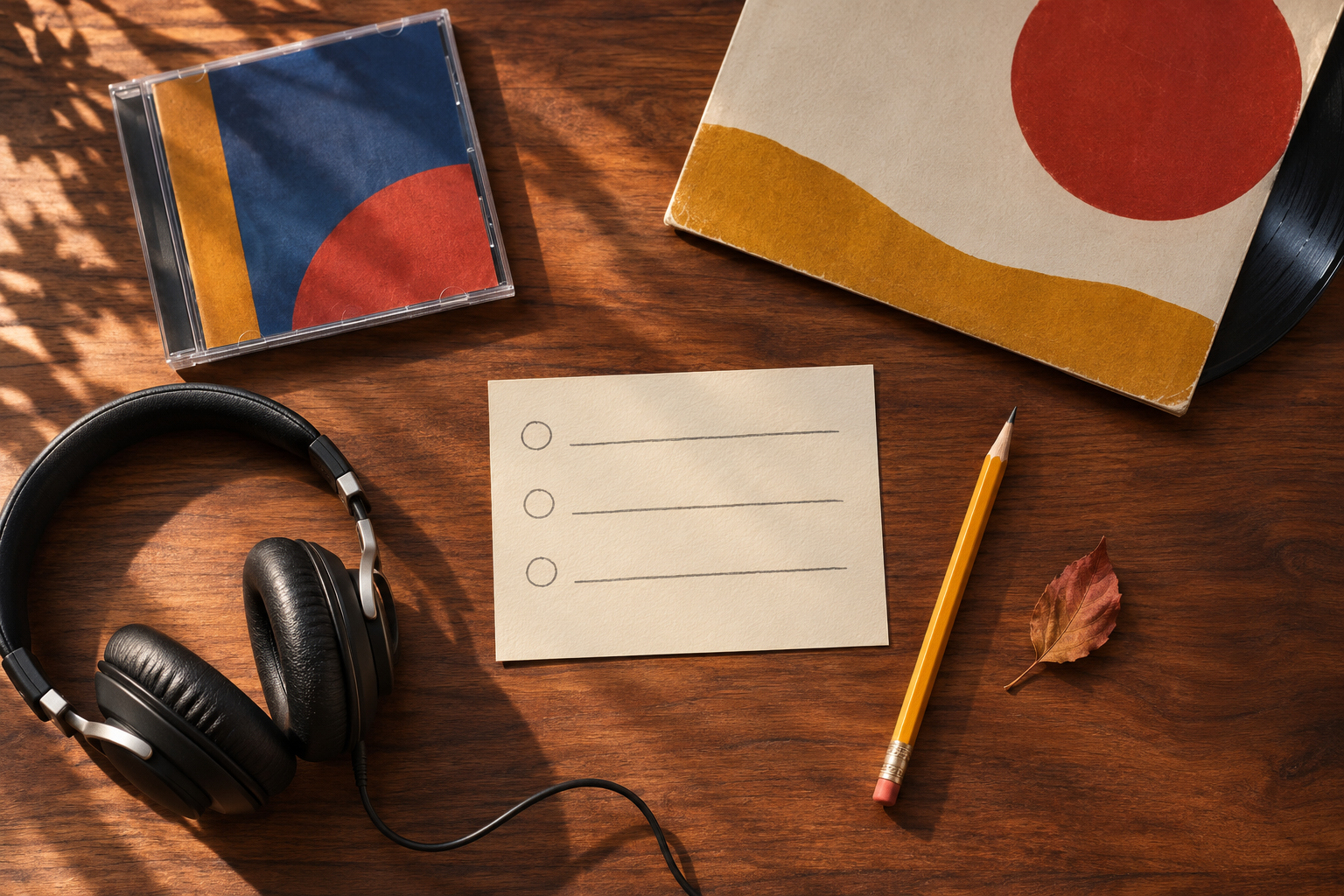
On a scrap of paper, leave three prompts: What changed? What surprised me? What do I want to replay? Write only when something catches you.
How to listen to a whole album without trying too hard
You do not need to identify a chord progression or know what every instrument is called. Follow one thread at a time.
- Track one: arrive. Let your ears adjust. Notice the first sound and whether the song enters abruptly or slowly.
- Tracks two and three: choose a thread. Follow the bass, drums, voice, lyrics or one recurring sound. Lose it? Pick it up again without rewinding.
- The middle: notice the change. Does the album get quieter, stranger, heavier or more open? On vinyl, the side change gives you a natural pause.
- The final stretch: switch threads. If you followed the voice earlier, listen to rhythm or background texture now.
- The last song: let it finish. Wait ten quiet seconds before deciding what you think. Then answer one note prompt.

Three listening games for the next album
1. Follow one instrument
Choose the drums, bass, piano or any repeated sound. Notice when it disappears, changes texture or moves from the background to the front.
2. Map the emotional weather
Give each track one plain word: bright, foggy, tense, tender, restless. At the end, look at the sequence. This is about your response, not discovering the “correct” meaning.
3. Find the hinge track
Which song changes the album’s direction? It may introduce a new pace, point of view or sound. The hinge is often clearer when you hear what comes before and after it.
Common problems, fixed
“I reached for my phone after eight minutes.”
Move it farther away and give your hands a pencil, knitting or a stress ball. You are changing a habit cue, not proving a character trait.
“The music turned into background noise.”
Choose one new thread at the next track. A reset is enough; you do not need to restart the album.
“I keep wanting to skip the songs I know.”
Listen for one element you never followed before. If a track is genuinely unpleasant, skip it and note why. Close listening is not compulsory suffering.
“My record is crackling or skipping.”
Stop playback rather than repeatedly forcing the stylus through the skip. Check the equipment maker’s instructions before cleaning. The Library of Congress recommends clean, dry hands, handling discs by the edge and label, keeping playback equipment clean and storing discs upright—not stacked.
Make the ritual repeatable
Keep the setup tiny. Choose the next album before the current one ends, write its name on the back of your note card, and schedule nothing more ambitious than “one album this weekend.” If you want a place to save favorite lines, sounds and observations, a commonplace book works beautifully. For more screen-light options sorted by energy, use LIFVYT’s 45 things to do instead of scrolling. If you want to take the ritual outside your home, try a first solo movie date and pay the same attention to its soundtrack.
Your one-album checklist
- Choose one 30–50 minute album before sitting down.
- Use vinyl, CD, cassette or a queued digital album.
- Turn off shuffle, crossfade and notifications.
- Place your phone out of easy reach.
- Write the three prompts: change, surprise, replay.
- Follow one sound for two or three tracks.
- Use the midpoint as a stretch-and-reset break.
- Let the final track end before rating the album.
- Choose one song to replay—or one album for next time.
The takeaway: A full-album listen is small enough for an ordinary evening and absorbing enough to feel different from more scrolling. Pick one record, keep the rules light and let the music hold the whole room for a while.
Sources and further reading
- Record Store Day UK: Black Friday 2026 announcement (October 6, 2026).
- Library of Congress: Care, handling and storage of audiovisual materials.
- Adiasto et al.: Music listening and stress recovery in healthy individuals, PLOS ONE (2022).
Editorial note: This article is for leisure and education. Music can feel restorative, but it is not a substitute for medical or mental-health care.
The Sunday Soft Reset
A calmer start to your week.
Get Lifvyt’s weekly collection of gentle wellness reads, nervous-system resets and practical tools — plus the free 5-Minute Nervous System Reset Guide.
By signing up, you’ll receive the free guide and one gentle Lifvyt email each week. Unsubscribe anytime.