
The jeans fit differently. A camera caught an angle you did not request. Your feed is now pretending everyone else woke up airbrushed.
On days like this, self-love does not have to mean loving every reflection. It can mean refusing to put your whole life on hold until you feel prettier.
First, you can stop negotiating with the mirror
Maybe your body changed after a pregnancy, a stressful year, a new job, more birthdays, or no neat reason at all. You do not owe anyone a progress report about it. An off day with your appearance is a feeling, not a verdict.
Try a sentence you can actually believe: “I’m having a hard body-image day, and I can still take care of myself.” It is less theatrical than “I adore every inch of me!” when you are not feeling that. It leaves room for the rest of your day.
Make a closet truce

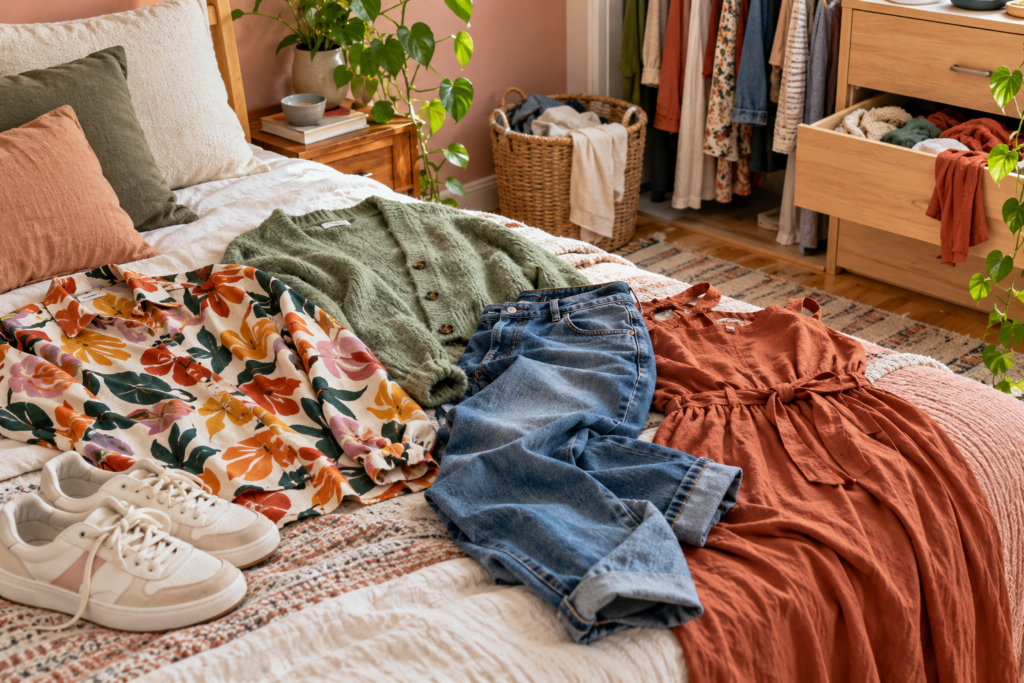
Getting dressed should not feel like a daily audition for a past version of you. Put the pieces that pinch, pull, or demand constant adjustment out of the morning rotation. You can decide later whether to alter, donate, sell, or keep them.
Then build one ready-to-go outfit from clothes that fit today: a soft tee and trousers, the dress you can sit in, sneakers you actually walk in. Clothes are supposed to work for your body. Your body is not a project for the clothes.
Edit the feed that keeps editing you
You do not need to announce a dramatic digital cleanse. Mute one account that reliably leaves you measuring yourself. Follow a creator whose life includes more than angles, “fixes,” and product links. Notice how you feel after five minutes, not just whether the content calls itself “wellness.”
A 2025 experiment with 326 women and gender-diverse participants compared brief TikTok compilations. Body-neutral and body-positive clips were linked with better immediate body-image measures than weight-stigmatizing clips; body-neutral clips also reduced self-objectification relative to the stigmatizing content. It was a short online exposure, so it cannot tell us what a permanent feed change will do for any one person.
In a separate 2026 seven-day diary study, exposure to fitspiration and thinspiration was associated with worse body-image and mood measures; body-neutral content was associated with greater body appreciation. Those everyday observations show associations, not proof that a specific post caused the feeling. Still, your “this account makes me feel lousy” data matters.
Let the photo be a memory, not a performance review

Did the picnic happen? Did you laugh so hard someone nearly spilled the lemonade? That counts, even if the photo does not pass your private committee of one.
You can ask a friend not to tag you, choose a picture that feels comfortable, or simply stay off the camera that day. You can also keep the imperfect picture because you want the memory. There is no moral score attached to either choice.
A kinder sentence you can use right now
After appearance-focused content, a 2025 randomized study of 107 young women found a short self-compassion writing exercise improved momentary body image more than a mindful-breathing comparison. That is an immediate result in a small, younger sample, not a promise about long-term change.
If writing helps, borrow the shape of that idea. Finish these three lines on your phone or a scrap of paper:
“I’m feeling ______ about my body right now.”
“If my friend felt this way, I’d tell her ______.”
“One useful thing I can do next is ______.”
“Something I want from today besides looking good is ______.”
The answer might be “eat lunch,” “text my friend back,” “wear the soft pants,” or “go to the park anyway.” It need not be profound. Nobody is grading the note.
The takeaway
You can have a body-image day and still get dressed, be in the picture, enjoy lunch, and show up for your life. Self-love can be as ordinary as choosing the comfortable outfit and refusing to let one unkind thought write the whole day.
For more small ways to practice it, read self-love that does not make you roll your eyes, a reset for a loud inner voice, or a solo date that fits real life.
Research notes
- Kilby & Mickelson (2025), Frontiers in Psychiatry: brief body-neutral, body-positive, and stigmatizing TikTok exposure.
- Schönhals et al. (2026), International Journal of Eating Disorders: seven-day social-media and body-image diary study.
- Li et al. (2025), Journal of Psychosomatic Research: self-compassion writing after appearance-focused content.
Educational note: This article offers general ideas and summarizes research; it is not individualized mental-health care. If body concerns are taking over meals, relationships, or daily life, a qualified professional can help you find support that fits.
The Sunday Soft Reset
A calmer start to your week.
Get Lifvyt’s weekly collection of gentle wellness reads, nervous-system resets and practical tools — plus the free 5-Minute Nervous System Reset Guide.
By signing up, you’ll receive the free guide and one gentle Lifvyt email each week. Unsubscribe anytime.