
Lifvyt Journal
What to Do When You Feel Overstimulated but Still Have Things to Do
A realistic nervous system reset for the days when you need quiet, but life still needs dinner, emails, children, errands, and basic human participation.

You Can Be Overstimulated and Still Responsible
When you feel overstimulated but still have things to do, it can feel unfair. Your body wants quiet, but life keeps handing you another task.
You may need silence, but someone needs dinner. You may want to lie down, but there are emails, errands, dishes, work messages, children, pets, bills, laundry, and one mysterious item on the floor that nobody in the house has ever seen before.
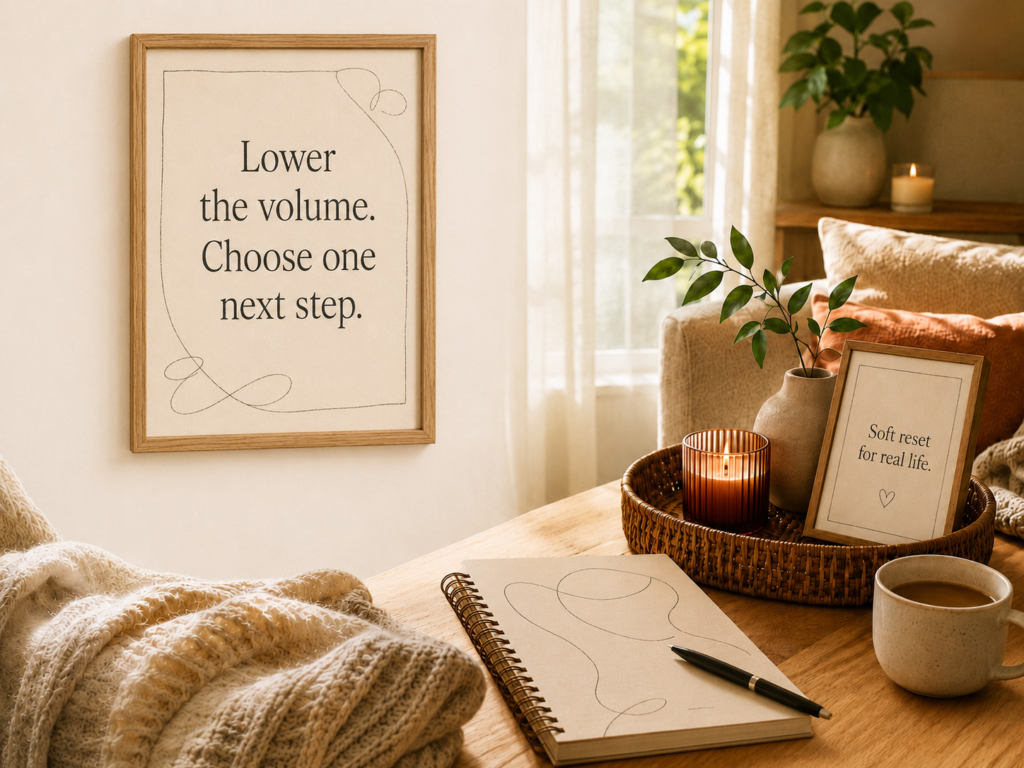
This is where a realistic reset matters. Not a perfect routine. Not a full disappearing act. Just enough support to help your nervous system lower the volume and take the next small step.
Overstimulation does not always happen in a peaceful room with a candle nearby.
Sometimes it happens in Target. Sometimes it happens at work. Sometimes it happens in the kitchen while the microwave is beeping, the group chat is alive, the sink is full, and a child is asking for a snack with the urgency of a tiny lawyer.
In those moments, telling yourself to “just calm down” usually does not help.
Your body needs fewer inputs, fewer decisions, and one clear next step.
The Quiet Truth
You do not always need to disappear. Sometimes you need to lower the input enough to take the next small step.
What Overstimulation Feels Like When You Still Have to Function
Overstimulation is not just “being annoyed.”
It can feel like your brain, body, and senses are all reaching capacity at the same time. The light feels too bright. The sound feels too sharp. The room feels too busy. Your patience leaves quietly without submitting a notice.
Sensory overload can happen when the brain receives more input than it can comfortably process. Once that input feels like too much, your body may become tense, irritable, restless, tearful, shut down, or desperate for space.
Signs You Are Overstimulated but Still Trying to Function
Every sound feels louder.
Your patience disappears fast.
Your clothes, hair, or skin feel annoying.
You cannot decide what to do first.
You feel rushed, even when no one is rushing you.
You want to cry, snap, hide, or abandon the whole day.
Simple tasks feel like they have 47 steps.
You are still moving, but your body feels maxed out.
As a nurse, I think of overstimulation as a load issue, not a personality issue. When the nervous system is already full, even normal tasks can feel like extra alarms. The goal is not to shame yourself into pushing harder. The goal is to reduce input while keeping the next step simple.

The Lifvyt “Lower the Volume” Method
When you feel overstimulated but still have things to do, the goal is not to complete your whole life at once.
The goal is to lower the pressure enough to keep going without completely overriding your body.
The 4-Step Lower the Volume Method
1. Lower one sensory input. Turn down the light, mute one sound, reduce screen brightness, or step away from the busiest room.
2. Reduce one decision. Pick the easiest next option. Do not redesign the whole evening.
3. Choose one body cue. Feet on the floor. Shoulders down. Jaw unclenched. One long exhale.
4. Take one next step. One email. One dish. One snack. One room. One message. One thing only.
This method works because it does not ask your nervous system to go from overwhelmed to peaceful in one heroic leap.
It simply gives your body a softer way to continue.
Try This First
The “Still Have Things to Do” Reset
Step 1: Lower input. Turn down one light, mute one sound, lower the screen brightness, or step away from the busiest room.
Step 2: Anchor your body. Place both feet on the floor. Drop your shoulders. Put one hand on your chest, belly, or the counter.
Step 3: Name the moment. Say, “I am overstimulated. I need less input, not more pressure.”
Step 4: Pick one tiny task. Not the whole list. One task.
Step 5: Move slowly on purpose. Slow is not lazy. Slow is how you avoid fully short-circuiting.
When You Are Overstimulated and Parenting
Parenting while overstimulated deserves its own gentle category.
Children do not always recognize your nervous system emergency. They may continue asking for snacks, shows, cups, socks, justice, and the location of one specific toy from 2022.
In those moments, your reset needs to be simple enough to do with noise in the room.
Parenting Reset Tools
Lower your voice instead of raising it.
Sit on the floor for one minute.
Use fewer words.
Give one simple instruction.
Create a snack or water pause.
Turn off background TV if it is adding noise.
Move everyone to one room if the whole house feels too much.
Say, “Mommy needs a quiet minute, then I can help.”
This does not make you a bad parent.
It makes you a human parent with a nervous system, which is inconvenient, but real.

When You Are Overstimulated at Work
Work can be difficult because you may not be able to leave, dim the lights, or request a silent wellness cave with snacks.
Still, small supports can reduce the load.
Work Reset Tools
Lower your screen brightness.
Drink water before checking another message.
Take a bathroom reset if you need privacy.
Look out a window for thirty seconds.
Write down the next three tasks.
Use headphones or earbuds if allowed.
Stop multitasking for five minutes.
Do one thing before opening another tab, app, chart, message, or problem.
A work reset does not have to look peaceful from the outside.
Sometimes it looks like drinking water in silence and refusing to let your inbox become your entire personality.
When You Are Overstimulated in Public
Public places can be a lot.
Bright lights. Loud carts. Music. Crowds. Lines. Strong smells. People standing too close. Your phone buzzing. Your brain asking why every store needs seventeen different kinds of visual chaos.
You may not always be able to leave immediately, but you can lower the load.
Public Place Reset Tools
Step to the side of the aisle.
Look at one neutral object.
Put in earbuds.
Unclench your jaw.
Take off one layer if you are hot.
Shorten the trip.
Leave before you hit the emotional danger zone. You are allowed to leave Target before Target wins.
What to Say When People Still Need You
When you are overstimulated, long explanations can feel impossible.
That is why it helps to have a few short scripts ready.
Soft Scripts for Overstimulated Moments
“I need one minute before I answer.”
“I can help, but I need less noise first.”
“I am overstimulated, not mad.”
“Give me a second to reset.”
“I need to do one thing at a time.”
“I am going to step away and come back.”
These phrases are not dramatic.
They are care instructions.
The Lifvyt One-Thing Rule
When everything feels urgent, choose the next kind thing, not the entire solution.
Wash one dish.
Answer one message.
Put one load in the washer.
Make one snack.
Clear one small surface.
Step outside for one minute.
Drink one glass of water.
What Not to Do When You Are Overstimulated
When your system is already full, some habits can make the overload worse.
This is not about being perfect. It is about noticing what adds more pressure.
Try Not to Add More Input
Do not start five tasks at once.
Do not scroll to calm down if your brain is already full.
Do not over-explain yourself.
Do not force a full routine.
Do not make big decisions while flooded.
Do not say yes to more input.
Do not clean the whole house because one counter annoyed you.
Do not judge yourself for needing quiet.

The Lifvyt Overstimulation Checklist
Use this when you are overwhelmed and need a quick way back to yourself.
Quick Check-In
Did I lower one sound?
Did I soften one light?
Did I drink water?
Did I unclench my jaw?
Did I choose only one next step?
Did I stop adding pressure?
Did I give myself permission to move slower?
When Overstimulation Needs More Support
Gentle resets can help with everyday overstimulation. However, they are not a replacement for medical or mental health care.
Consider speaking with a healthcare provider, therapist, or occupational therapist if sensory overload is affecting your work, sleep, parenting, relationships, eating, safety, or daily function.
This is especially important if overstimulation comes with panic attacks, severe anxiety, depression, shutdowns, meltdowns, trauma symptoms, or thoughts of harming yourself.
You do not have to wait until you are completely overwhelmed to ask for support.
Continue Your Journey
Explore More from Lifvyt
Browse gentle wellness resources, digital tools, and intentional living guides created to support calmer routines and everyday well-being.
Browse Our ProductsThe Lifvyt Closing Ritual
Today, do not ask yourself to handle everything at full volume.
Lower one sound.
Soften one light.
Put one thing down.
Drink water.
Choose one next step.
Then let that be enough for this moment.
“I do not have to disappear to take care of myself. I can lower the volume and choose one next step.”
Overstimulation does not mean you failed the day.
It means your body is asking for less input.
So start there.
Less noise.
Less pressure.
One breath.
One task.
One softer way through.
References
Cleveland Clinic. “Sensory Overload: What It Is and How To Manage.” Read source
Centers for Disease Control and Prevention. “Managing Stress.”
Read source
The Sunday Soft Reset Get Lifvyt’s weekly collection of gentle wellness reads, nervous-system resets and practical tools — plus the free 5-Minute Nervous System Reset Guide. By signing up, you’ll receive the free guide and one gentle Lifvyt email each week. Unsubscribe anytime.A calmer start to your week.