
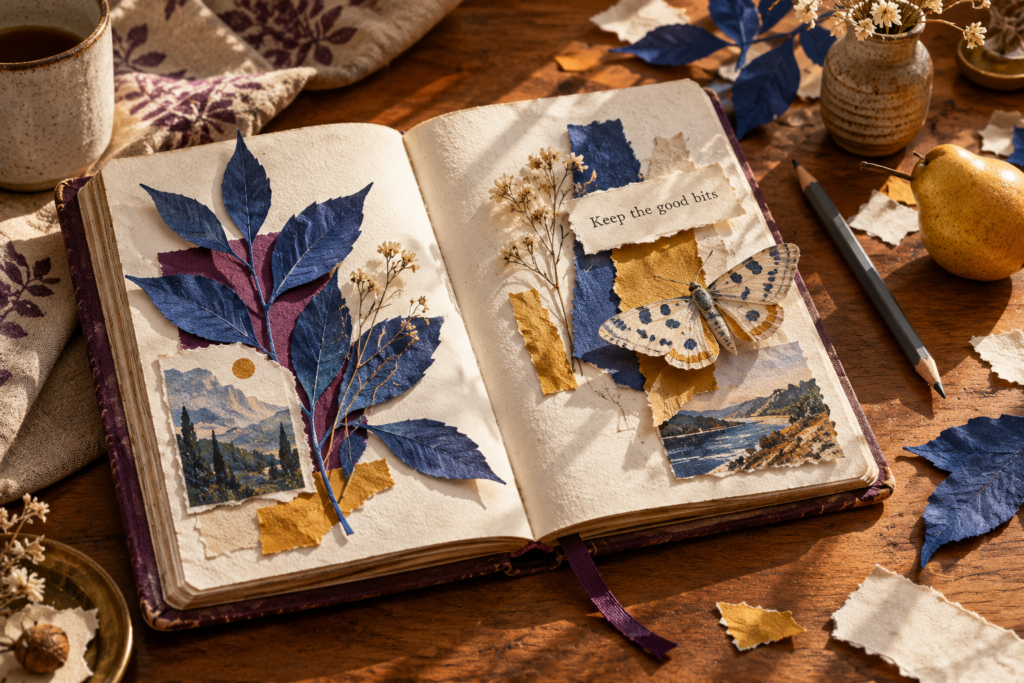
Some ideas deserve better than becoming your 437th screenshot. A sentence that makes you pause. A useful tip you want to try. A question that follows you home from a book.
Learning how to start a commonplace book gives those little discoveries somewhere to land. You need a notebook, something to write with, and one thing worth keeping. This guide walks you through a first entry, a simple index, and a way to return to your notes without giving yourself another daily assignment.
A small note: This is a creative reading activity. The examples below are teaching examples, and the timing is a flexible suggestion—not a target you need to meet.
What is a commonplace book?
A commonplace book collects ideas from reading and other things you encounter, usually with some way to organize or retrieve them. It can hold brief quotations, summaries, questions, and your responses.
This is an old practice with plenty of room for personal interpretation. The University of Notre Dame describes the historical form as a collection of quotations and commentary arranged under headings. For this beginner version, we will use numbered pages and a short topic index.
A diary often follows your days. A commonplace book follows your interests. A gardening idea and an interesting word can sit beside each other, even if they came from completely different places.
You can keep both in one notebook. Mark collected material with a small star and add it to your index. If you mainly want somewhere to write about your day, start with LIFVYT’s practical journaling guide.
The bookish trend, with something useful inside
Pinterest’s 2026 forecast includes “Poetcore”, a literary aesthetic connected with Gen Z and millennials. A commonplace book is our practical way into that mood: spend a little time with words you like.
That connection is an editorial interpretation. Pinterest’s report does not establish that commonplace-book searches are currently surging. You can enjoy this activity without buying the outfit—or a fountain pen with a more impressive résumé than yours.
Start with a notebook you already own
- A notebook with usable blank pages. Lined pages can make writing easier; blank pages give you room to sketch. A half-used notebook is fine.
- One comfortable pen or pencil. Test it on a back page to check for ink showing through.
- Something to read or revisit. Use a book you own or have borrowed, a magazine article, or an idea you have already noted.
- Optional: one bookmark. A clean scrap of paper works. Tabs, stickers, special paper, and glue are extras.
Choose a size you will actually keep nearby. A small notebook travels well; a larger one may be easier to write in. If handwriting is uncomfortable, a loose-leaf folder with printed notes and brief annotations is another option.
How to start a commonplace book in five steps
Leave space for an index
Reserve the first two usable pages. Write “Index” at the top of the first. Number your working pages as you use them, starting at 3. Already have page numbers? Use those instead.
Skip large preallocated sections for now. You cannot know yet whether “Nature” will need two pages or twenty.
Choose one thing worth returning to
Look for a useful idea, an unfamiliar word, a short passage you admire, or something you disagree with. Ask: What would I want to find again?
Choose the smallest piece that keeps the meaning intact. A sentence with its context is often more useful than a dramatic phrase detached from what the writer meant.
Make it clear whose words they are
Label your entry “Quote,” “Summary,” or “My observation.” Use quotation marks only when you copy the exact wording. For a summary, restate the idea in your own words and still record the source.
For a book, note the author, title, page, and edition or publication year. For a web article, keep the author or organization, title, URL, and the date you viewed it. You can write a short citation in the notebook and keep the full link in one reference list.
Add your own response
Give the borrowed idea a little company. Under “Why keep it?” write one sentence: “I want to try this on my balcony,” “This explains something I could not name,” or “I disagree because…”
You do not have to agree with everything you collect. Curiosity is allowed to have questions.
Add the topic to your index
Choose a broad heading such as Home, Words, Nature, Making, or Questions. Write the topic and the notebook page: “Home — 3.” Use one or two headings per entry, then stop.
Close the book while the activity still feels manageable. You have made something usable.
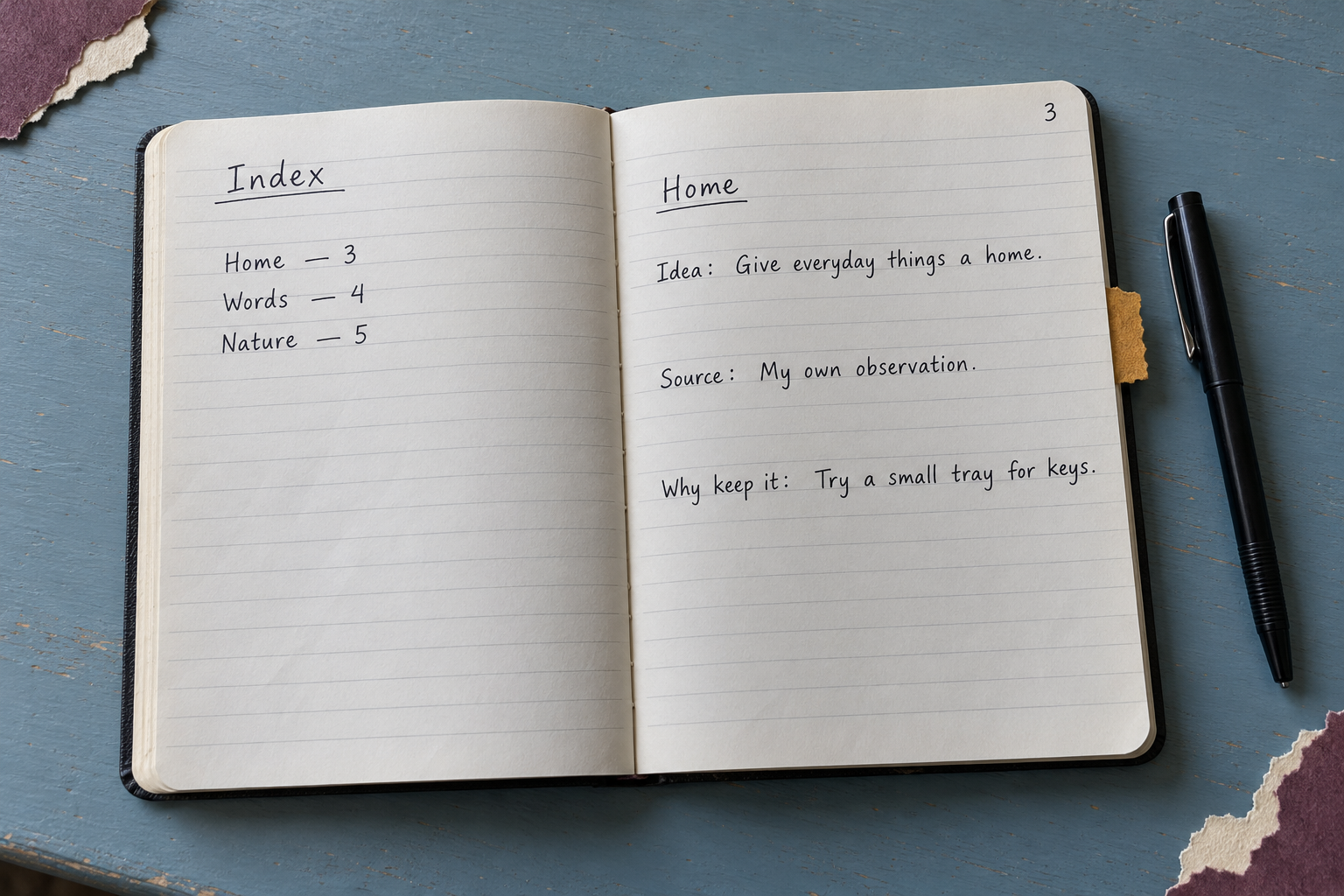
Here is what a finished entry can look like
This first example uses an original observation, so there is no borrowed quotation to track. It demonstrates the layout rather than presenting a universal rule about organizing your home.
Page 3 · Home
Idea: Give everyday things a home.
Source: My own observation.
Why keep it: Try a small tray for keys.
Index: Home — 3
For a sourced entry, the middle line changes. Here is an example based on a real collection:
Topic: Reading
Summary: George Ripley’s commonplace notebook included reading excerpts, his observations, and source references.
Source: Harvard Library, “Precepts put into practice”, viewed October 30, 2026.
Why keep it: I want to record where an idea came from while I still have the source open.
Notice that the historical information is labeled as a summary. The response underneath is our example of a reader’s next step, not a claim made by Harvard.
Make an index you will actually use
Write each new entry on the next available page. If Home appears again on page 11, update the index to “Home — 3, 11.” A second topic can point to the same page. “Making — 7” and “Gifts — 7” are both fine.
When the front index fills up, continue it on the next blank page. Add “Index continues on page 28” at the bottom of the old index, using your actual page number. No recopying required.
Use words you would naturally look for. “Dinner” may be easier to retrieve than “Domestic Nourishment.” Your future self is looking for a useful idea, not attending a symposium.
Give your notes a second visit
After a few entries, browse them for five minutes. Circle one idea to try, put a question mark beside something to check, or connect two related pages with “See also page 12.” Choose one action at most.
Skip the review if it starts feeling like admin. The index exists to help you when you want something; it does not need a weekly performance review.

What to collect when nothing feels profound
- A word you want to use. Record its meaning, where you found it, and a sentence of your own.
- A practical technique. Summarize a craft tip and save the source so you can check the full instructions later.
- A question from your reading. “What would change my mind about this?” is a valid entry.
- An observation. Describe a color combination, an interesting building detail, or something you noticed on a familiar walk.
- A connection. Note why one book reminds you of another, with enough detail to remember the link.
For an easy solo outing, bring your notebook to a library and browse one shelf. Read a little, save one idea, and leave with a next book to consider. Check local hours and use your own paper rather than marking borrowed materials.
Common snags—and simple ways through them
“I keep copying too much.”
Pause after one short passage. Add your response before collecting another. If you cannot say why you want it, leave it in the original source for now.
“My notebook looks messy.”
Leave a blank line between entries and underline the topic. Those two choices can make a page easier to skim without requiring a redesign. A crossed-out word does not need a replacement page.
“I forget where a quote came from.”
Write “source to check” rather than guessing. Search for the original wording and verify the attribution before presenting it as someone’s quotation. A social post that names an author is a lead, not confirmation.
“I only have a few spare minutes.”
Write the page reference and a one-line reminder first. Return to it if you want. This can fit into a lunch break or the small quiet patch before the next household task.
“I missed a month.”
Use the next blank page. There is no backlog to complete. Interests change, and an occasional notebook is still a notebook.
Your next step: keep one good thing
Open the notebook you have. Save one idea, name its source, and say why it matters to you. Add its page to the index.
That little exchange between someone else’s thinking and your own is enough to begin. Let the notebook become interesting through use.
Sources and further reading
- Pinterest Predicts 2026 — Poetcore cultural context. Its search analysis covers September 2023–August 2025; it is not an October 2026 commonplace-book demand measurement.
- University of Notre Dame: The Commonplace Book — historical form and a contemporary educational use.
- Harvard Library: Precepts Put into Practice — George Ripley’s notebook and source-recording methods.
Creative-practice disclaimer: This guide offers a flexible hobby method, not a treatment or a promise about attention or memory. The examples and artwork are illustrative. Keep attribution with collected material, protect private information, and check permissions before republishing other people’s writing or images.
The Sunday Soft Reset
A calmer start to your week.
Get Lifvyt’s weekly collection of gentle wellness reads, nervous-system resets and practical tools — plus the free 5-Minute Nervous System Reset Guide.
By signing up, you’ll receive the free guide and one gentle Lifvyt email each week. Unsubscribe anytime.