

Offline Hobbies · A beginner’s guide
A few honest lines. A little room to think. Absolutely no requirement to become a poet.
Wondering how to start journaling when your mind goes blank the second you open a notebook? Start with something ordinary: what happened, what is on your mind, and one thing you want to remember. Your first entry can take five minutes.

Maybe you bought a beautiful journal and have been respectfully avoiding it. Maybe your days are busy enough that “reflect on your inner world” sounds like another calendar invitation. This is the low-pressure version: a small writing hobby that fits the life you actually have.
A notebook and a comfortable pen, or a private digital note.
Three lines in about five minutes. Decorations and daily streaks are optional.
What counts as journaling?
Journaling is keeping a personal record of thoughts, observations, experiences or ideas. A diary often records what happened; a journal can also hold questions, lists, sketches and little things you notice. You can mix them in the same notebook.
There is no required opening line. You do not have to write “Dear diary,” explain your childhood or find a silver lining in a genuinely irritating day. “The meeting could have been an email. The sandwich was excellent.” That is a start.
How to start journaling: your first five minutes
- Pick an easy place to write. Choose a page in any notebook. If a lovely new book feels too precious, use the second page or a scrap of paper first.
- Add the date and one real detail. Try “Saturday, kitchen table, finally sitting down.” A place or moment gives you something concrete to work with.
- Finish three short sentences. “On my mind…” “A small good thing…” “Next…” If the middle prompt does not fit today, replace it with “Something I noticed…”
- Follow one thought if you want. Add a sentence about why that moment stood out. You can also stop at three lines.
- Close the notebook. You do not need a lesson, a plan or a dramatic ending. Writing an entry is the whole assignment.

A first entry you can borrow
On my mind: Too many tabs open.
A small good thing: Lunch outside.
Next: Put my phone away for ten minutes.
Want to make it more personal? Add one detail: “I ate without answering messages and noticed how windy it was.” Specific beats impressive.
Choose a journal style that matches today
The quick bullet list
Good for a tired evening. Write fragments instead of paragraphs.
Finished the presentation. Forgot the laundry again. Best moment: the kids’ ridiculous dinner conversation.
The brain dump
Write the thoughts competing for space without arranging them. When you finish, circle one thing that needs action; leave the rest as a record.
Need to book the appointment. Still annoyed about that comment. Want a weekend with fewer plans.
The small-memory entry
Record a moment you might otherwise forget. Include a sound, a phrase or a detail.
The little one called the moon a nightlight. I want to remember that exact sentence.
The question-and-answer page
Give yourself one question and answer in plain language.
What would make tomorrow easier? Packing lunch tonight and deciding what can wait.
Prefer pictures? Make a tiny memory page
Pair a photograph or doodle with two sentences: what happened and why you kept it. You can use a park photo, a sketch of your mug or a color that reminds you of the day. A page does not need to look finished to hold a memory.
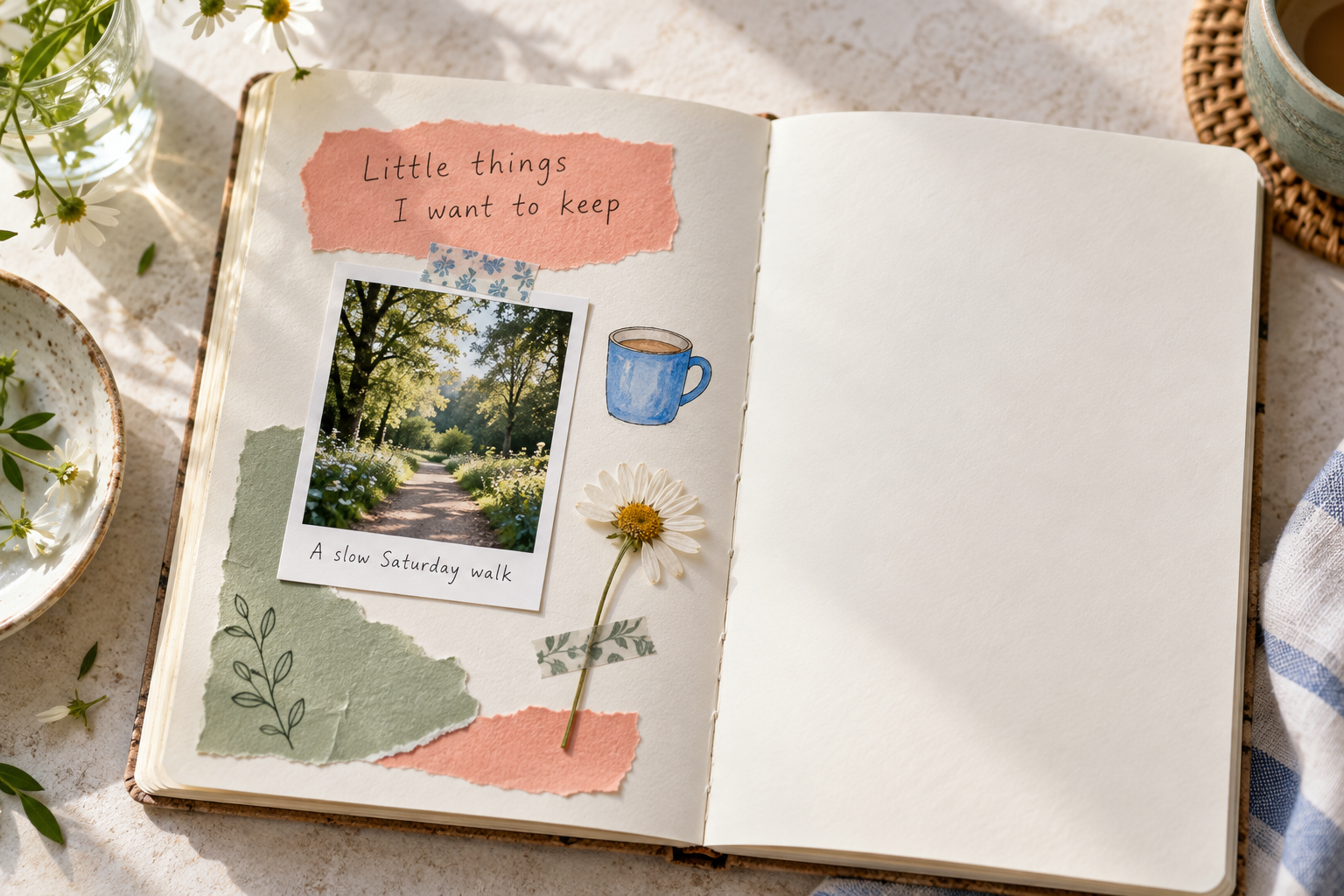
If collecting scraps is your favorite part, our junk-journaling beginner guide walks through the paper-and-glue side. For this writing habit, treat decoration as an option rather than an admission fee.
What to write when nothing comes to mind
- What happened today that I would tell a friend?
- What took more energy than I expected?
- What made me laugh, even briefly?
- What am I looking forward to, however small?
- What do I wish someone understood about today?
- What did I notice on the way home?
- What can stay unfinished until tomorrow?
- What would I like to do just because I enjoy it?
Try the camera trick: Describe what a camera would see before writing how you feel. “Shoes by the door, half a cup of tea, rain against the window.” Concrete details give the next sentence somewhere to go.
Make journaling fit your actual week
Choose one existing pause: after lunch, before you open your laptop in the evening, or during a weekend coffee. Keep the notebook where that pause happens. A pen that works is more useful than a complicated stationery system.

Try three short sessions this week. This is an experiment, not a rule. Afterward, ask whether the timing and format were enjoyable. If bedtime feels like homework, try a midday list. If handwriting is uncomfortable, type or dictate into a private note.
Miss a week? Put today’s date on the next page. There is no backlog to clear and no need to apologize to a notebook.
For a shared version, invite a friend to a café, write quietly for ten minutes, then talk about the experience. Agree beforehand that nobody has to read an entry aloud. Company can be part of the hobby; access to each other’s pages does not have to be.
Keep the personal part personal
Decide where your journal will live, especially in a shared home. A drawer or lockable box may suit paper entries. For digital writing, use a locked device and check whether the app syncs to a shared account or device. Initials can be useful when writing about other people.
Leave out work passwords, identifying client or patient details, and information that belongs in a secure workplace system. Your journal can capture how a workday felt without copying someone else’s private record.
A few beginner questions, answered
Do I have to write every day?
No. Some people enjoy daily entries; others write after memorable moments or once a week. Choose a rhythm you want to return to.
Should I reread my entries?
Only if you find it useful or enjoyable. You might revisit a month to spot favorite moments or recurring ideas. You can also write and move on.
What if every entry turns into a complaint?
You are allowed to record an annoying day. If you want variety, follow the complaint with “What do I need?” or switch to a neutral observation. Forced gratitude is not required.
Can I stop mid-page?
Yes. Leave space, draw a line or begin the next entry underneath. Your notebook does not have a layout department.
Your first page is enough
Pick one prompt. Write three honest lines. Close the notebook while it still feels manageable. You can build a hobby by returning to it, not by making the first attempt perfect.
Keep exploring
- Keep hobbies fun without turning them into another job
- Try cozy coloring when you want a word-free page
- Browse more Offline Hobbies
The sample entries are illustrative examples. This guide presents journaling as a personal writing hobby, not a mental-health treatment.
The Sunday Soft Reset
A calmer start to your week.
Get Lifvyt’s weekly collection of gentle wellness reads, nervous-system resets and practical tools — plus the free 5-Minute Nervous System Reset Guide.
By signing up, you’ll receive the free guide and one gentle Lifvyt email each week. Unsubscribe anytime.