
EVERYDAY LIFE · SMALL OUTINGS, GOOD FINDS
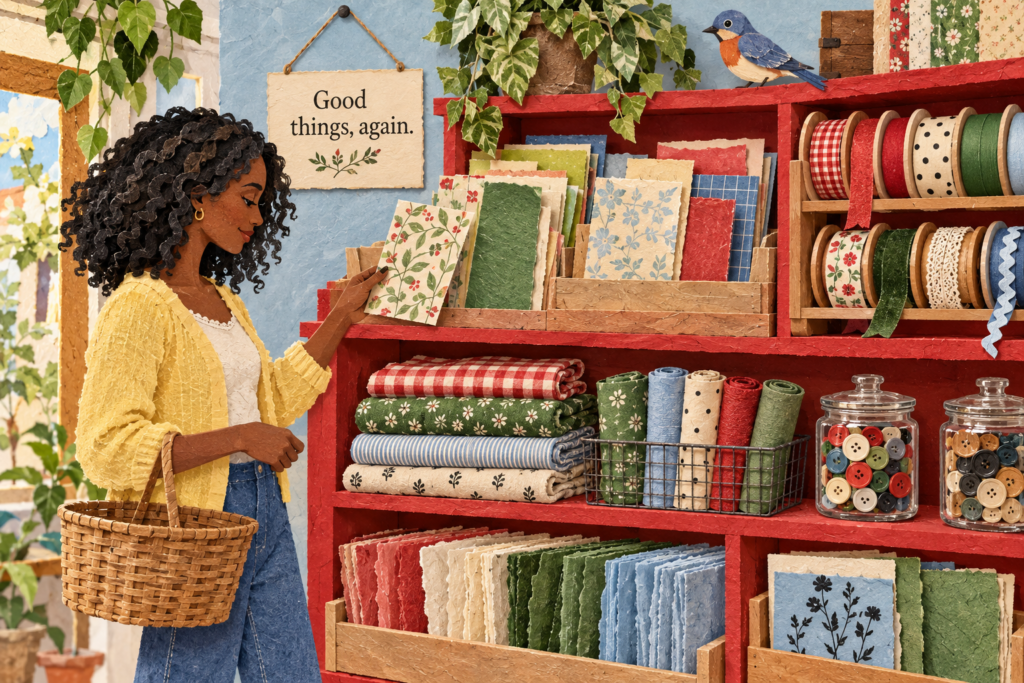
A place for lovely paper, odd buttons and the perfectly reasonable belief that a small scrap could become something wonderful.
A creative reuse store is a little like a thrift shop for your next hobby: donated paper, fabric, yarn, tools and unexpected bits waiting for another use. You might walk in looking for card stock and leave excited about a piece of wallpaper the size of a sandwich.
The useful version of this outing ends with materials you can actually use. Here’s how to find a store, shop without getting overwhelmed and bring home enough for one satisfying project.
What is a creative reuse store?
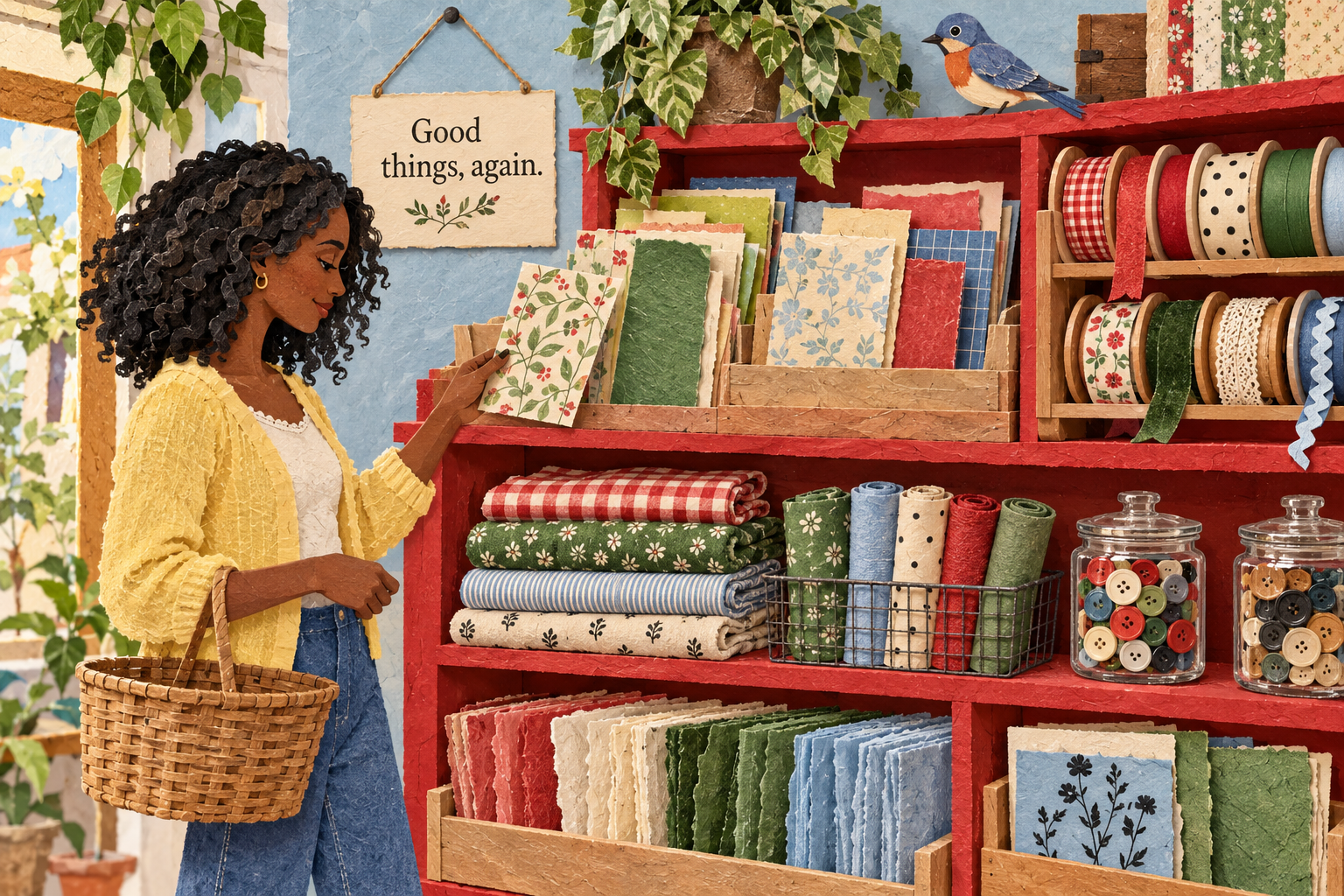
These shops collect reusable materials and make them available for new creative projects. Stock might include ordinary art supplies alongside remnants, packaging, maps, ribbon and other things that do not look like “craft supplies” until you have an idea.
Upcycle Arts in Charlotte, for example, collects materials from residents and businesses and sells affordable donated supplies. UpCycle Creative Reuse Center in Alexandria lists paper, fabric, notions, art materials and collage supplies, with inventory that changes as donations arrive.
That changing selection is the charm—and the practical limitation. Go with a flexible project, rather than needing an exact shade of yarn or twelve matching pieces by tomorrow.
Find somewhere you can actually visit
Start with Indigo Hippo’s U.S. creative reuse directory, then open the individual center’s own website. You can also search your town plus “creative reuse,” “art supply thrift store” or “craft supply resale.” A directory is a starting point; the store’s current visitor information is the important part.
Before leaving, check these four things:
- Public shopping: Is the shop open to everyone, or does this program serve registered teachers or member organizations?
- The right hours: Retail shopping, donation drop-offs and workshops may run at different times.
- Your visit needs: Look for parking or transit details, step-free access, seating and any rules for children or strollers. Ask if the site does not answer your question.
- How to pay and return: Check payment methods, pricing rules and whether sales are final.
For Charlotte readers, Upcycle Arts currently lists shopping Tuesday–Sunday, 11 a.m.–7 p.m., at 3046A Eastway Drive. That information was checked October 29, 2026; confirm it before traveling, especially around holidays.
Take one small project with you—in your head
Choose a result that fits your current time and skill, then jot down what it needs. “Make three simple cards” is easier to shop for than “become a person who crafts.” The second one has no checkout limit.
If you want to make cards
Look for blank card bases, matching envelopes and two coordinating paper scraps. Check that the cards fit inside the envelopes before buying.
If you want to mend a tote
Bring the tote or measure the repair area. Look for a suitable fabric patch and thread, then follow our beginner visible-mending guide.
If you want a paper-weaving picture
Look for two contrasting papers, enough length for the strips and a sturdy backing. Our paper-weaving walkthrough gives you the technique.
If you only want to browse
Pick one department and give yourself a short visit. You can leave with an idea and no purchase. Browsing does not create a contractual obligation to adopt a button jar.
Set a budget and a basket limit
Decide your total outing budget before you start: materials plus transport or parking, and any planned drink or snack. For example, if your limit is $15 and getting there costs $4, you have $11 left. That is a personal budget example, not a prediction of store prices; remember any applicable tax.
Ask how the shop prices its materials. Some items may be individually marked, while others belong to a basket, bag or weighed category. Do not assume everything in one room follows the same rule.
One real example: UpCycle in Alexandria currently lists small, medium and large baskets at $5, $10 and $30, with some special items separately priced. You do not need membership to shop there. Those are that store’s listed terms, checked October 29, 2026—not a universal creative-reuse price list.
Choose a physical limit too: one small basket or one envelope of paper. A cheap item still needs somewhere to live and something to do.
Check the supplies before they come home
Secondhand shopping works best when you can tell whether the material suits your project. Ask before opening packages, testing tools or unfolding bundled stock. Keep the check simple:
| Find | Check | Good beginner decision |
|---|---|---|
| Paper and card | Usable size, water marks, tears and whether both sides work for your plan. | Choose clean pieces large enough for your finished shape. Decorative paper is not automatically suitable for watercolor. |
| Fabric and ribbon | Length, holes, stains, strong odors and any care or fiber label. | Take a measured piece for a specific small project. For washable work, choose material whose care needs you understand. |
| Yarn | Quantity, tangles, condition and the label’s fiber and weight information. | A partial ball may suit a small accent. Skip it for a large pattern unless you can establish that you have enough compatible yarn. |
| Stamps and punches | Cracks, missing parts and whether the moving mechanism works. | Ask staff if testing on scrap is allowed. A jammed punch is a repair project of its own. |
| Paint, glue and markers | Original label, intended use, container condition and whether testing is permitted. | Pass on unlabeled liquids or unusable dried supplies. You do not need mystery chemistry to make a greeting card. |
These are general shopping checks, not guarantees of quality. If you need archival materials, a known fiber content or a product rated for a particular use, look for reliable labeling. An attractive offcut does not come with those assurances just because it is beautiful.
A first visit that fits into an ordinary day
Try a 30–45-minute visit if that feels manageable. Treat the timings below as a suggestion; crowded shops, access needs and the joy of finding good paper may change the plan.
- Get oriented. Ask, “It’s my first time—how does pricing work, and where are the paper supplies?” Find the department for your project first.
- Choose the essentials. Select the base material before the decorations. A beautiful ribbon cannot replace the card you came for.
- Allow one unexpected find. Pick something that fits your spending and storage limits. If it needs six more purchases, it can stay a lovely idea for another visit.
- Edit the basket. Check quantities, condition and price. Put back the items you cannot connect to a project.
- Ask about making there. Look for a workshop or open craft session if you would like a reason to return. Check whether it is taught, drop-in, booked or intended for a particular age group.
Going alone is perfectly workable: you can stay in the paper aisle without negotiating anyone else’s patience. If you have children with you, check the store’s supervision rules and give each child one manageable job, such as finding two matching colors. Small loose materials may need to stay out of younger children’s reach.
Turn the finds into one finished thing
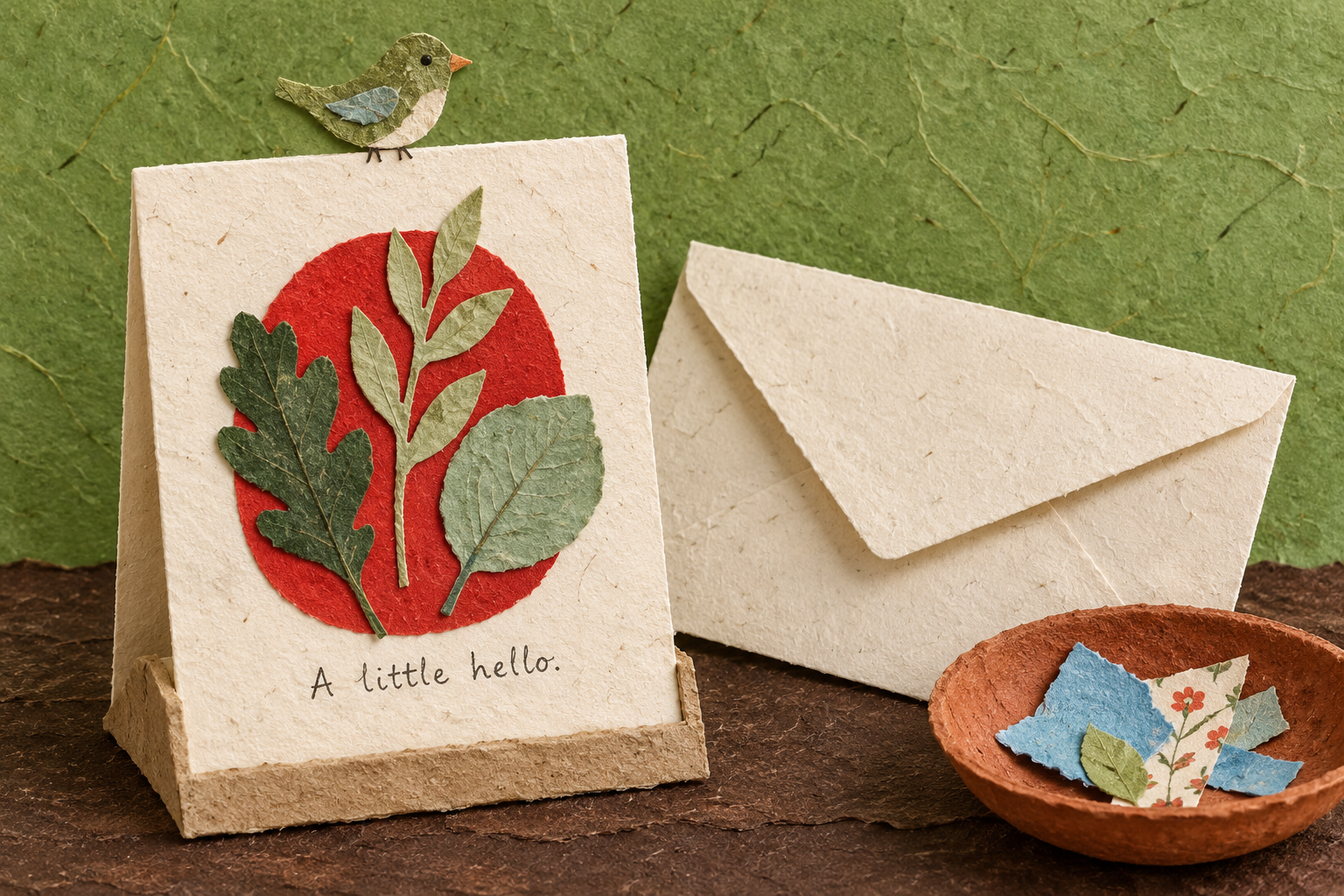
For one collage card: gather a blank card with a matching envelope, two paper scraps, paper-safe adhesive and a pen. Scissors are optional if you prefer torn edges.
Before the supplies disappear into a drawer, make one simple collage card. Use a ready-made blank card and an envelope that fits; that removes the need to work out envelope sizing.
- Choose a plain background scrap and one patterned scrap. Place them on the card without glue first.
- Tear or cut a small background shape, leaving a visible border of card around it. Cut three simple leaves from the patterned paper; uneven shapes are welcome.
- Arrange the leaves, then lift and attach each piece with a thin layer of paper-safe adhesive. Follow its label and let it dry flat.
- Write a short message inside. Check that the finished card still slides into the envelope easily; keep bulky decorations off a card you plan to mail.
Use “A little hello,” “Thinking of you” or your own mildly ridiculous inside joke. For postage and correspondence basics, continue with our snail-mail hobby guide.
Keep the remaining pieces together with a note naming their next use. A small envelope labeled “two more cards” is more useful than a mystery bag labeled, spiritually, “potential.”
No creative reuse shop near you?
Ask your library about craft-supply swaps, check a thrift store’s craft section or arrange a small exchange with a friend who already makes things. Before driving a long distance, consider whether the travel cost defeats your modest supply budget.
You can also start with your own clean packaging, old cards and leftover paper. The useful habit is seeing a new purpose in material you already have. Visiting a shop is one enjoyable way to do that.
Bring donations only when the center can take them
Read the center’s current accepted-materials list and booking requirements first. Upcycle Arts in Charlotte, for example, requires donation appointments. Shopping hours do not automatically mean staff can process a bag of donations.
Sort useful materials by type, label anything that needs identifying and leave out damaged or unusable items. If you are unsure about an unusual material, ask before bringing it. A donation should be something another person can reasonably use.
Note: Shopping and craft guidance. Check store rules and supply labels; keep small pieces and cutting tools away from young children.
The Sunday Soft Reset
A calmer start to your week.
Get Lifvyt’s weekly collection of gentle wellness reads, nervous-system resets and practical tools — plus the free 5-Minute Nervous System Reset Guide.
By signing up, you’ll receive the free guide and one gentle Lifvyt email each week. Unsubscribe anytime.