
Offline Hobbies · Make something with what’s already there
Some evenings, writing a whole journal entry feels like being assigned a second shift. Blackout poetry gives you a smaller job: find a few words you like and let the others disappear.
This guide to blackout poetry for beginners starts with a paragraph you can use right now. You’ll choose six words, see how they become a poem and learn how to try a second version that sounds like you. No rhyming, fancy notebook or dramatic gaze out of a rain-streaked window required. The window is optional.
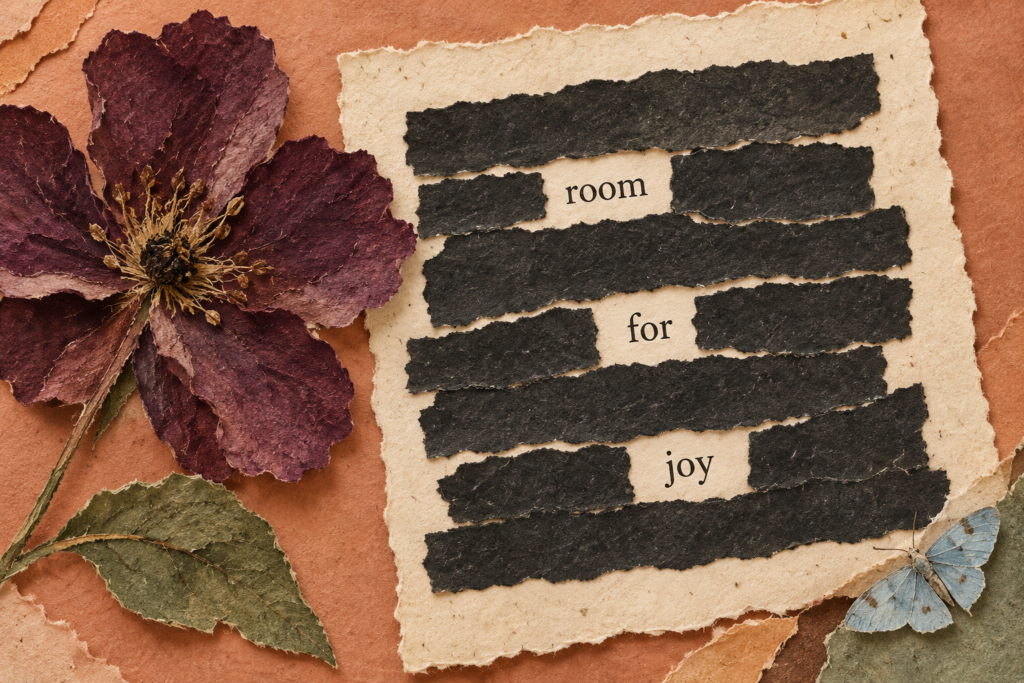
What is blackout poetry, exactly?
Blackout poetry is a form of erasure poetry: you begin with existing text and obscure much of it, allowing selected words to form something new. The spaces and dark areas become part of the artwork.
For this beginner exercise, keep the words in their original reading order—left to right, then down the page. You can skip as many as you like, but don’t move a later word in front of an earlier one. That small constraint gives you something concrete to work with.
A poem can be a complete sentence, an image or a surprising fragment. It doesn’t need to summarize the source. A paragraph about household clutter can become a small statement about making space for pleasure.
Gather supplies you probably already have
- A disposable page: print or copy the original practice paragraph below, or use your own writing. Ordinary printer paper is fine.
- A pencil and eraser: these let you change your mind before committing.
- A black pen or marker: use a fine tip near words and a wider tip for larger spaces if you already have both. One pen is enough.
- A backing sheet: place scrap paper or card under the page and test your marker on a spare piece first.
Skip glossy paper for a first attempt; your particular ink may smear. If you dislike markers, simply circle your chosen words or shade around them with pencil. Keep library books, borrowed pages and treasured books intact.
Try this original practice paragraph
This paragraph was written for this LIFVYT exercise. You’re welcome to use it for your practice page. Print it with generous line spacing, or copy it by hand.
Before looking at the solution, circle three words that catch your attention. Maybe home, quiet and shine. They don’t have to belong together yet. You’re collecting possibilities.
Blackout poetry for beginners: six simple steps
1. Find one word worth keeping
Read the paragraph once, then choose an anchor: a word with an image, sound or feeling you like. In our example, joys is the anchor. Because it appears near the end, we look backward for words that could lead into it.
2. Search for a short path to that word
Lightly circle possibilities in pencil. Don’t forget the modest little words—I, for, the, and—that help a phrase make sense. A page full of beautiful nouns can still sound like a shopping list that went to art school.
3. Read only the circled words
Ignore everything else. For our version, select the second I, after “shoes,” followed by made, room, for, small and joys. Notice that “small” and “joys” come from different sentences.
4. Test it before making anything permanent
Write your chosen words on scrap paper and read them aloud. Does the line say something you actually like? Remove an unnecessary word or try another connector. Return to the source and make sure the words still appear in the same order.
5. Protect the words, then obscure the rest
Draw a small box around each final word, leaving a little breathing room around its letters. Work carefully near those boxes, then cover the other text. You can use separate dark bands instead of coloring the entire page; fewer large areas means less ink and less opportunity for smudging.
6. Let it dry, then stop or decorate
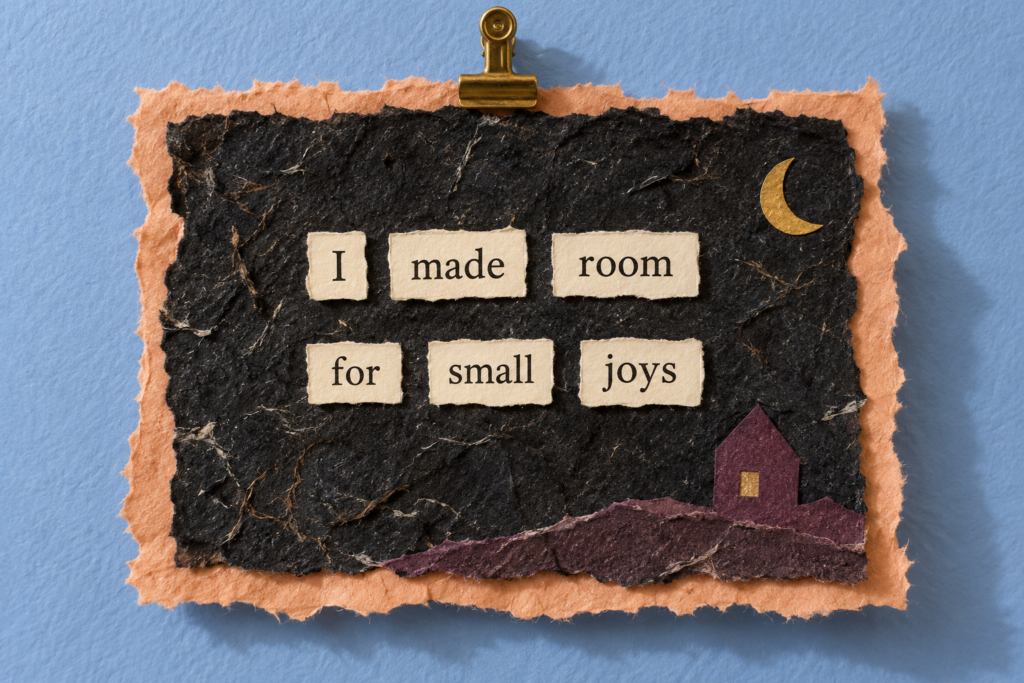
Let the ink dry before rubbing out visible pencil marks. If you want decoration, choose one small motif—a house, a moon, a leaf—or one accent color. Keep it away from the word windows so the poem stays easy to follow.
Here’s exactly how the example works
The highlighted words below stay in their original positions. Read only those words, moving through the paragraph normally.
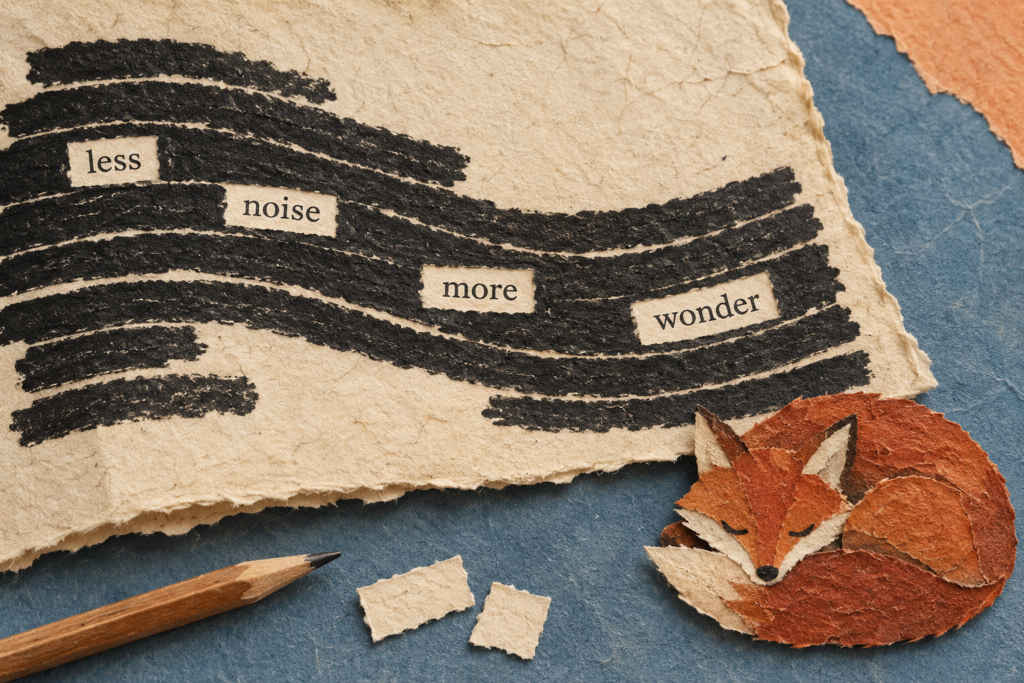
Now the surrounding text is covered. This version still keeps the selected words where they were; it doesn’t rearrange them to make the sentence work.
I made room
for small joys
That line break is a way to present the extracted poem separately. The original blackout page keeps the source layout. Both versions can sit together in your notebook.
When the page isn’t cooperating
“I can’t find the word I need.”
Try a shorter phrase or change the idea. If the missing word is essential, use a different page. For this exercise, the challenge is working with the words already there. Cutting them out and rearranging them can be a lovely separate found-poetry project.
“It sounds like random words.”
Choose one clear image or action and remove words that pull in another direction. “Rain / pavement / shine” has a shared scene. Adding “envelopes / Saturday / bag” may make the scene harder to follow unless you have a reason for including them.
“I just copied a sentence that was already there.”
Try selecting across two sentences. Our example borrows “I made room for” from one sentence and “small joys” from later in the paragraph. That gap is where the new meaning appears.
“My marker bled, or I covered a word.”
Use your backing sheet, switch to a drier or finer pen, or try pencil shading on another copy. If a word gets covered, start from a fresh copy using your penciled plan. A collage repair is possible too, but there’s no need to turn one ink blob into a three-hour restoration project.
Give it a look that feels like you
Quiet and graphic: use tidy dark bands with generous margins. A little odd and cozy: add a torn-paper border and one tiny house or moth. Colorful: use a single colored pencil around the chosen words, keeping a strong contrast so they remain readable.
Decorating is optional. If you add opaque scraps, place them between the selected words rather than over them. The collage illustrations in this guide are visual inspiration; the live-text example above shows the actual word selection.

Make room for another page, not another obligation
On a busy evening, just circle words and stop. Another day, finish the blacking-out or make a second poem from the same paragraph. Keeping two versions is often more interesting than trying to declare one the winner.
If you enjoy working on a small scale, tuck a poem into a handmade mini zine. If the line sparks something you want to say in your own words, use it as the first sentence of a journal entry with our beginner journaling guide.
Helpful references and places to explore
These resources explain the form and offer further practice. The paragraph, worked poem and troubleshooting examples above were created for this guide.
- Academy of American Poets: Erasure — a concise definition of the form.
- Milwaukee Public Library: Blackout Poetry Activity (PDF) — a library activity sheet with materials and a pencil-to-marker process.
- Plumas County: Blackout Poetry Instructions (PDF) — another approach to selecting, rereading and presenting words.
Illustrations are AI-generated paper-collage artwork, not photographs of a physical workshop. The original practice text is provided for readers to use; choose your own writing or other text you have permission to reuse for projects you plan to share.
The Sunday Soft Reset
A calmer start to your week.
Get Lifvyt’s weekly collection of gentle wellness reads, nervous-system resets and practical tools — plus the free 5-Minute Nervous System Reset Guide.
By signing up, you’ll receive the free guide and one gentle Lifvyt email each week. Unsubscribe anytime.