
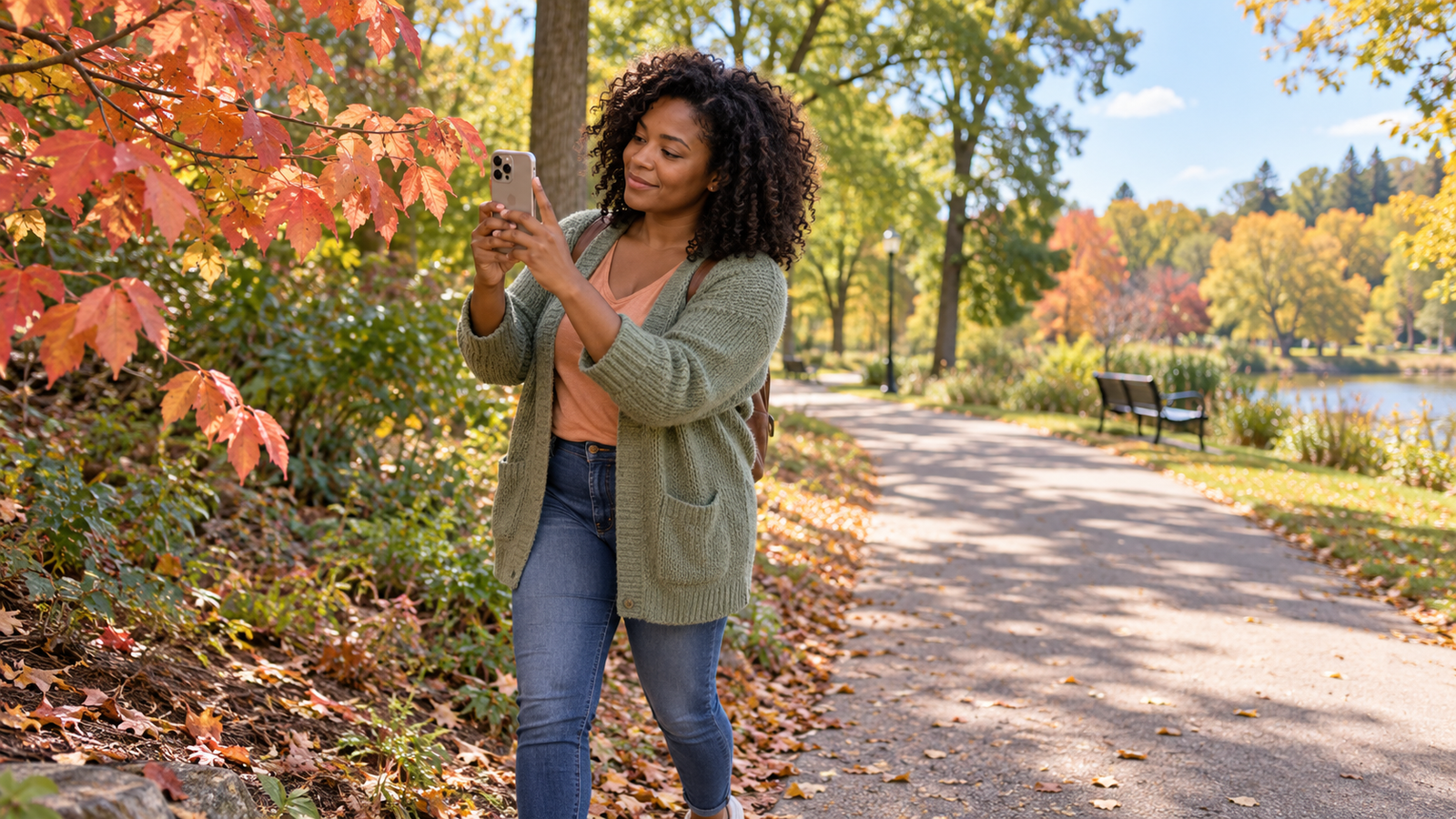
Your neighborhood does not need to look like a travel magazine. A good leaf and a slightly dramatic shadow can carry the afternoon.
A cozy photo walk is a short outing with one small creative purpose: notice a few things you would normally pass. You can use your phone, stay close to home and finish with five pictures you like. No special camera, perfect outfit or posting schedule required.
Think of it as a hobby that borrows a tool you already own. The camera is allowed. The accidental forty-minute detour into everybody else’s weekend can wait.
Choose a route you can actually enjoy
Start with a nearby sidewalk, a public garden path or a park loop you know. Pick a route with places to pause without blocking anyone. Check opening hours, weather and access before leaving; an inviting bench is more useful than an ambitious itinerary.
Autumn gives you changing leaves and longer-looking shadows, but you do not need peak foliage. Green leaves, porch paint, bark, seedheads and reflections give you plenty to work with. On a gray day, look for soft color and texture. On a sunny day, try light passing through leaves or shadows falling across a wall.
Bring your charged phone, comfortable layers and whatever water or mobility support you normally need. Clean the camera lens with a suitable soft cloth. Smudges have a way of making every scene look like it was photographed through a sandwich.
The five-photo challenge
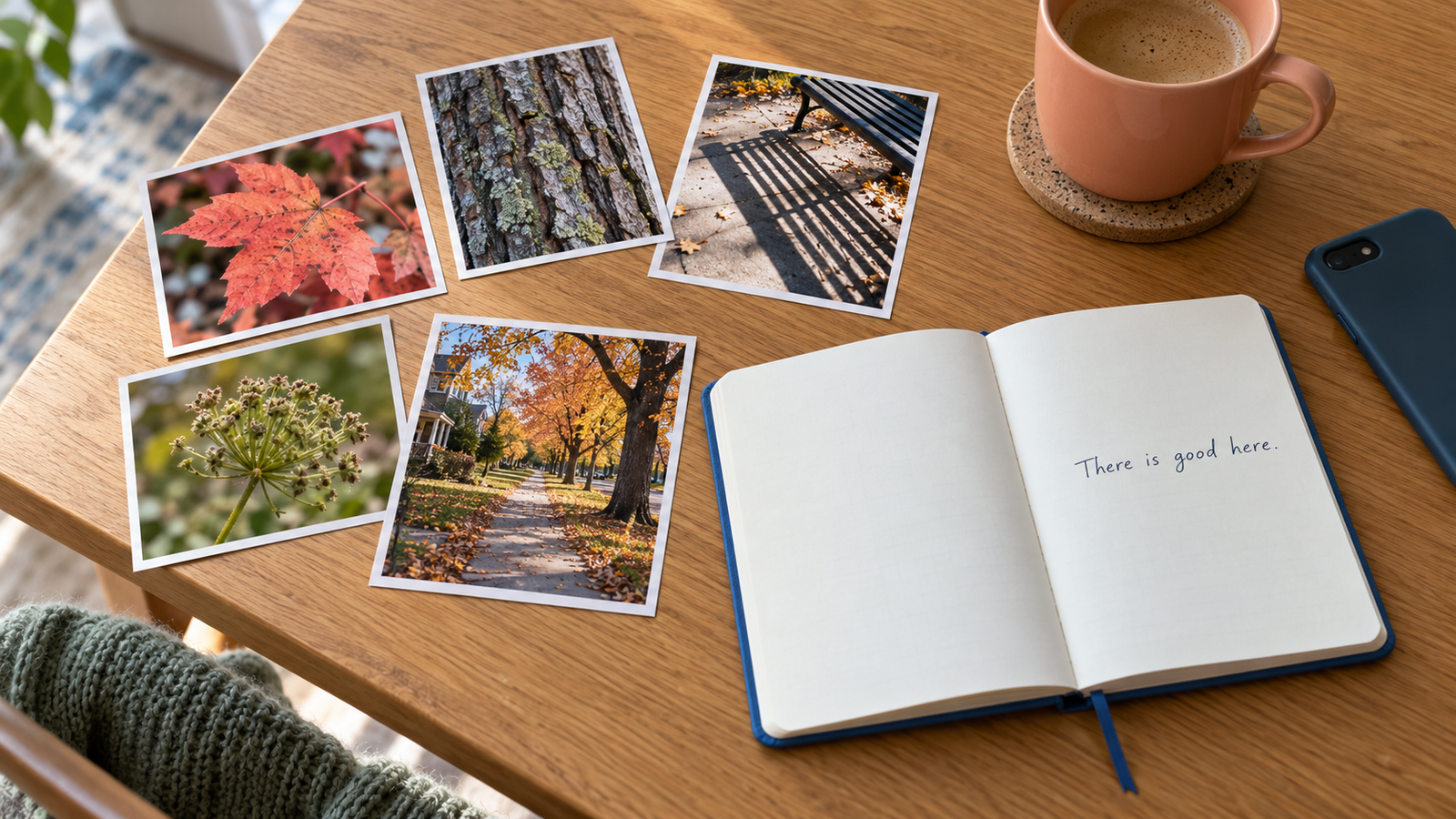
Use these prompts once each. Take a few attempts if you like, then move on. The goal is a small collection with variety, not a camera roll containing 83 nearly identical leaves.
1. One color
Choose a color before you start—coral, green or blue—and find it somewhere ordinary. Fill much of the picture with that color, or show it standing out against a quieter background.
Example: one orange leaf against a gray path, rather than an entire busy tree.
2. One texture
Look for bark, a weathered bench or the surface of a stone. Photograph without touching or disturbing it. Try a slight angle so light reveals the ridges.
Example: a close view of bark with a strip of green moss, photographed from the path.
3. One patch of light
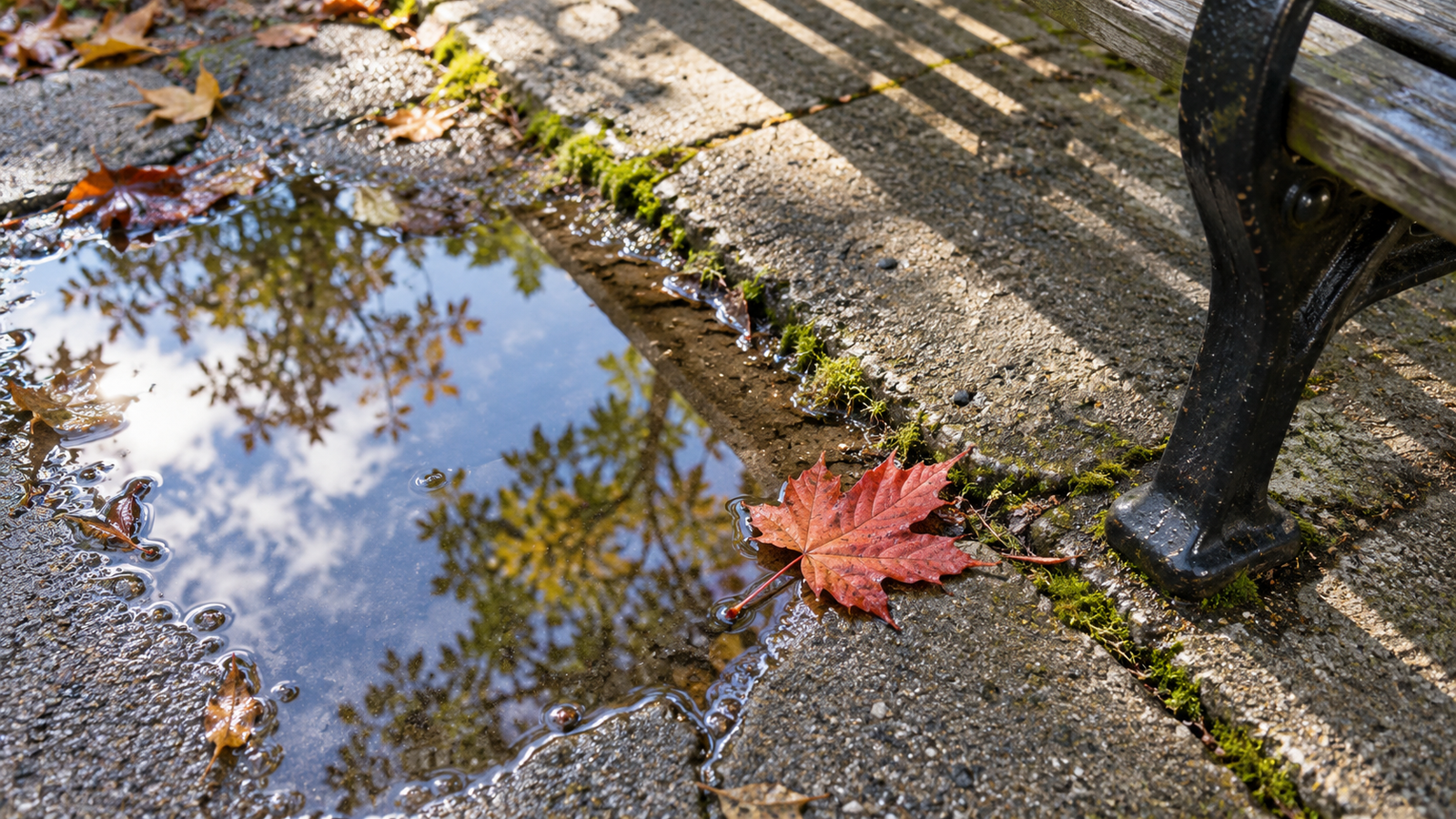
Notice a shadow, a reflection or a sunlit edge. Move your framing a little while staying in a safe position and see what changes.
Example: a bench shadow making stripes on the pavement. The bench itself need not be in the shot.
4. One tiny detail
Choose a leaf vein, a raindrop or a seedhead. If your phone will not focus close up, move back until it can. A sharp picture from farther away beats an extremely close blur.
Example: a single fallen leaf where it lies, with a little surrounding ground for context.
5. One wider scene
Finish with a view that shows where the smaller moments happened. Include a path, tree or bench that gives the eye somewhere to begin.
Example: the neighborhood path framed by branches, with space around its edges.
Make the pictures clearer without learning every camera setting
Stand still first. Stop walking before you compose. Hold the phone with both hands when practical and tuck your elbows comfortably toward your body. Wait for a moving leaf to settle instead of chasing it with the camera.
Choose the subject before the settings. Ask, “What do I want someone to notice first?” If the answer is the red leaf, check whether a bright trash can or busy sign is stealing attention. Change the framing rather than rearranging the environment.
Use your usual camera mode. Start with the main camera rather than a strong zoom. Digital zoom can reduce detail; if you cannot move closer safely, keep the wider view and try a modest crop later. On many phones, tapping the subject sets focus; the exact controls vary by model.
Check one photo while you are there. Look for focus, a tilted horizon and overly bright areas. If the sky is blank white, reduce how much sky you include or try the camera’s brightness adjustment. You can experiment without mastering the whole menu.
If your street seems “boring”
Give yourself a smaller assignment. Photograph only circles, only green things or only shadows for ten minutes. Familiar places become easier to explore when you have something specific to look for.
Try three views of the same subject: the whole tree, one branch and one leaf. This is a simple way to practice telling a visual story without hunting for a spectacular destination.
Another option is to revisit one public spot next week. Make the picture from roughly the same position and compare what has changed. Keep a note of the date; your own little seasonal record is more interesting than pretending every walk is a grand expedition.
A seated version, a friend version and a family version
Seated: choose a comfortable bench, porch or window view. Look for three different compositions from that position. You can explore color, light and framing without covering distance.
With a friend: choose the same color, then each take three pictures during a short shared route. Compare them at the end. It is interesting how two people can stand in the same place and notice completely different things.
With children: let them choose a shape or color to spot, while an adult handles the camera if needed. Keep normal supervision and road-crossing routines. Finding one good subject still counts when somebody urgently needs a snack.
Take the picture; leave the place as you found it
Stay on established routes, respect barriers and avoid stepping into plantings for a better angle. Leave plants, rocks and natural objects where they belong. The National Park Service suggests photo scavenger hunts as an alternative to collecting finds.
Give wildlife space and skip feeding, calling or approaching animals to stage a shot. On residential streets, avoid photographing through windows; ask before making another person the subject. A lovely detail is not permission to enter someone’s yard.
Keep your phone down while crossing roads or navigating uneven ground. If a photo requires an awkward lean, a step into traffic or crowding another visitor, choose a different subject. There will be another leaf. Nature has an impressive inventory.
Do something small with your five favorites
At home, choose up to five pictures. A simple crop or slight brightness adjustment is enough; keep the originals if you want to experiment. Create a named album such as “October things I noticed” so the outing does not disappear between receipts and screenshots.
Print one favorite, send a picture to a friend with a sentence about it, or add a small print to a journal. Printing is optional, and you do not need to share publicly. The photographs can simply belong to you.
For a paper follow-up, try our beginner journaling guide or tuck a print into a note using our cozy snail-mail guide. If your attention turns toward birds, our North American bird guide offers another direction to explore.
Resources worth keeping
- Nikon: Autumn Impressions, by Tom Bol—examples of autumn light, detail and composition. The specialist camera settings are optional for this phone-based activity.
- National Park Service: Leave What You Find—why photographs can make good keepsakes without removing natural objects.
- Leave No Trace: Photography—practical ways to enjoy photographing outdoors with less impact.
Images are AI-generated editorial illustrations, not documentary photographs from a named location. This guide is a creative activity, with no promised health outcome.
The Sunday Soft Reset
A calmer start to your week.
Get Lifvyt’s weekly collection of gentle wellness reads, nervous-system resets and practical tools — plus the free 5-Minute Nervous System Reset Guide.
By signing up, you’ll receive the free guide and one gentle Lifvyt email each week. Unsubscribe anytime.