
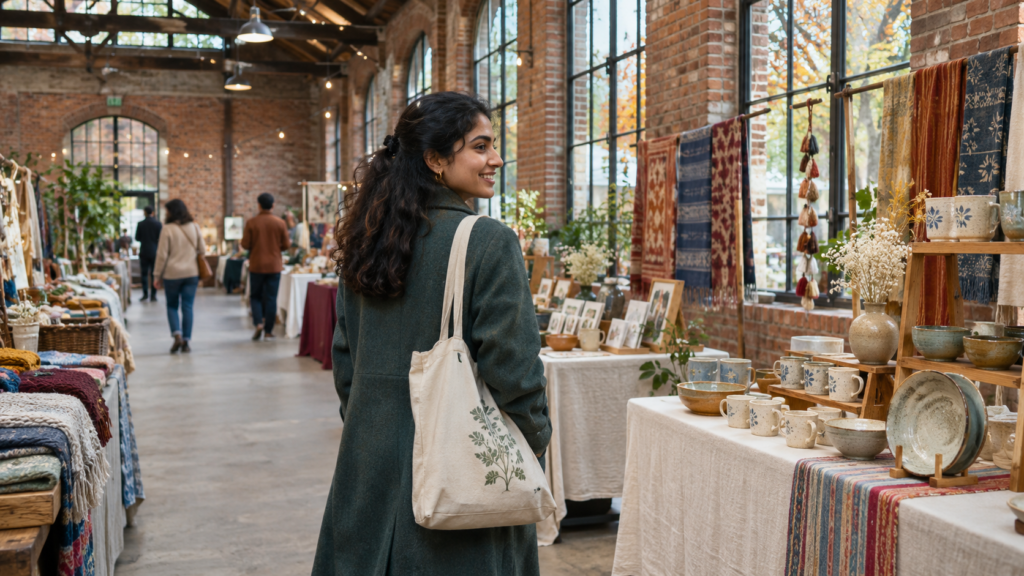
A solo craft market visit gives you something to do with your hands, your curiosity, and that small pocket of weekend time you keep accidentally donating to your phone. You can look closely at a ceramic cup, ask how a scarf was woven, and leave whenever you feel done. No group-chat scheduling summit required.
The trick is choosing a manageable event and deciding what kind of outing you want before you arrive. Here is a simple plan for finding a market, browsing comfortably on your own, and keeping the afternoon enjoyable even if you buy nothing.
Before you go: This is an independent outing guide. Check the organizer’s current hours, admission, accessibility and policies. All budgets below are examples, not quoted local prices.
Why this is a timely November outing
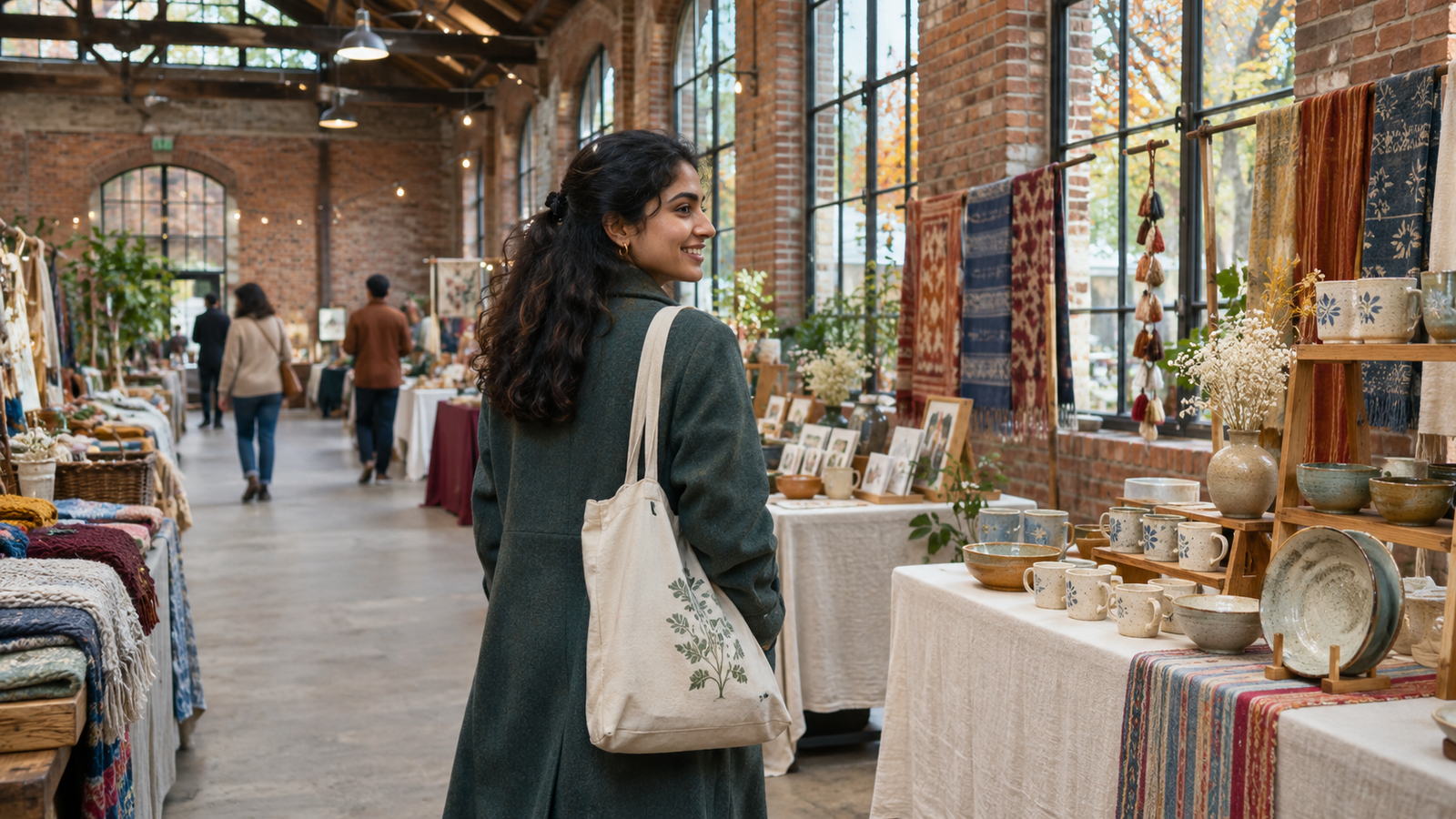
The U.S. Small Business Administration lists November 28, 2026, as Small Business Saturday. Meanwhile, the American Craft Council’s calendar includes November fairs, exhibitions and community craft events. That gives you a useful starting point for finding a local outing this month.
For one concrete example, the Council lists Artazan in Pasadena on November 14–15, 2026, with independent makers working across materials. You do not need to travel to that event. Use the same idea locally: a place where you can see objects up close and meet the people behind them.
1. Choose one market that fits your actual day
Search your town’s arts council, museum, community center or official visitor calendar for “makers market,” “handmade market” or “holiday craft fair.” Add the current month and year. Then follow the listing to the organizer’s own page; a pretty repost can be from last December.
- Look at the vendor list. Find three stalls that interest you, such as pottery, textiles and prints. A market selling mostly things you do not enjoy is unlikely to improve when you reach the parking lot.
- Check the total visit cost. Include admission, parking or transit, and any timed-entry requirement.
- Check the physical setup. Indoor or outdoor? Stairs or step-free entry? Seating and restrooms? If an access detail matters to you and is missing, ask the organizer before going.
- Check what “craft market” means here. Some events feature maker-produced goods; others mix handmade work, vintage items and resale. Choose knowingly rather than assuming every stall has the same rules.
2. Give the afternoon a spending limit
Pick a total before leaving, then subtract the costs that get you through the door. What remains is your optional shopping money. This keeps a “small treat” from collecting several expensive friends.
| Part of the visit | Example limit |
|---|---|
| Admission | $5 |
| Parking or transit | $5 |
| Drink or snack, including any tip | $6 |
| Optional purchase, including tax | $24 |
| Total | $40 |
If the real travel or admission cost is higher, reduce the purchase allowance or choose a different event. A free-entry market can also be a browsing-only outing. You are not required to buy a small item at every table to prove you appreciate the work.
For gifts, write down one person, one useful object and a maximum total: “Sister—small zip pouch—up to $25 including tax.” That is easier to use than “something cute,” which is how three decorative mushrooms become your dependents.

Pack for browsing, not a full expedition
- A comfortable bag: choose one that leaves a hand free to look at work when invited.
- A charged phone: save your ticket, address and return route before leaving. Going off-screen does not mean giving up practical tools.
- Your payment plan: check whether the event or vendors specify cash or card. Keep your travel money separate from your shopping allowance.
- A tiny paper list: note three stalls, your spending limit and any gift measurements. A print is much easier to buy when you know the frame size.
3. A 75-minute route for your solo craft market visit
This is a suggested pace, not a target to beat. Add travel time separately. If you have a childcare handoff or another commitment, choose a firm departure time before browsing.
- First 10 minutes: get your bearings. Locate the exit, restroom and seating. Make one light pass through the space, noticing stalls you want to revisit.
- Next 30 minutes: stop at three interesting stalls. Look at materials, ask a question if the maker is available, and note a booth number or business name. Ask before touching delicate pieces or taking close-up photos.
- Next 15 minutes: take a break. Sit down if seating is available. Compare your favorites with your budget and gift list. Keep a drink away from merchandise.
- Final 20 minutes: return or leave. Revisit one favorite, check its practical details, and make a decision. Browse another aisle if you prefer. Leaving without a purchase is a valid ending.
4. Ask questions that make shopping more interesting
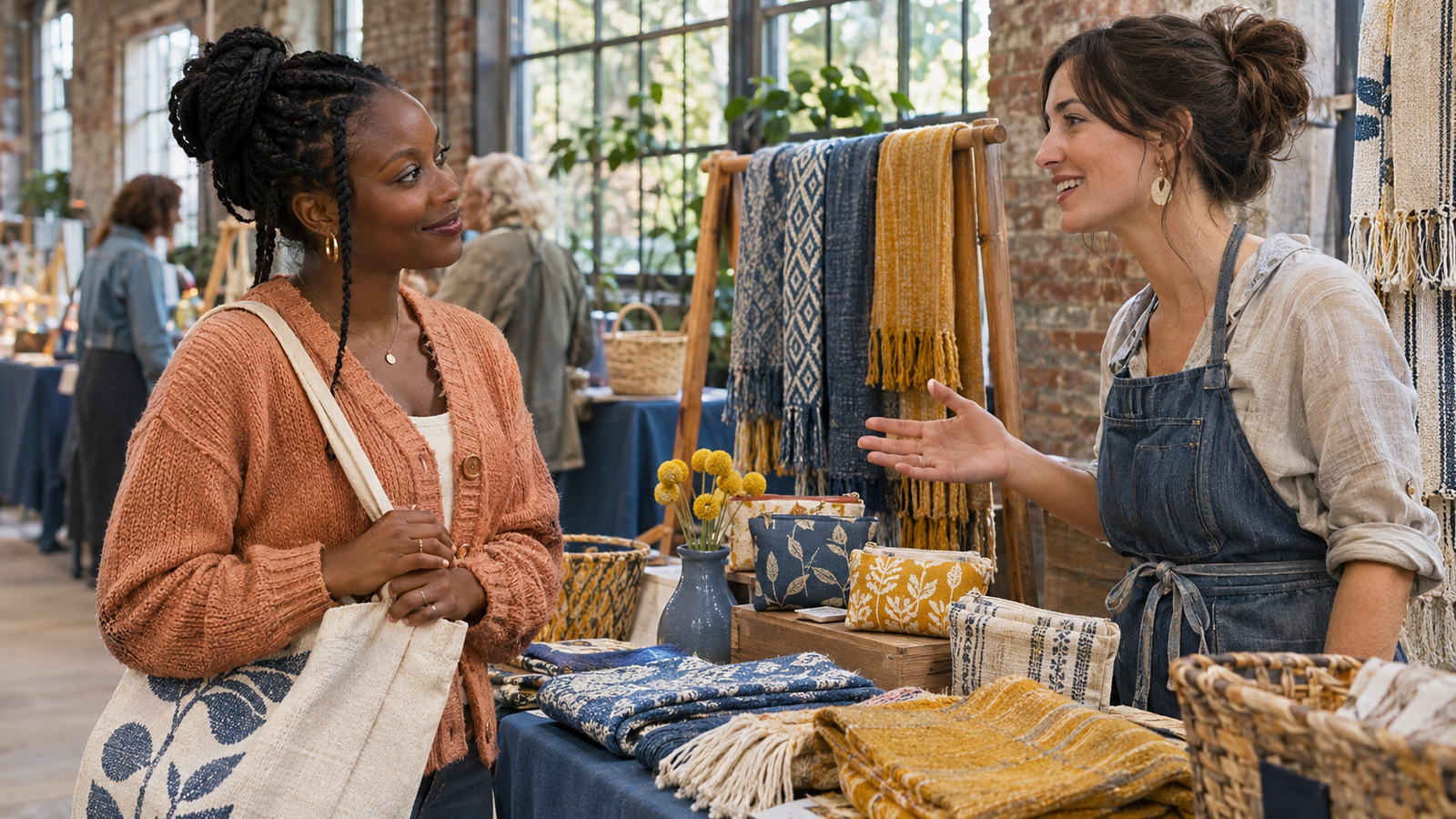
You do not need to know craft terminology. Start with something you can see. “I like the blue stitching—how do you do that?” gives the maker a specific place to begin.
- To understand the work: “Did you make or design these yourself?” Follow with “Which part takes the most time?”
- For pottery: “Is this intended for food and drinks? What are its washing and microwave instructions?” Appearance alone cannot answer those questions.
- For fabric: “What fiber is this, and how should I wash it?” Ask about shrinkage or color transfer if relevant.
- For a gift: “What is your exchange policy, and can I have the care instructions?” Check the policy before paying.
- If you want to learn: “Do you offer beginner classes or demonstrations?” A market can introduce you to your next hobby.
If a queue forms, keep the conversation short. If you are not buying, “Thank you for explaining that—I’m going to keep browsing” is enough. You do not need an elaborate story about your bank account.
5. Make the purchase practical, if you make one
Before paying, check the exact item you will take home. Does the pouch zipper run smoothly? Are the print’s dimensions right for your frame? Does the mug feel comfortable to hold, if the seller allows you to pick it up?
Use a quick check for the item in front of you
- Prints: ask whether the piece is an original or a reproduction, whether a frame is included, and whether the listed size includes the white border or mount. Write down the dimensions before buying a frame.
- Textiles and pouches: ask permission to inspect the seams and work the zipper. Check the lining, fastenings and care label. A delicate hand-wash item may not suit someone who needs a washable everyday bag.
- Jewelry: ask what the parts touching skin are made from, whether the finish is plated, and how to care for it. If you have a known metal allergy, do not guess from color or appearance; ask for material details and skip anything uncertain.
- Ceramics: ask the maker to confirm its intended use and care. A decorative bowl is not automatically suitable for food, and visual inspection cannot establish that.
Small differences can be part of handmade work. Judge whether the item functions as described and suits your needs; a high price or a “handmade” sign alone does not answer those questions.
Ask for the final total, a receipt and a way to contact the seller. For a custom order, get the agreed details, delivery estimate and cancellation or return terms in writing. Do not assume a holiday deadline is guaranteed.
Bring a comfortable bag, but let the seller wrap fragile objects appropriately. A large tote is useful; it is not protective packaging by itself.
6. Give yourself an enjoyable finish
Stop for a drink if it fits the plan, or sit somewhere nearby before heading home. Write one sentence about what caught your attention: “The woven blue scarf made me want to try a loom.” You can follow up on a class later without spending the rest of the outing on your phone.
If crowds or noise make the visit unpleasant, leave sooner. Ask organizers about quieter periods for a future visit; opening time is not automatically quiet. For a different kind of solo outing, try LIFVYT’s first solo museum visit guide or silent book club guide.

Your craft-market checklist
Save these eight checks for the day of your visit.
- Confirm the date, address, hours and entry requirements on the organizer’s page.
- Check parking or transit, access, seating and restrooms.
- Pick three stalls and write down your departure time.
- Set your total budget, then subtract admission, travel and refreshments.
- Bring your ticket, payment method, comfortable bag and short shopping list.
- Make a first lap, then ask a maker one specific question.
- Before buying, check the item, final price, care instructions and return policy.
- Keep the receipt and seller’s contact details—or head home happily without a purchase.
Take one small next step
Find one nearby market and check its vendor list today. If three stalls interest you and the logistics fit, put the visit on your calendar. Your goal can be as small as seeing something made with care.
If the outing makes you want to make something yourself, the creative reuse store guide can help you find materials for a first project. For now, you are allowed to enjoy being curious.
Sources and planning resources
- SBA: Small Business Saturday—November 28, 2026.
- American Craft Council: Craft Happenings Calendar—a starting point for fairs, exhibitions and workshops.
- American Craft Council: Artazan Pasadena—one verified November 14–15, 2026 event example.
Sources checked November 3, 2026. The itinerary, budget and conversation prompts are LIFVYT editorial suggestions; they are not research findings or promises about a particular event.
Disclaimer: Event details and seller policies can change. Verify arrangements directly before traveling or purchasing. LIFVYT is not affiliated with the organizations or events referenced.
The Sunday Soft Reset
A calmer start to your week.
Get Lifvyt’s weekly collection of gentle wellness reads, nervous-system resets and practical tools — plus the free 5-Minute Nervous System Reset Guide.
By signing up, you’ll receive the free guide and one gentle Lifvyt email each week. Unsubscribe anytime.