
OFFLINE HOBBIES · A LITTLE CURIOSITY
You have an hour to yourself. You would like to go somewhere that does not involve groceries, a checkout cart or answering “What’s for dinner?” An art museum is a lovely candidate—even if your current art vocabulary is mostly “I like that blue.”
A solo museum visit lets you follow your own interests: spend longer with a tiny ceramic bowl, skip the room that does nothing for you, or sit down halfway through. You do not need to see the whole collection to have a good afternoon.
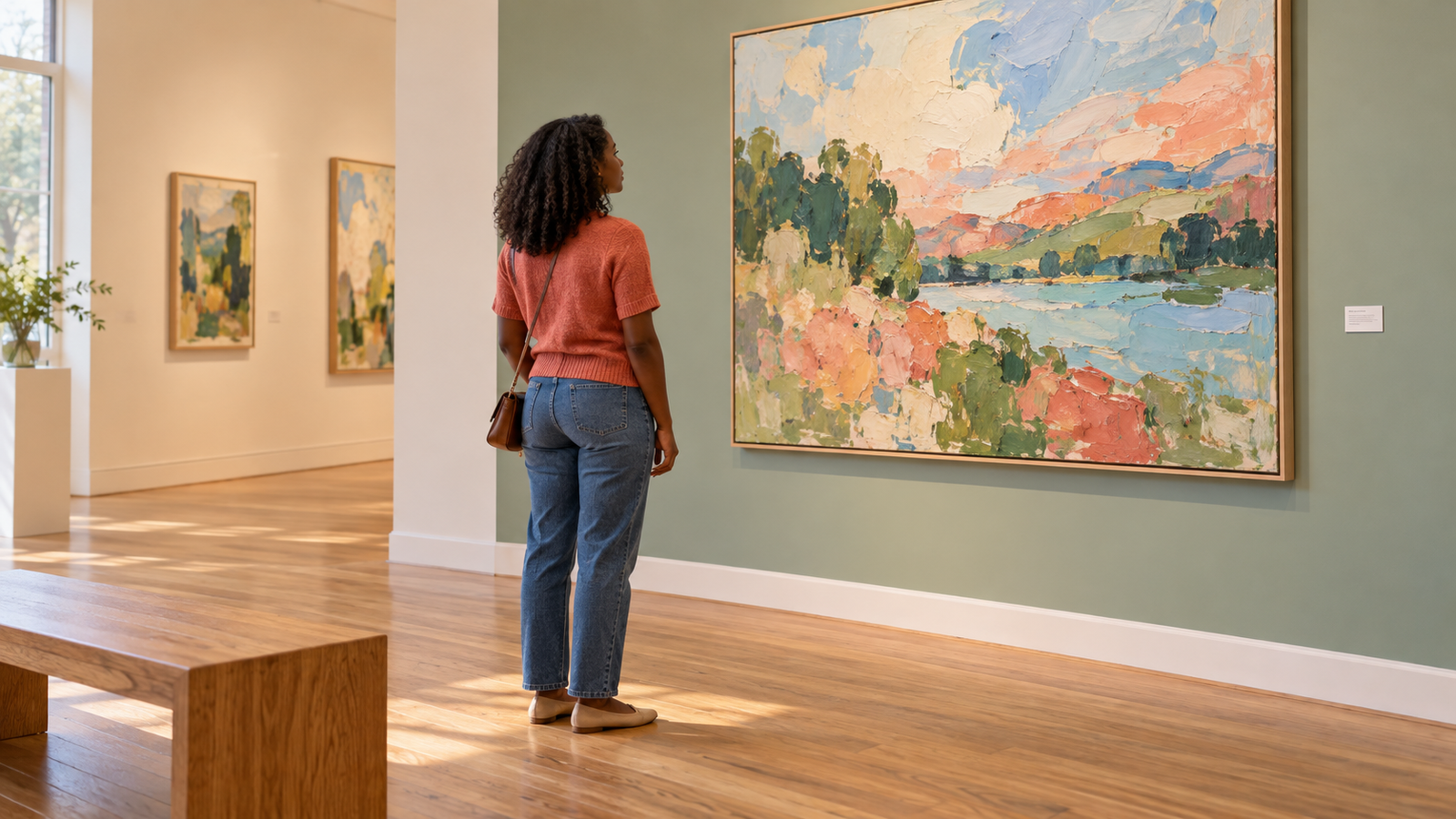
Choose a museum you can actually enjoy this week
Start with something you already like: textiles, photography, pottery, gardens in paintings, fashion or local history. A collection with a familiar doorway gives you a place to begin. You can try the more mysterious room another day.
Search your city or county plus “art museum,” “university gallery” or “community art center.” Open the venue’s own website rather than relying on an old roundup. A smaller gallery with one exhibition can be easier to fit into a workday than a huge museum across town.
- Look at the visit page: Confirm opening hours, last admission, timed tickets, current exhibitions and any rooms temporarily closed.
- Count the whole cost: Include transport, parking, childcare if needed, and any separately ticketed exhibition. Free general admission may not include everything.
- Check comfort and access: Look for step-free entrances, elevators, seating, accessible toilets, sensory information and available assistance. Contact the venue about the details you need.
- Ask about busy periods: A school-group morning or a free evening may feel very different. A free session is useful; it is not a promise of a quiet room.
Find the affordable way in
Before buying a ticket, check the museum’s admission page for free hours, local-resident offers or other discounts you qualify for. Ask your public library whether it lends museum passes; availability, reservations and eligibility depend on your library system.
In the U.S., Museums for All lists participating venues with admission of $5 or less per person for up to four people when visitors present a SNAP EBT card and photo ID. Confirm the venue’s booking rules first. The EBT card demonstrates eligibility; admission is paid separately, not with SNAP benefits.
A Charlotte example: As checked on October 20, 2026, The Mint Museum lists free admission on Wednesdays from 5–9 p.m. at both locations. Recheck the visit page for your date and any special-exhibition terms. Parking and getting there still belong in the budget.
Bring a pocket kit, not a portable studio
A small bag, comfortable shoes, any glasses you use, and your admission details cover the basics. A pocket notebook and pencil are optional. Check the venue’s rules for bag size, sketching tools and where food or drinks may be carried or used.
Save your route and ticket before arriving. Ask whether there is a paper map. Put your phone on a setting that limits distractions while letting important family calls through. Using a phone for accessibility, navigation or a useful audio guide still fits the spirit of an off-screen outing.
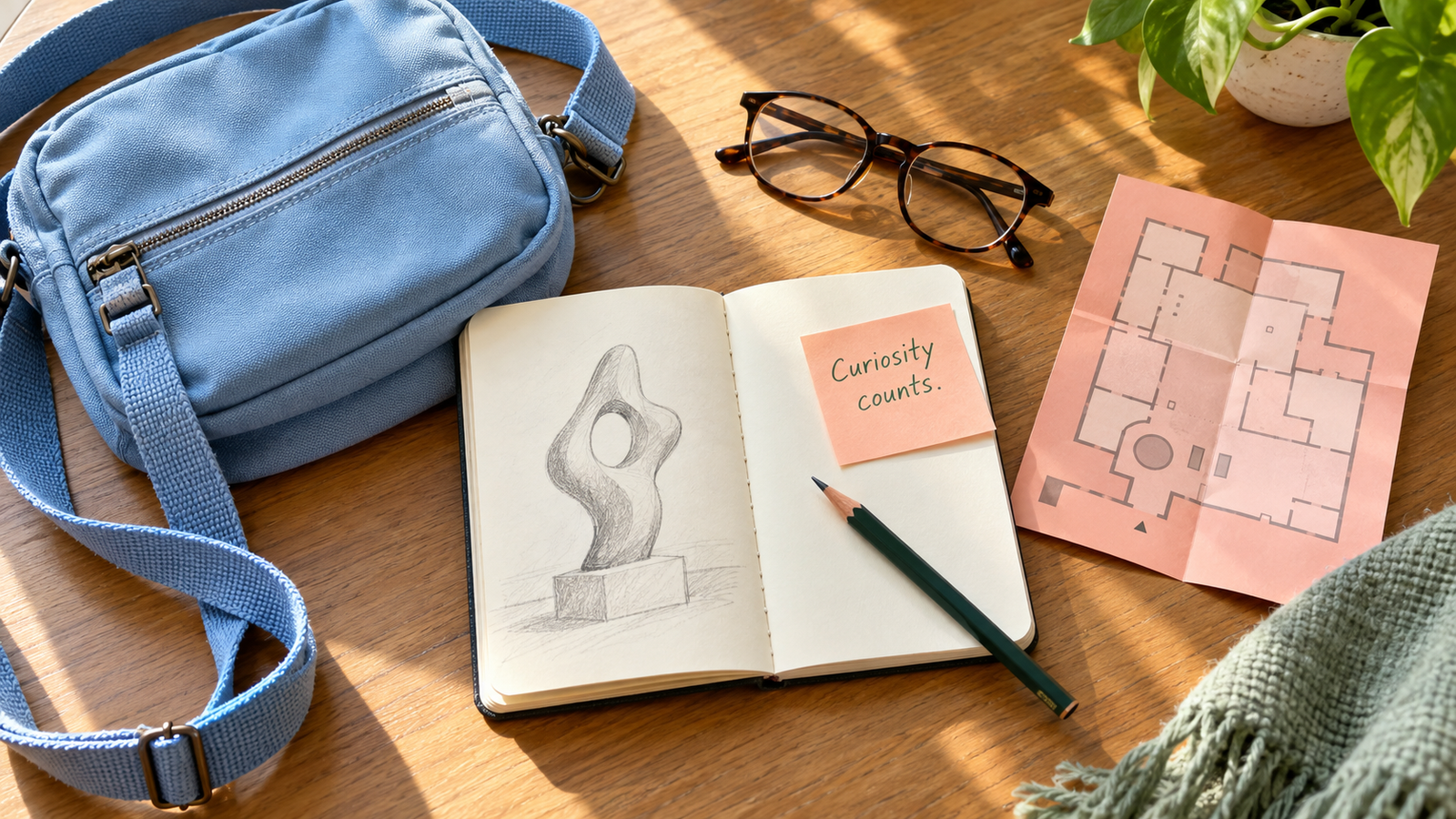
A flexible one-hour route
This is time inside the museum. Add travel, parking and any admission queue separately. Choose one floor or exhibition so most of your hour goes to looking instead of finding the elevator.
Get your bearings
Check in, find the toilets and choose a gallery. Ask staff where to start. Take a moment to arrive before trying to appreciate anything.
Browse and choose
Walk or move through a small area at your own pace. Choose three pieces: one that attracts you, one that surprises you and one you want to understand better.
Spend time with your three
Try a few minutes with each, leaving time to move between them. Read a label, look again and notice what changes. You can sit whenever a seat is available.
Keep one detail
Make a small sketch or write a sentence. If photography is allowed, a photo of the work and another of its label may help you find it later. Neither is compulsory.
Finish while you still want to return
Revisit your favorite, check the artist’s name and head out. A gift-shop browse is optional. Your ticket did not come with a souvenir requirement.
Shrink the route
Use five minutes to settle in, fifteen in one gallery and five to wrap up. Choose one work instead of three. Consider a free session if a short paid visit would feel frustrating.
What do you actually do while looking at art?
MoMA’s slow-looking guide encourages time with an artwork, attention to visual details and curiosity before rushing to the label. You can borrow that general approach anywhere. These are our own simple prompts:
- Start with something concrete. Find the brightest area, the smallest repeated shape or the edge your eye keeps following.
- Separate noticing from guessing. “The room has no visible door” is an observation. “The person feels trapped” is one possible interpretation. Both can lead somewhere interesting.
- Read for context. Check the artist, title, date and material. Read the longer text if you want it. What new detail makes more sense now?
- Look once more. Find something you missed the first time. You do not have to arrive at the exhibition’s grand conclusion.
Imagine a painting of a kitchen table. You might first notice a yellow cup, then an empty chair, then realize the label describes a family gathering. Your reaction may change—or it may stay “excellent yellow.” Enjoyment and understanding can grow at different speeds.
Make a tiny sketch, even if you do not draw
First confirm that sketching is permitted and ask which materials are allowed. MoMA, for example, publishes drawing and writing prompts for visitors; another venue may have different rules.
On one notebook page, draw three small boxes. In the first, sketch only the outside shape of an object. In the second, copy a single detail, such as a curve or pattern. In the third, write three words describing what caught your attention. Five minutes is plenty for this little exercise.
Keep the notebook in your hands or on your lap, use visitor seating, and stay clear of walkways. Do not rest it on display cases or plinths. If drawing feels like homework, just write “I want that shade of green somewhere in my life.” That is a useful souvenir too.
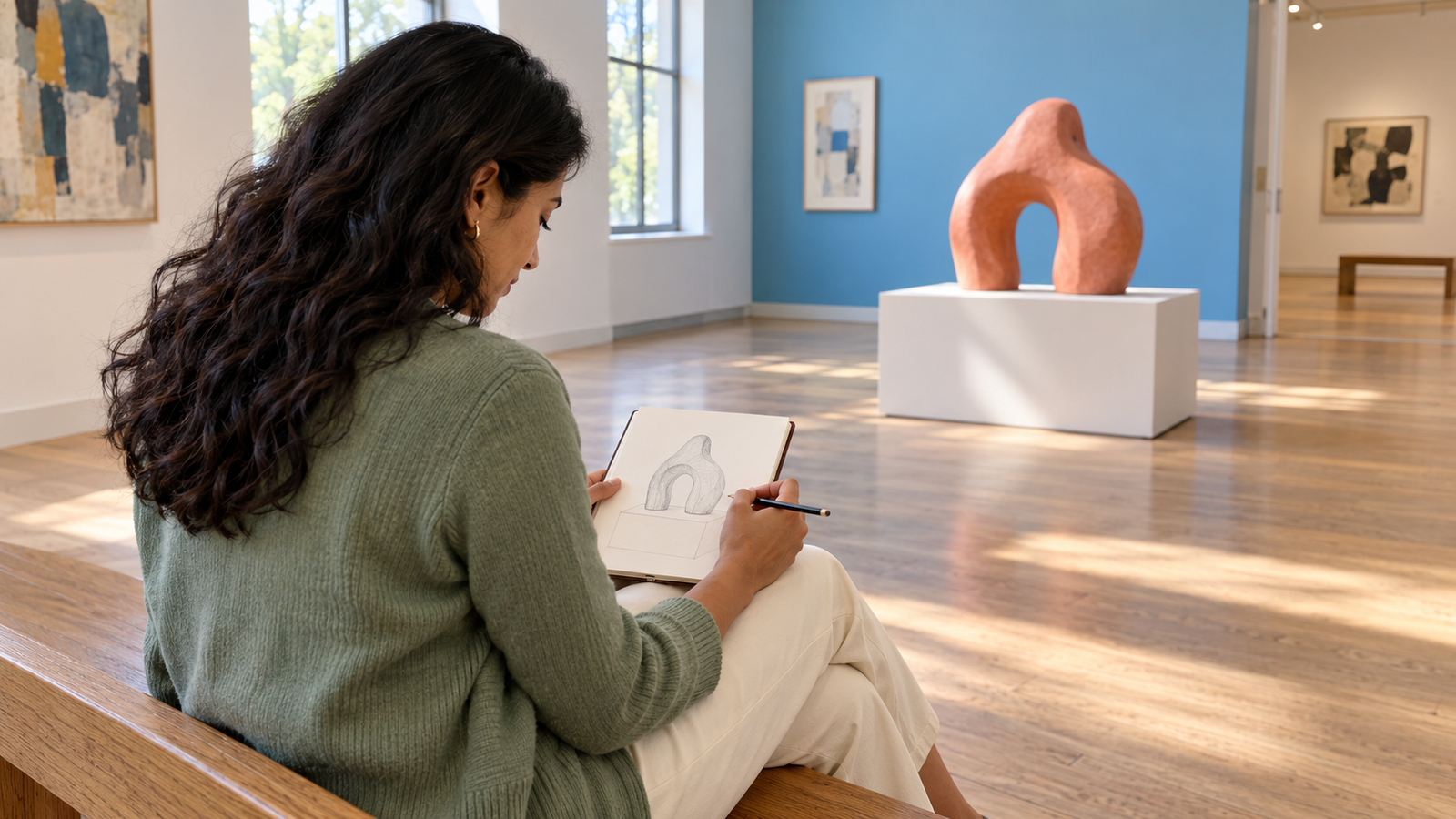
The small rules that make the visit easier
Follow the venue’s signs and staff guidance. Keep the required distance from art, avoid touching unless an exhibit explicitly invites it, and check photography rules in each space. A sculpture that looks like furniture may still be an artwork rather than a seat.
If you need a pause, ask for the nearest seating or quieter area. Use an audio guide if it adds something; skip it if you would rather look quietly. Being alone means you can change your plan without calling a committee meeting.
Turn one visit into an analog hobby
At home, keep a tiny record: the museum, date, artist, artwork title and one detail you remember. Add your own sketch or a ticket if you have one. Three lines are enough. Our beginner journaling guide can help if the blank page tends to stare back.
Next time, follow a thread: another textile exhibition, a local ceramic artist, or a collection from a different period. For a creative afternoon afterward, use a color combination you noticed in your own watercolor bookmark. Credit an artist when sharing a study of their work, and do not assume an artwork is free to reproduce just because it is on display.
Your curiosity is enough to start
Choose one exhibition, make the logistics easy and give yourself permission to enjoy a small part of it. A successful visit might leave you with a new artist’s name, a funny observation or a shade of coral you cannot stop thinking about.
Your next step: Open one nearby museum’s visit page and pick a realistic date. The rest can stay pleasantly small.
More places to take your curiosity
Want a different kind of outing next time? Explore our self-love solo-date guide or 21 third places beyond home and work. For this outing, use the museum-specific steps above.
Useful resources and references
- MoMA: Slow Looking — museum-led prompts for observing art.
- MoMA: Can You Draw at MoMA? — examples of visitor drawing and writing activities.
- Museums for All: Visitor information — eligibility, admission and planning details.
- The Mint Museum: Plan Your Visit — the Charlotte admission example and current visitor information.
Visitor information checked October 20, 2026. Confirm hours, access arrangements and policies directly before traveling. Images are illustrative AI-generated scenes, not photographs of the named museums or their collections.
The Sunday Soft Reset
A calmer start to your week.
Get Lifvyt’s weekly collection of gentle wellness reads, nervous-system resets and practical tools — plus the free 5-Minute Nervous System Reset Guide.
By signing up, you’ll receive the free guide and one gentle Lifvyt email each week. Unsubscribe anytime.