
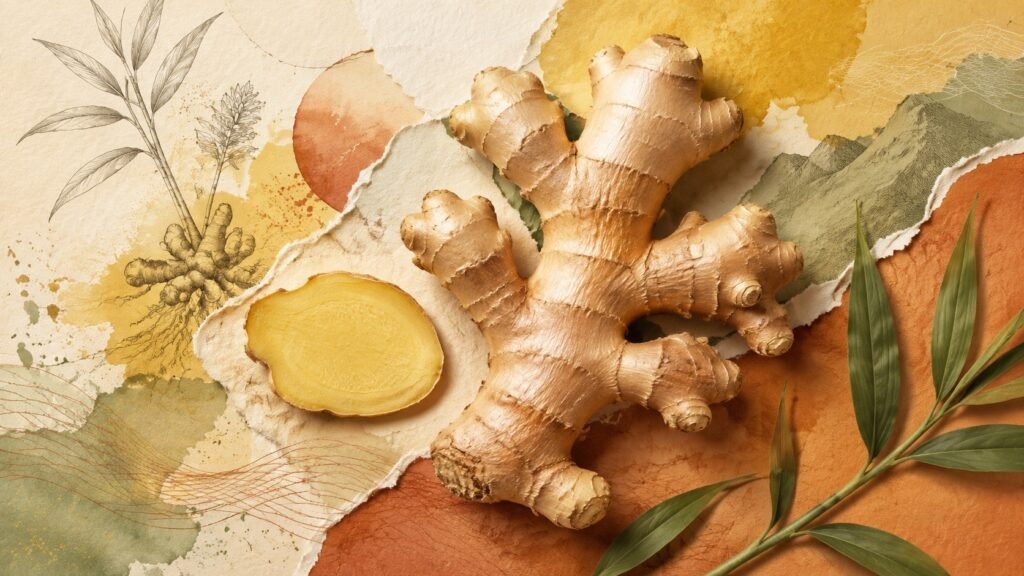
Ginger has one of the more useful human-research records in everyday herbalism.
The clearest positive evidence centers on nausea in pregnancy and menstrual pain. Osteoarthritis, digestive movement, chemotherapy-related nausea and metabolic markers also show encouraging—but more conditional—signals.
Pronunciation Guide
Botanical Latin varies by speaker. Being understood matters more than perfection.
gingerJIN-jer
ZingiberZIN-jih-ber
officinaleoh-fiss-ih-NAH-lee
gingerolJIN-jer-ol
shogaolSHOH-gah-ol
rhizomeRYE-zohm
Meet the Plant Behind the Heat
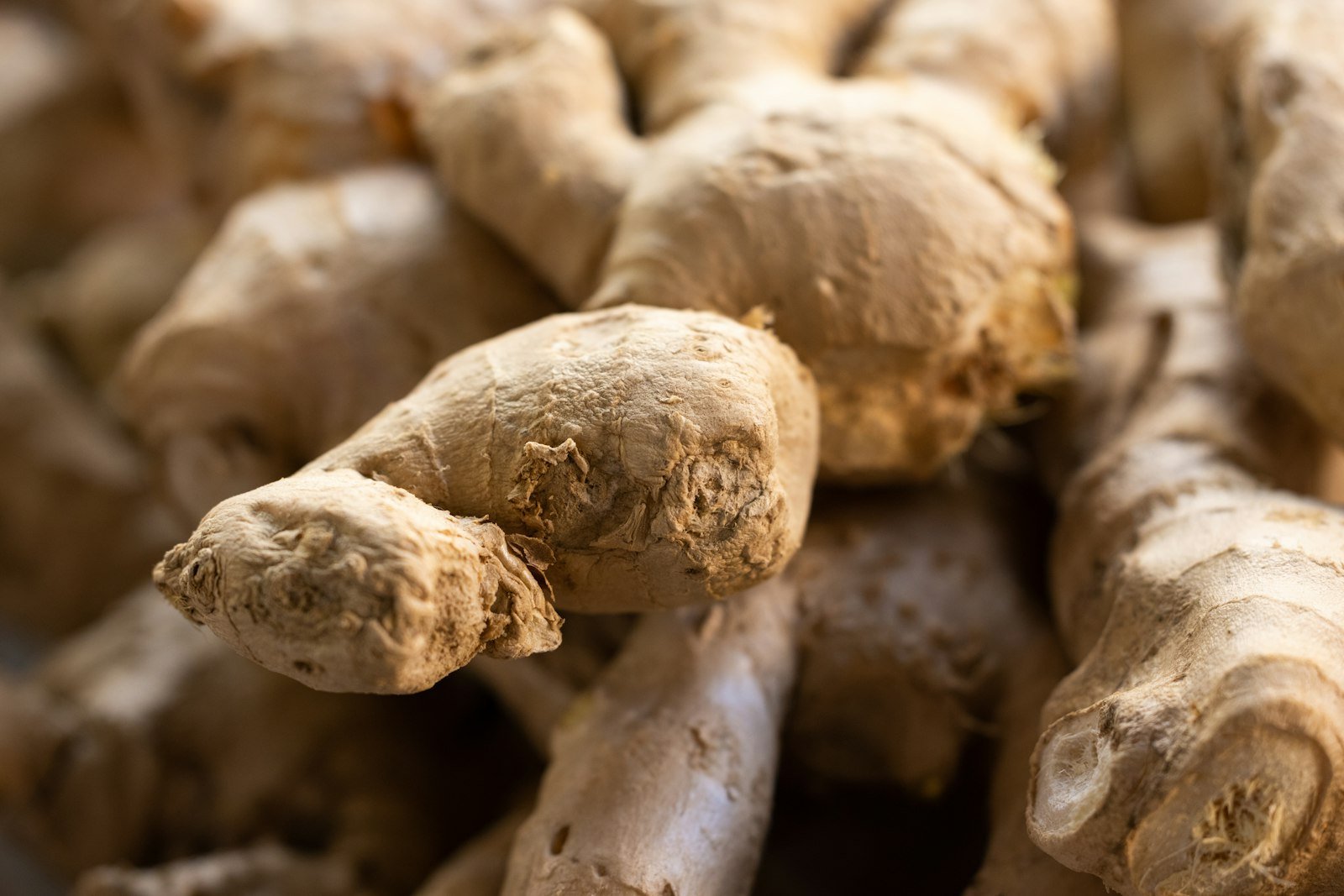
Zingiber officinale is an accepted species in the ginger family. Kew describes it as a rhizomatous perennial native from the East Himalaya through south-central China.1 The knobbly ingredient sold as “ginger root” is its aromatic underground stem.
What you see
Reed-like green shoots above ground; branching tan or golden rhizomes below. Most kitchen use begins with the rhizome.
What you taste
Fresh ginger is bright, citrusy and hot. Drying and heat shift the chemistry, so powdered ginger can feel warmer and more lingering.
What research tests
Trials use powders, capsules and standardized extracts—often around 0.5 to 3 grams daily, but not always. The label matters.
What one cup means
Tea is a gentle food-like preparation. It cannot be assumed to reproduce a capsule trial without matching the material and dose.
Ginger across kitchens and healing traditions
Fresh ginger appears in curries, broths, stir-fries, pickles and warming drinks. It also has long histories in Ayurvedic and regional practices.
Traditional Chinese practice distinguishes fresh ginger from dried or processed forms, assigning them different qualities and uses.
Pickled ginger, grated ginger, syrups and teas show how preparation can move the flavor from sharp to sweet, soft or preserved.
Ginger travels through punches, beers, biscuits, candies, soups and spice blends—an everyday food long before it becomes a supplement.
Traditional use can point researchers toward good questions. It does not by itself prove a treatment. Modern trials add another lane: defined participants, preparations, comparators and outcomes.
Fresh, Dried, Tea and Extract Are Different Tools
Fresh rhizome
Rich in gingerols and volatile aromatics. Good for cooking, grating, juicing and a bright, sharp tea.
Dried powder
Water loss concentrates the material by weight. Drying and heat encourage conversion of some gingerols into shogaols.
Tea or decoction
Hot water extracts part of the rhizome’s chemistry. Slice size, simmer time and starting weight all change the cup.
Capsule
May hold plain ground ginger or a concentrated extract. Those are not the same exposure.
Standardized extract
Designed to control selected chemical markers. Results belong most directly to the tested product.
Candy, ale or syrup
Can be enjoyable, but sugar and small ginger amounts make them poor stand-ins for research preparations.
Ginger Chemistry, Without the Lab-Coat Fog
Gingerols
6-Gingerol is the best-known member. Gingerols help create fresh ginger’s pungency and are frequently studied for effects on signaling involved in nausea and inflammation.
Shogaols
Drying or heating can convert gingerols into shogaols. They are often more pungent, which is one reason dried ginger is not merely fresh ginger minus water.15
Zingerone
Zingerone contributes a sweeter, warmer aroma in cooked ginger. Laboratory interest is substantial, but isolated-compound research is not a clinical promise.
Paradols & volatile oils
Paradols and aromatic terpenes add to ginger’s complex sensory and biological profile. Variety, age, storage and processing shift the balance.
Several plausible pathways
Ginger constituents may influence serotonin-related signaling in the gut, gastric movement and other pathways involved in nausea and vomiting.
Plausible is not universal
Mechanisms help explain why a result might occur. They do not prove that every form of ginger treats every cause of nausea—or that tea matches a standardized capsule.
How to Read the Evidence
Longstanding food and herbal practice. Important context, not a controlled test.
Cells, enzymes and isolated compounds. Useful for mechanisms, not enough for a person.
A human signal with limited precision. Replication and product details matter.
Many studies together. Stronger overview, but weak inputs do not become perfect evidence.
Where Ginger Research Looks Most Positive
Pregnancy nausea
Randomized trials and reviews repeatedly report less nausea with ginger. This is the clearest evidence lane, though pregnancy still calls for clinician guidance.25
Menstrual pain
Trials and meta-analyses find ginger better than placebo, with pain relief not significantly different from NSAIDs in pooled comparisons. Study quality and reporting vary.78
Knee osteoarthritis
A large comparative trial found more responders with ginger extract than placebo, though the advantage was modest and stomach effects were more common.9
What Human Ginger Studies Actually Found
One gram daily improved nausea and vomiting
Participants70 pregnant women at or before 17 weeks
DesignRandomized, double-blind, placebo-controlled
Use1 gram ginger daily
DurationFour days
Nausea scores fell more with ginger than placebo. Twenty-eight of 32 ginger participants reported improvement, compared with 10 of 35 receiving placebo; vomiting also decreased more.4
Across six trials, ginger favored improvement
StudiesSix randomized trials
Participants508 pregnant people
Typical exposureAbout 1 gram daily
Minimum durationFour days
The pooled analysis associated ginger with roughly five times the likelihood of symptom improvement compared with placebo. Differences among studies created uncertainty around the exact size of benefit.5
Less intense pain—and in some protocols, shorter pain
Single trial120 students
Use500 mg ginger three times daily
Review12 studies in quantitative analysis
ComparatorPlacebo or pain medicines
In the student trial, ginger significantly reduced pain severity; taking it for five days also improved pain duration.6 A 2024 meta-analysis found lower pain intensity and duration versus placebo, and no statistically significant difference from NSAIDs for intensity.7
More people met the pain-response target
Randomized261 adults
Evaluable247 adults
DesignDouble-blind, placebo-controlled
DurationSix weeks
Sixty-three percent of the ginger-extract group reached the study’s pain-improvement target while standing, compared with 50% of the placebo group. Some secondary outcomes did not differ, and mild gastrointestinal effects were more frequent with ginger.9
The stomach emptied faster after ginger
Participants24 healthy volunteers
DesignRandomized, double-blind crossover
Use1,200 mg ginger
MeasureGastric emptying and contractions
After ginger, the stomach’s half-emptying time was about 13 minutes versus about 27 minutes after placebo, with more antral contractions. The participants did not report a matching symptom difference.10
Ginger reduced acute nausea alongside standard medicine
Randomized744 adults with cancer
Analyzed576 adults
Use0.5, 1 or 1.5 grams daily
Background careAll received a 5-HT3 antiemetic
All three ginger doses reduced acute nausea severity on the first day of chemotherapy compared with placebo; the largest effects appeared at 0.5 and 1 gram.11
A standardized extract improved delayed nausea and quality of life
Participants103 chemotherapy-naive adults
DesignRandomized, double-blind, placebo-controlled
UseStandardized ginger extract plus medication
DurationThree chemotherapy cycles
The ginger group reported better nausea-related quality of life, delayed-nausea control and fatigue outcomes. Delayed nausea and vomiting were lower in cycles two and three, while acute and anticipatory symptoms did not significantly differ.12
What Reviews See From Farther Back
A review of 109 randomized trials found encouraging evidence across nausea in pregnancy, inflammatory conditions, metabolic outcomes and digestive function—but only 43 studies were rated high quality. Small samples and inconsistent methods limited many conclusions.3
An umbrella review of 24 systematic reviews gave its strongest ratings to pregnancy-related nausea, osteoarthritis pain and glycemic control. It also found positive signals for menstrual pain, blood pressure, body measures and some nausea settings, with confidence ranging from moderate to very low depending on the outcome.14
That overall picture is genuinely positive. It is also more interesting than a single miracle claim: ginger appears to have several useful, bounded effects rather than one universal “anti-inflammatory” superpower.
Why Ginger Studies Disagree
Different material
Fresh ginger, dried powder and concentrated extracts can carry different ratios of gingerols and shogaols.
Different dose
Half a gram and three grams are not the same exposure; a weak tea may not match either.
Different timing
Taking ginger before chemotherapy, during menstrual pain or daily for weeks answers different questions.
Different nausea
Pregnancy, motion, surgery and chemotherapy have different triggers. Evidence does not transfer automatically.
Different outcomes
Fewer vomiting episodes, lower nausea ratings and better quality of life are related but distinct endpoints.
Small studies
Promising estimates can shift when larger, better-controlled trials arrive.
What You Might Reasonably Expect
From food
Flavor, warmth and a low-pressure way to include ginger in daily meals. Culinary amounts are not clinical doses.
From tea
A soothing sensory ritual and possible relief of mild queasiness. Strength is hard to standardize at home.
For pregnancy nausea
A reasonable evidence-supported option to discuss with a prenatal clinician, especially before concentrated supplement use.
For menstrual discomfort
A genuine possibility of less pain, based on several trials. Severe or changing pain still deserves medical assessment.
For joints
A modest possibility of added relief from a tested extract, not a replacement for movement, diagnosis or prescribed treatment.
For glucose
An interesting research signal—not permission to alter medication, skip monitoring or self-treat diabetes.
Ginger Tea: A Flexible Kitchen Ritual
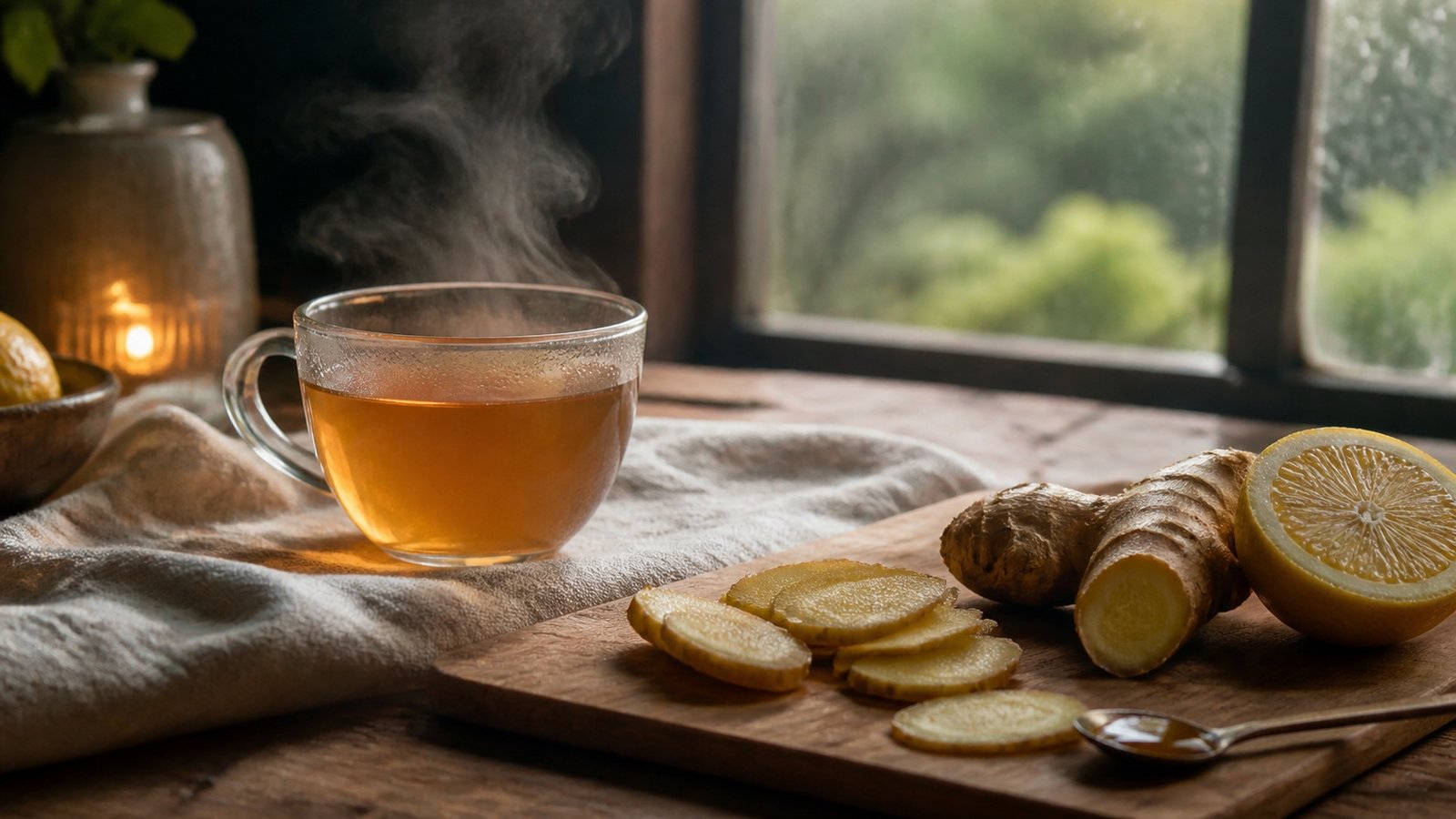
Tea does not have to prove itself as a drug to be worthwhile. Its warmth, aroma and gentle bite can create a useful pause—and it may feel settling when the stomach is mildly uneasy.
Fresh ginger tea
- Thinly slice or grate a 1-inch piece of washed fresh ginger.
- Add it to about 10 ounces of water.
- Simmer gently for 8 to 12 minutes; strain.
- Add lemon or a little honey if desired.
Start mild if you are prone to heartburn. A home recipe is not a standardized medical dose.
What We Should Not Tell Each Other
- “Ginger cures every kind of nausea.” Pregnancy nausea has the clearest support; motion sickness, postoperative nausea and chemotherapy settings are more variable.
- “Natural means interaction-free.” Concentrated products can cause side effects and may matter with medication or before surgery.
- “A tea equals a capsule trial.” Without matching material, dose and chemistry, that leap is not justified.
- “Promising glucose findings mean you can replace diabetes care.” They do not.
- “More will work better.” In several settings, lower tested doses performed as well as or better than higher ones.
Notice the transformation
Slice. Simmer. Smell. Sip.
Fresh ginger begins crisp and bright. Heat softens its edges and sends its aroma into the room. While the tea steeps, notice one thing your body is asking for: warmth, food, quiet, movement or help.
The ritual is not a cure. It is a way to pay attention.
Safety: Food-Friendly Does Not Mean Limitless
The U.S. National Center for Complementary and Integrative Health lists abdominal discomfort, heartburn, diarrhea and mouth or throat irritation among possible oral side effects. It advises discussing supplement use during pregnancy and checking with a healthcare professional when medicines are involved.2
- Choose the right lane. Culinary ginger and moderate tea are different from concentrated capsules or extracts.
- Pregnant or breastfeeding? Discuss medicinal-dose supplements with your obstetric or prenatal clinician.
- Taking medication? Ask a pharmacist or clinician about interactions—especially with blood-thinning, glucose-lowering or other closely monitored medicines.
- Preparing for surgery? Tell the surgical team about supplements and follow their stop-use instructions.
- Heartburn-prone? Start with a mild tea or food amount and stop if symptoms worsen.
- Persistent nausea or pain? Do not let an herb delay evaluation of severe, new, worsening or unexplained symptoms.
Research Notes & Sources
Positive findings belong to the tested preparation, dose, population and outcome. Links below lead to botanical authorities, U.S. health guidance and the research records used in this article.
- Kew Plants of the World Online: Zingiber officinale Roscoe.
- NCCIH: Ginger—usefulness and safety.
- Systematic review of 109 randomized controlled ginger trials.
- Randomized trial of ginger for pregnancy nausea and vomiting.
- Meta-analysis of ginger for pregnancy-associated nausea and vomiting.
- Randomized trial of ginger timing for primary dysmenorrhea.
- 2024 systematic review and meta-analysis of ginger for dysmenorrhea.
- Earlier systematic review of ginger for dysmenorrhea.
- Randomized trial of ginger extract for knee osteoarthritis.
- Randomized crossover trial of ginger and gastric emptying.
- Large U.S. trial of ginger for chemotherapy-related nausea.
- Australian randomized trial of standardized ginger during chemotherapy.
- Randomized trial of ginger powder in type 2 diabetes.
- Umbrella review of ginger health effects.
- Laboratory study of heat-driven gingerol-to-shogaol conversion.
This Lifvyt article is for general education only, not medical advice, diagnosis, treatment or prescribing. Traditional uses are historical or practice-based knowledge, not promises to treat or cure disease.
Herbs, teas, extracts and supplements can cause side effects and interactions. Before medicinal internal use—especially during pregnancy or breastfeeding, for a child, before surgery, with medication or a medical condition—consult an appropriate physician, pharmacist or healthcare professional.
You are responsible for your purchasing, preparation and personal-use decisions. Seek medical care for severe, persistent, worsening or emergency symptoms.
The Sunday Soft Reset
A calmer start to your week.
Get Lifvyt’s weekly collection of gentle wellness reads, nervous-system resets and practical tools — plus the free 5-Minute Nervous System Reset Guide.
By signing up, you’ll receive the free guide and one gentle Lifvyt email each week. Unsubscribe anytime.