
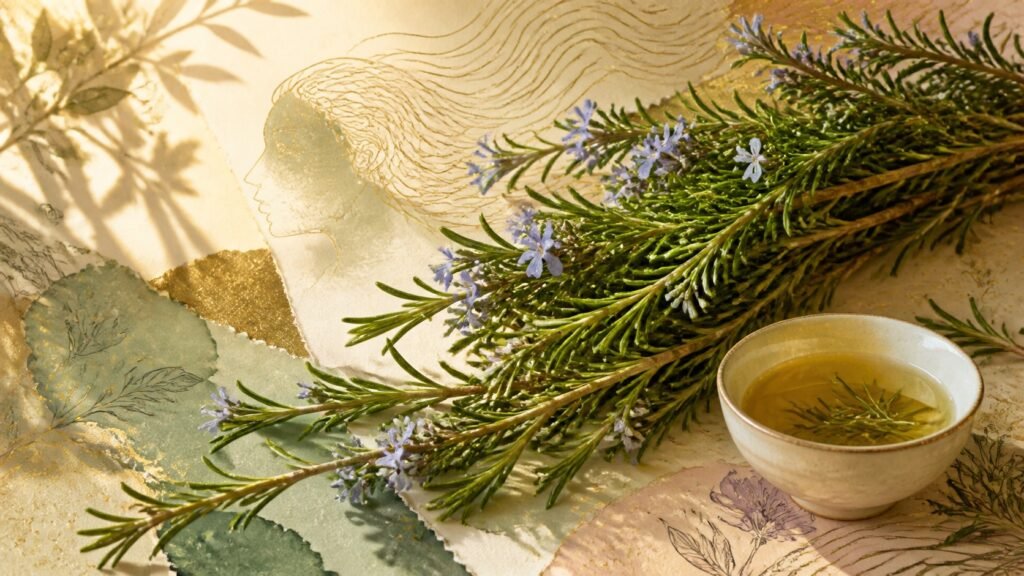
Rosemary has earned genuine scientific attention. Human studies report encouraging signals for memory and attention, mood, patterned hair loss and scalp comfort—alongside centuries of kitchen and body use.
Rosemary can wake up a room before it changes a single measurement. Its scent is resinous, green and unmistakable. The evidence deserves the same clarity.
Pronunciation Guide
Botanical Latin varies by speaker. Clarity matters more than courtroom-level pronunciation.
rosemaryROHZ-mair-ee
SalviaSAL-vee-uh
rosmarinusrohz-muh-RY-nus
cineoleSIN-ee-ohl
First, Meet the Right Rosemary
Rosemary is an evergreen, woody shrub in the mint family. Kew accepts Salvia rosmarinus as the current botanical name and lists Rosmarinus officinalis as a synonym—the name you will still see in older books, product labels, clinical papers and European regulatory documents.1
It is native to the Mediterranean region. Narrow, leathery leaves line square-ish stems; the upper surface is deep green while the underside looks paler. Small blue, violet, pink or white flowers can appear among the leaves, depending on the plant and growing conditions.
Crush a leaf and volatile compounds reach the nose quickly. That instant aroma is part of rosemary’s identity—but it is not a certificate of potency, purity or clinical effect.
The leaf
The main culinary and traditional medicinal part. Whole, cut and powdered dried leaf appears in teas and extracts.
The flowering sprig
Used in food, fragrance and decorative traditions. A beautiful sprig is not automatically equivalent to a measured study preparation.
The essential oil
Distilled from aromatic plant material. It is highly concentrated and chemically different from a cup of leaf tea.

One Plant, Several Lives: Kitchen, Memory and Body Care
Rosemary did not begin as a supplement. It grew through Mediterranean foodways, household practice, perfumery, ceremony and herbal medicine long before a bottle could promise “focus” in twelve-point type.
Tradition changes with place, purpose and preparation
Fresh or dried leaves season breads, beans, meats, potatoes and vegetables. Here rosemary is food first: aromatic, bitter and used in modest amounts.
Rosemary has long carried associations with memory, fidelity and remembrance. Symbolism helps explain its cultural staying power; it does not prove treatment for cognitive disease.
Leaf preparations have traditional medicinal use for digestive complaints. Baths have traditional use for minor muscular, joint and peripheral-circulation complaints.2
Rosemary appears in rinses, infused oils, massage products and aromatic baths. Modern hair claims require product-specific evidence and skin-safety attention.
Keep tradition and clinical evidence in neighboring rooms—not the same chair
Traditional use tells us what people prepared, where it fit into daily life and which questions later researchers chose to test. A clinical trial asks something narrower: what happened with one defined preparation, dose, group and time period?
Respecting both kinds of knowledge means labeling both. It does not require turning a traditional use into a guaranteed outcome.
Leaves, Tea, Extract and Oil Are Different Experiences
Rosemary products can share a plant name while delivering very different chemistry. Route matters too: smelling an aroma, drinking tea and applying a diluted scalp product are three separate exposures.
Fresh culinary leaf
Moist, aromatic sprigs used in ordinary food amounts. Flavor can become bitter when the leaf is heavy-handed.
Dried culinary leaf
More concentrated by weight because the water is gone. It is still a food form when used as seasoning.
Leaf tea
Hot water draws out water-soluble phenolics and some aromatic compounds. Strength changes with weight, water, cut size and steep time.
Powder or capsule
May contain ground leaf or a dried extract. A gram of plain powder is not automatically equivalent to a gram of extract.
Standardized extract
Made to concentrate or control selected markers. Findings belong to that extract unless equivalence is demonstrated.
Essential oil
A concentrated volatile fraction. It is not “extra-strong tea,” and casual swallowing is not an evidence-based shortcut.
A human rosemary-tea metabolism study detected dozens of compounds and metabolites in plasma and urine after tea intake. The researchers concluded that tea polyphenols were partly bioavailable and extensively transformed, including by gut microbes.8 That shows exposure and metabolism—not a clinical benefit by itself.
Inside the Piney Scent: Rosemary Compounds in Plain English
Variety, climate, harvest, storage and extraction all change rosemary chemistry. Essential oil emphasizes volatile molecules; tea and many extracts contain a broader mix of water-soluble and nonvolatile compounds.
1,8-Cineole
Also called eucalyptol. It contributes to rosemary’s penetrating aroma and can be absorbed during inhalation. Small cognition studies have measured it in blood while people completed tasks.
Camphor
Part of the cooling, sharp scent profile in many rosemary oils. Concentration varies, which is one reason essential oils deserve more caution than culinary leaf.
Alpha-pinene and relatives
Pine-associated aromatics help create the familiar “green and resinous” impression. A pleasant smell and a therapeutic dose are not the same concept.
Rosmarinic acid
A water-compatible plant compound found in rosemary and other mint-family herbs. Laboratory work makes it biologically interesting, but isolated-compound findings do not predict what one mug will do.
Carnosic acid
A rosemary-associated antioxidant compound often emphasized in extracts and food-preservation research. Extraction method strongly affects how much reaches a finished product.
Carnosol
Closely related to carnosic acid and part of rosemary’s complex phenolic mixture. Mechanistic interest should not be translated into a disease-treatment claim.
Why do researchers study rosemary for attention and memory?
Hypotheses include cholinergic signaling, aroma-related arousal, cerebral blood-flow changes and antioxidant or inflammatory pathways.
A mechanism is not a promise
A cell, enzyme or blood-flow signal can make a question plausible. It cannot prove that tea prevents dementia, that scent fixes brain fog or that more rosemary works better.
Four Evidence Lanes—Clearly Separated
Longstanding food, fragrance and herbal practice. Valuable context; not a controlled test.
Isolated compounds, enzymes or cells. Useful for mechanisms; cannot forecast a person alone.
Whole-body biology under controlled conditions, often with unlike doses or preparations.
Most relevant, but sample size, comparator, outcome and product still decide how much we can conclude.
Rosemary has a large preclinical literature and a smaller—but genuinely encouraging—human one. Positive signals appear in short-term cognitive tasks, mood research, patterned hair loss and scalp comfort. The evidence is not equally strong for every benefit, but it is substantial enough to discuss with interest rather than apology.
Where Human Rosemary Research Looks Positive
A low dose of dried rosemary improved speed of memory in older adults. Aroma and rosemary-water experiments also found benefits on selected cognitive measures.457
In a small placebo-controlled adjunct trial, rosemary capsules were associated with larger improvements in depression and anxiety scores after eight weeks.13
Hair count increased after six months in a rosemary-oil trial for androgenetic alopecia. Other controlled trials using rosemary-containing blends also reported improved growth measures.91012
A 5% rosemary lotion reduced itching in scalp seborrheic dermatitis and improved quality of life, with greater itch relief than 2% ketoconazole in that small trial.11
What Human Rosemary Studies Actually Did
The low dose and the high dose did not behave alike
Participants28 older adults; average age about 75
DesignRandomized, placebo-controlled, double-blind crossover
ExposurePlacebo and four doses from 750 to 6,000 mg
TimingAcute testing over six hours
Participants completed computerized cognitive tasks after each dose. The 750 mg dose improved one measure—speed of memory—compared with placebo. The 6,000 mg dose impaired that measure, and some other negative findings appeared inconsistently.4
Rosemary scent changed some task measures—but not in one simple direction
Earlier study144 healthy adults assigned to rosemary, lavender or no aroma
Later study20 healthy volunteers exposed to rosemary aroma
MeasuresMemory, attention, mood and blood 1,8-cineole
In the earlier experiment, the rosemary group performed better on some memory-quality measures but more slowly on speed of memory than controls.5
In the later study, higher blood levels of absorbed 1,8-cineole correlated with better speed and accuracy on certain tasks. Because that study focused on correlations after exposure, it cannot by itself show that cineole caused the performance differences.6
Small cognitive effects and an exploratory blood-flow signal
Participants80 healthy adults
DesignRandom allocation
Comparison250 mL rosemary water vs mineral water
MeasuresComputerized cognition, mood and near-infrared spectroscopy
The researchers reported several statistically significant but small cognitive effects after one serving. They also observed a difference in deoxygenated hemoglobin during task performance and described it as a novel cerebrovascular finding.7
Anxiety and depression scores improved more with rosemary
Participants51 adults with major depressive disorder
DesignRandomized, double-blind, placebo-controlled
UseRosemary or placebo alongside prescribed treatment
DurationEight weeks
Compared with placebo, the rosemary group had significantly larger reductions in anxiety and depression scores after eight weeks. The researchers also reported memory improvement as a beneficial secondary observation.13
Rosemary and Hair: Why the Positive Interest Is Reasonable
Hair is where rosemary’s human evidence becomes especially practical. The trials do not all test rosemary alone or the same diagnosis, but they point in a hopeful direction: improvements in hair count, growth rate, density, thickness, hair fall and scalp itching have all appeared in controlled human research.
That does not mean every bottle will work. It does mean rosemary is more than an internet rumor in this area.
Hair count increased after six months
Participants100 people with androgenetic alopecia
DesignRandomized comparative trial
ComparisonRosemary oil vs 2% minoxidil
DurationSix months
Neither group showed a significant change at three months. By six months, however, hair count had increased significantly in both the rosemary-oil and 2% minoxidil groups. The difference between the two groups was not statistically significant. Scalp itching occurred with both treatments but was more frequent with minoxidil.9
44% improved versus 15% with carrier oils
Participants86 people with alopecia areata
DesignRandomized, double-blind, controlled
Active blendRosemary, thyme, lavender and cedarwood oils
ComparisonJojoba and grapeseed carrier oils
Participants massaged their assigned oil into the scalp daily. Blinded photographic assessment found improvement in 19 of 43 people (44%) using the essential-oil blend, compared with 6 of 41 (15%) using carrier oils alone.10
Rosemary lotion was especially helpful for itching
Participants42 people with scalp seborrheic dermatitis
DesignDouble-blind randomized trial
Comparison5% rosemary lotion vs 2% ketoconazole lotion
DurationTwo months
Both lotions improved scalp seborrheic dermatitis and quality-of-life scores. Ketoconazole reduced adherent flaking more, while rosemary produced a significantly larger reduction in itching at one and two months.11
Rosemary-containing blends improved several hair measures in 90 adults
A 2025 double-blind, three-arm trial compared rosemary–lavender oil and rosemary–castor oil with coconut oil over 90 days. Both rosemary-containing groups improved hair-growth rate, thickness, density and length and reduced hair fall more than the coconut-oil group.12
Why it adds hope, not certainty: the products were blends, the trial lasted three months, and it was funded by the company connected to the formulations. Still, objective phototrichogram measures moved in a positive direction across multiple outcomes.
What the Evidence Looks Like From Farther Back
When the individual studies are placed side by side, rosemary looks promising and still developing. Hair and scalp research is particularly encouraging because several controlled trials measured visible or instrument-based outcomes over months.
Acute cognition
Several small experiments report changes in selected memory, speed, attention or mood outcomes. Results are not uniform, and most studies measure hours—not months or years.
Dementia prevention
No rosemary study here establishes prevention or treatment of Alzheimer’s disease, cognitive impairment or another neurologic condition.
Hair growth
Multiple controlled studies report positive hair outcomes. The strongest rosemary-alone signal is the six-month androgenetic-alopecia trial; blend studies add support but cannot isolate rosemary’s contribution.
Digestion and body comfort
European recognition is based on long-standing traditional use, not well-established clinical efficacy.3
Why Rosemary Studies—and Products—Disagree
Smelling volatile oil is not the same exposure as drinking tea or applying a scalp preparation.
The older-adult study found opposite effects at the lowest and highest tested doses.
Leaf variety, harvest, storage and extraction change the balance of cineole, camphor and phenolics.
One memory-speed score, subjective alertness, cerebral oxygenation and hair count answer different questions.
Healthy volunteers, older adults and people with androgenetic alopecia cannot be treated as one population.
Interesting signals are easier to overread when participant numbers are modest and replication is limited.
What You Might Reasonably Expect
From food
A vivid aromatic flavor and an easy way to make vegetables, beans, breads or soups feel more intentional.
From tea
A bitter, resinous cup. Traditional digestive use exists, but personal symptom relief is not guaranteed.
From aroma
A noticeable sensory cue that may feel alerting. Human task studies are interesting, not a medical cognitive treatment.
From scalp use
A reasonable possibility of better hair count over about six months for patterned loss, plus potential scalp-itch relief. Consistency matters, and irritation remains possible.
Rosemary Tea: A Practical Cup, Not a Personality Test
Rosemary tea is savory, piney and slightly bitter. It is not designed to taste like chamomile wearing a green sweater.
Start mild
- Use about ½ to 1 teaspoon of dried culinary rosemary leaf—or one small fresh sprig—per 8-ounce cup.
- Add just-boiled water, cover and steep for 5 to 8 minutes.
- Strain carefully. Taste before deciding it needs a stronger second round.
- Add lemon peel or a little honey if the bitterness feels louder than the ritual.
This is a modest food-style cup, not individualized treatment advice. The EMA monograph separately describes measured medicinal tea preparations for traditional-use indications; those directions and cautions belong to the regulated product and the person using it.2
If symptoms are persistent, recurrent or severe, tea should not become a delay button. Digestive pain, memory change and hair loss each have causes that rosemary cannot diagnose.
What I Would Not Tell You About Rosemary
I would not tell you rosemary prevents dementia, replaces sleep or fixes every version of brain fog. I would not use a 20-person aroma study to promise a sharper mind.
I would tell you that rosemary hair research is genuinely promising. I would not tell you every bottle is equivalent to the studied products—or skip a medical evaluation for sudden shedding, patchy loss, scalp pain or scarring.
And I would not call essential oil a stronger tea. Concentration changes both the chemistry and the risk.
A Rosemary Ritual for Coming Back Online
Use rosemary where it is easiest to respect: in food.
Tear a sprig over vegetables or beans. Notice the scent before the screen asks for your attention again.
Drink a glass of water while dinner cooks. Let the ritual cue something rosemary cannot do for you: eating, pausing and coming back into the room.
If what you were calling brain fog is actually exhaustion, the useful part may be the reset around the herb—not a heroic claim about the herb.

If your mind feels wrung out, start with the nervous system—not a miracle claim.
Try a short reset that asks less of you and gives your attention somewhere gentle to land.
Try the mentally exhausting day resetBefore You Use Rosemary
- Food is not extract. Ordinary culinary rosemary is a different exposure from medicinal tea, capsules, tinctures or essential oil.
- Do not casually swallow essential oil. European monograph use for rosemary essential oil is cutaneous, and concentrated oils can irritate or cause harm.3
- Patch test topical products. Rosemary can trigger hypersensitivity or contact dermatitis. Do not apply essential oil neat or to broken or irritated skin.
- Pregnancy and breastfeeding need caution. The EMA does not recommend medicinal rosemary-leaf use because safety data are insufficient.2
- Medicinal use is not recommended for children under 12 in the EMA rosemary-leaf monograph because adequate data are lacking.2
- Ask before oral medicinal use if you have bile-duct obstruction, cholangitis, gallstones, liver disease or another biliary disorder requiring supervision.3
- Medication and surgery context still matters. “No interaction reported” is not the same as “interaction impossible,” especially with concentrated products.
- Get the cause checked. New confusion, weakness, severe headache, rapidly worsening memory, sudden or patchy hair loss, scalp inflammation, or neurologic symptoms need medical evaluation.
Sources & Further Reading
- Royal Botanic Gardens, Kew: Salvia rosmarinus—accepted name, description, distribution and uses.
- European Medicines Agency: Rosemary leaf (Rosmarini folium) monograph and public information.
- EMA/HMPC: Final assessment report on rosemary essential oil and rosemary leaf, Revision 1.
- Pengelly et al. Short-term study on rosemary and cognitive function in an elderly population.
- Moss et al. Rosemary and lavender aromas, cognition and mood in healthy adults.
- Moss and Oliver. Plasma 1,8-cineole and cognitive performance following rosemary aroma exposure.
- Moss et al. Acute ingestion of rosemary water: cognitive and cerebrovascular effects.
- Bioavailability and nutrikinetics of rosemary-tea phenolic compounds in humans.
- Panahi et al. Rosemary oil vs 2% minoxidil for androgenetic alopecia.
- Hay et al. Randomized controlled aromatherapy trial for alopecia areata.
- Sadati et al. 5% rosemary lotion vs 2% ketoconazole for scalp seborrheic dermatitis.
- Patel et al. Rosemary–lavender and rosemary–castor oils for hair regrowth and scalp health.
- Azizi et al. Rosemary as an adjunctive treatment in major depressive disorder.
Source note: regulatory recognition based on “traditional use” is not the same as well-established clinical efficacy. Human-study findings remain attached to the tested dose, route, product, population and outcome.
This Lifvyt article is provided for general educational and informational purposes only. It is not medical advice, diagnosis, treatment or prescribing and does not establish a clinician-patient relationship. Traditional herbal uses described here are historical or practice-based information, not promises that an herb will diagnose, treat, cure or prevent disease.
Herbs, teas, tinctures, extracts, supplements, essential oils and topical preparations can cause side effects, allergic reactions and medication interactions. Product identity, purity, concentration and individual response vary. Before medicinal internal use—especially during pregnancy or breastfeeding, for children, before surgery, with prescription or OTC medication, or when you have a medical condition—consult an appropriately qualified physician, pharmacist or healthcare professional.
Essential oils require particular caution. Do not ingest an essential oil simply because it comes from a plant. Follow the intended route and label of the specific product.
You are responsible for your own purchasing, preparation and personal-use decisions. Lifvyt cannot assess your allergies, diagnoses, medication list, product quality, dose or individual risk. Seek appropriate medical care for severe, persistent, worsening, unusual or emergency symptoms rather than relying on an herbal remedy or this website.
The Sunday Soft Reset
A calmer start to your week.
Get Lifvyt’s weekly collection of gentle wellness reads, nervous-system resets and practical tools — plus the free 5-Minute Nervous System Reset Guide.
By signing up, you’ll receive the free guide and one gentle Lifvyt email each week. Unsubscribe anytime.