
LIFVYT · REST & ROUTINES
An analog bag is a tote filled with a few screen-free activities you can reach for during the odd pockets of time that usually disappear into scrolling. In 2026, the idea has been showing up across social media and lifestyle coverage. The useful part is much less trendy: a paperback, a pencil and one small project are easy to keep around long after the hashtag moves on.
This guide shows you how to build an analog bag without buying a new personality at the craft store. You’ll choose three activities for three different energy levels, pack the supplies safely and test the bag in real life.

First, decide where your analog bag will actually go
Pick three places where you regularly wait. Be specific: the fifteen minutes before school pickup, the pediatrician’s waiting room, your commuter train, a child’s practice or the coffee shop before an appointment.
Now rule out anything that doesn’t suit those places. Watercolor pans may be lovely at the kitchen table and mildly chaotic in a parked car. Loose beads and a waiting room carpet are natural enemies.
Use a bag you already own if it is comfortable, washable and easy to open. A zippered pocket is useful; an expensive “perfect” tote is not a requirement.
How to build an analog bag with the three-lane rule
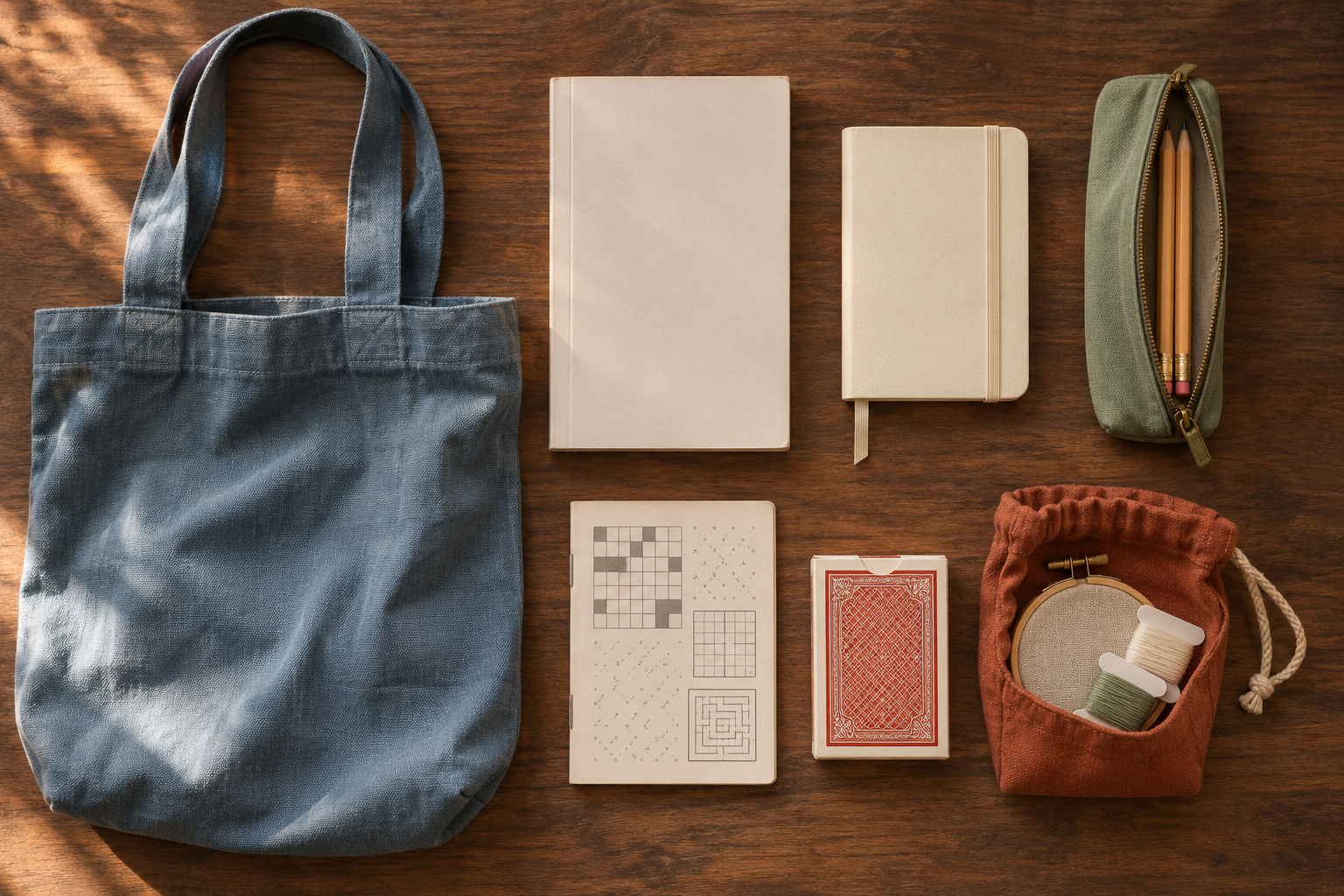
Choose one activity from each lane. This gives you options without hauling around the entire craft aisle.
| Lane | What it is for | Good choices |
|---|---|---|
| Easy start | Five scattered minutes or a tired brain | A pocket puzzle book, magazine, small coloring book or deck of cards for solitaire |
| Longer focus | Fifteen to thirty quiet minutes | A slim paperback, essay collection or printed article you actually want to finish |
| Hands busy | When you want to make instead of consume | A sketchbook, crochet square, embroidery hoop or simple friendship bracelet |
Add one small notebook and two reliable writing tools. The notebook is the flexible piece: it can hold a grocery list, a rough sketch, a paragraph for a mini zine or the thought that arrived once your phone stopped talking.
Pack it in six practical steps
- Empty the bag completely. Receipts, snack wrappers and the mystery crayon can leave. Start with a clean base.
- Choose your three activities. Pick one easy-start, one longer-focus and one hands-busy option.
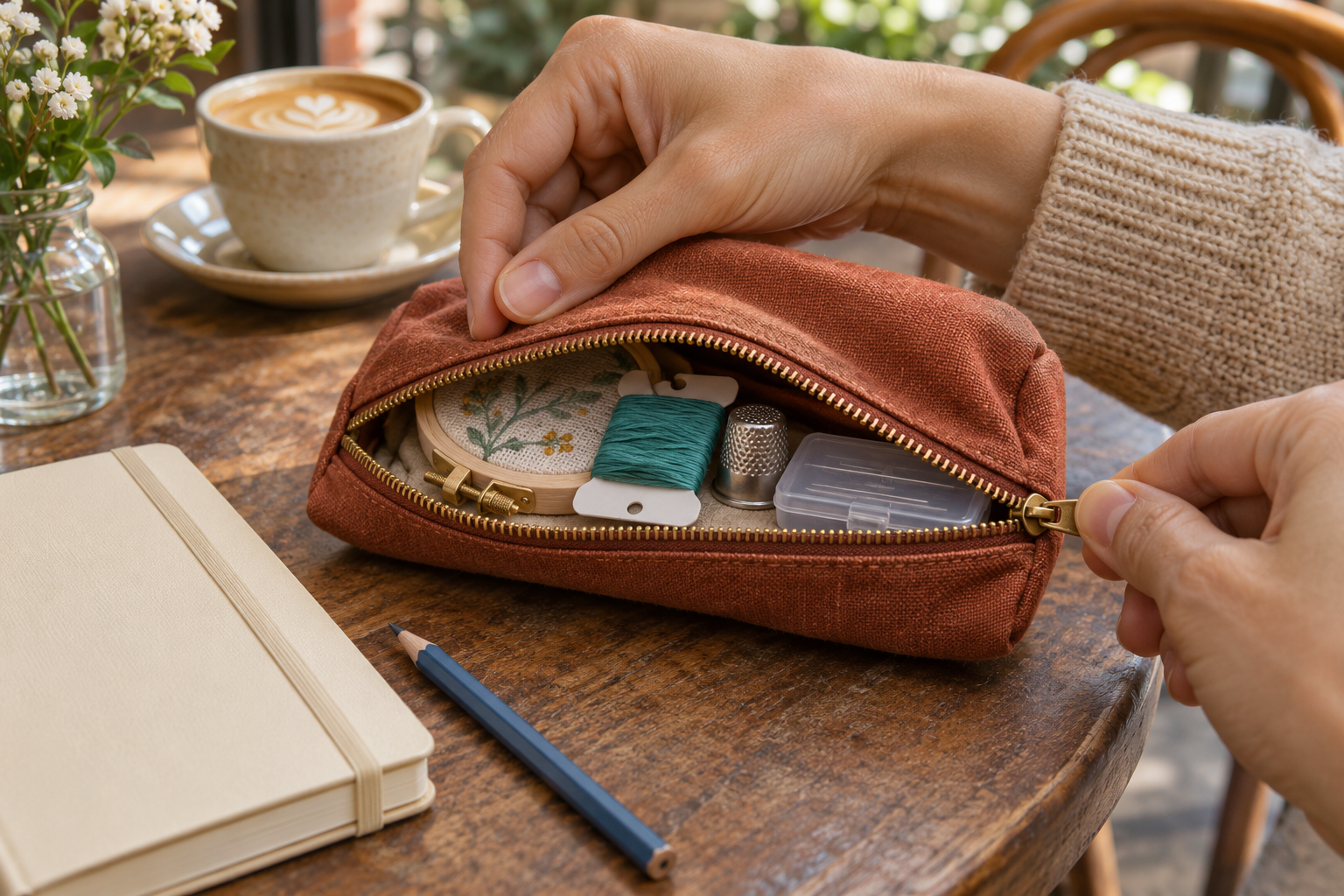
- Make every activity self-contained. Put pencils with the puzzle book. Wind embroidery thread. Place cards back in their box.
- Contain anything sharp or tiny. A needle belongs in a hard needle case inside a closed pouch. Small beads need a locking container. When children will be nearby, choose a pencil project instead.
- Put the easiest item on top. If the first thing you touch is a puzzle book, you are more likely to open it. If you have to excavate past four pouches, your phone has already won.
- Give your phone a boring home. Zip it into an interior pocket or leave it facedown in your regular purse. Keep it available for calls, directions and emergencies without placing it on top of your activity.
Match the activity to the time you have
If you have five minutes
- Solve three clues.
- Read two pages.
- Sketch the shape of your coffee cup without erasing.
- Write one sentence about what you noticed today.
If you have fifteen minutes
- Read one short chapter or essay.
- Fill half a puzzle page.
- Stitch one small patch or one section of a hoop.
- Fold a one-page mini zine and plan its eight panels.
If you have thirty minutes
- Finish a chapter and mark one line to remember.
- Play one round of solitaire.
- Work on your hand project until the next natural stopping point.
- Make a tiny observational sketch of the room—not the people in it unless they agree.
These are stopping points, not productivity quotas. The point is to make spare time feel inhabited, not optimized within an inch of its life.
Three real-life versions that stay manageable
The school-pickup bag
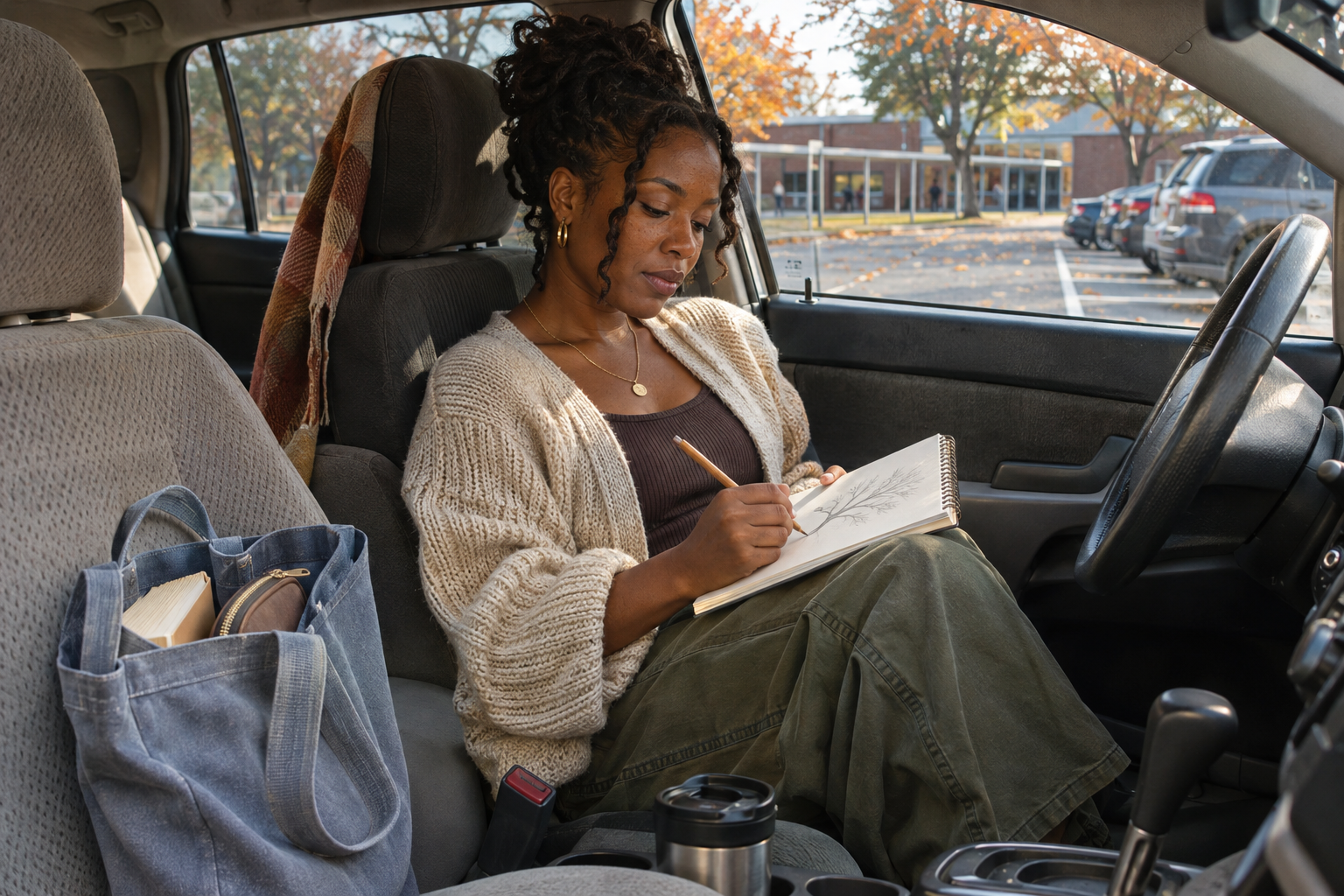
Pack a puzzle book, an A6 notebook and a paperback. Use pencils rather than loose markers, and skip tiny parts if younger children will reach the bag once they get in. Keep the activity closed until you are safely parked in a designated space. A moving pickup queue or a red light is not a parked break.
The waiting-room bag
Choose quiet, clean activities: a slim book, pencil puzzles and a sketchbook. Leave food, strong-smelling pens and projects that spread across the neighboring chair at home.
The coffee-shop or train bag
A paperback, notebook and contained hand project work well. Check venue or transit rules before bringing scissors. If you need to cut thread, do that at home and pre-measure a few lengths.
Common mistakes—and the easy fix
- The bag is too heavy: Carry three activities, not seven. The flat lay is a home menu, not a command to pack everything.
- Every activity requires concentration: Add one low-focus option, such as a visual puzzle or magazine.
- The supplies migrate everywhere: Give each project one pouch and remove anything the current project does not use.
- You never reach for the activity: Replace it without guilt. A respectable classic you avoid is less useful than the mystery novel you inhale.
- The bag becomes storage: Reset it after each outing instead of adding more.
The three-minute reset
- Throw away scraps and receipts.
- Return cards, pencils and tools to their cases.
- Replace used puzzle pages or finished reading.
- Restock only what ran out.
- Put the easiest activity back on top.
If you want something small to make for the bag, try LIFVYT’s one-page mini zine, watercolor bookmark or beginner stretch bracelet. For a sturdier fabric project, this visible-mending guide can help you repair the tote you already have.
- One easy-start activity
- One longer-focus activity
- One hands-busy activity
- One notebook and two writing tools
- A closed pouch for every small or sharp item
- A boring, zipped place for your phone
- A three-minute reset after the outing
Take the bag somewhere ordinary
You do not need a cabin weekend or a grand digital detox. Pack the bag for the errand you already have. Open it once while you wait. If you read four pages or draw one crooked chair, it worked.
Sources and further reading
- Fast Company: why Gen Z is carrying analog bags
- The Guardian: the rise of the analogue bag
- NHTSA: distracted-driving guidance
Safety reminder: Use activities in a car only after parking. Secure needles, scissors and small pieces, and choose child-safe supplies when children can reach the bag.
The Sunday Soft Reset
A calmer start to your week.
Get Lifvyt’s weekly collection of gentle wellness reads, nervous-system resets and practical tools — plus the free 5-Minute Nervous System Reset Guide.
By signing up, you’ll receive the free guide and one gentle Lifvyt email each week. Unsubscribe anytime.