
Lifvyt Journal · Calm routines
Stay-at-home mom burnout with toddlers can feel like loving your children fiercely while having no uninterrupted thought, meal, shower, bathroom trip, or real end to the workday. The answer is not a perfect Pinterest schedule. It is a small amount of dependable structure that protects the children and the person caring for them.
Life with a two-, three-, or four-year-old is repetitive and unpredictable at the same time. You may prepare breakfast three times, answer the same question twenty times, prevent a fall, clean a spill, settle a fight, and realize at 2 p.m. that you have not eaten.
Burnout does not mean you do not love being a mother. It means the demands have been larger than the recovery, support, or capacity available. “Stay-at-home mom burnout” is not a standalone medical diagnosis, and exhaustion can overlap with depression, anxiety, sleep problems, ADHD, anemia, thyroid conditions, postpartum mental-health concerns, or other issues. Persistent or severe symptoms deserve professional attention.
Signs you need more structure and support—not more guilt
Why routine matters so much with toddlers
The CDC explains that routines help young children feel safe and know what to expect. Predictability also helps parents because fewer moments require a brand-new decision. The most useful routine is not a minute-by-minute schedule. It is a sequence of dependable anchors.

A realistic template
A firm, flexible toddler day
- Wake and feed everyone. Handle your own water, food, medication, and bathroom needs early instead of treating them as optional.
- Get outside before the day gets stuck. Use the yard, a walk, a playground, a porch activity, or chalk on the driveway. Keep it supervised and weather-appropriate.
- Lunch, then the same short wind-down. Dim the room, change diaper or use the toilet, read one five-minute book, use the same sentence, and begin nap or quiet time.
- Protect a two-to-three-hour household quiet block when it fits. A younger toddler may sleep for much of it. A child who no longer naps can use a shorter, supervised quiet period with books, soft toys, puzzles, or audio stories. Do not force a three-hour nap.
- Use one contained afternoon zone. Choose the playroom, gated family room, or enclosed yard instead of letting toys and supervision spread across the whole house.
- Lower expectations after dinner. Repeat a short closing routine: tidy a few items, brush teeth, read briefly, bed. Skip nonessential extras when the family is depleted.
Sleep needs vary. The CDC lists 11–14 total hours per 24 hours, including naps, for ages 1–2 and 10–13 hours for ages 3–5. Some three- and four-year-olds still nap; others do not. Watch total sleep, behavior, bedtime, and your pediatrician’s guidance rather than treating a specific nap length as a moral test.
Five minutes of reading still counts
A short book before nap or bedtime can become a powerful cue: diaper or toilet, book, lights down, rest. The American Academy of Pediatrics recommends predictable bedtime steps and regular reading, but a routine is allowed to bend.
If you cannot read one night, do not turn it into a parenting failure. Say: “We are too tired for a book tonight. We are going straight to bed. Tomorrow we will try again.” You explained the change, kept the boundary, and protected sleep. The routine did not disappear because one piece was skipped.
Talk to the age in front of you
A toddler’s brain is developing quickly, but a two-year-old does not have an adult’s attention, language, memory, or impulse control. Inability is not automatically defiance. The CDC recommends directions that fit the child’s age, say exactly what to do, use a neutral firm tone, and give one direction at a time.
Use fewer words and clearer actions
Instead of “Why do you always make a mess?” say “Blocks go in the basket.”
Instead of “Stop acting wild!” say “Feet stay on the floor.”
Instead of asking “Do you want to get dressed?” say “It is time to dress. Blue shirt or green shirt?”
For hitting: “You may be mad. I will not let you hit.” Block the hit, move the child or object, and follow through.
For transitions: “First shoes, then outside.” Point to the shoes and offer two acceptable choices.
Calm boundaries are not permissive parenting
Young children need limits. Pick two or three house rules they can remember, such as: gentle hands, feet on the floor, and toys stay in the play area. Say the rule before the predictable problem, praise the behavior you want, and use immediate, related consequences.
- If a toy is thrown after one clear warning, the toy rests on a high shelf.
- If water is intentionally dumped, water play ends and the child helps wipe with you.
- If a child runs from the yard boundary, outdoor play moves to the enclosed area or ends.
- If hitting continues, separate bodies and stay close until everyone is safe.
Time-out can be one tool for a specific repeated rule violation, not a response to every big feeling. AAP guidance uses about one minute per year of age as a rule of thumb. Keep it brief, low-emotion, and consistent. Do not use a locked room, frightening place, or prolonged isolation.
For the parent
Take a safe adult time-out before you shout
- Secure the children first. Use a crib, playpen, or fully childproofed play area appropriate for their age. Stay within hearing range and use direct supervision where required.
- State what is happening. “Mom needs two quiet minutes. You are safe. I am coming back.”
- Lower the stimulation. Put both feet down, unclench your jaw, drink water, and breathe out longer than you breathe in.
- Call backup early. Text the person who agreed to be your relief contact. Do not wait until you are afraid of your own reaction.
- Return and give one direction. Skip the lecture. Restate the rule in a neutral voice and follow through.
Bathroom breaks are not a luxury. If the children cannot safely remain in a childproofed area, bring them with you, use a playpen or secured gate appropriate for their age, or ask another adult to cover. Never leave a toddler alone near water, food, stairs, an open exterior door, or an animal.
Make outside time easier to say yes to
Outdoor play often changes the energy of the day, but it only helps if the setup does not create another impossible supervision job. A securely enclosed area, shade, water, a bench, and a small number of repeatable activities may be worth more than a large collection of indoor toys.
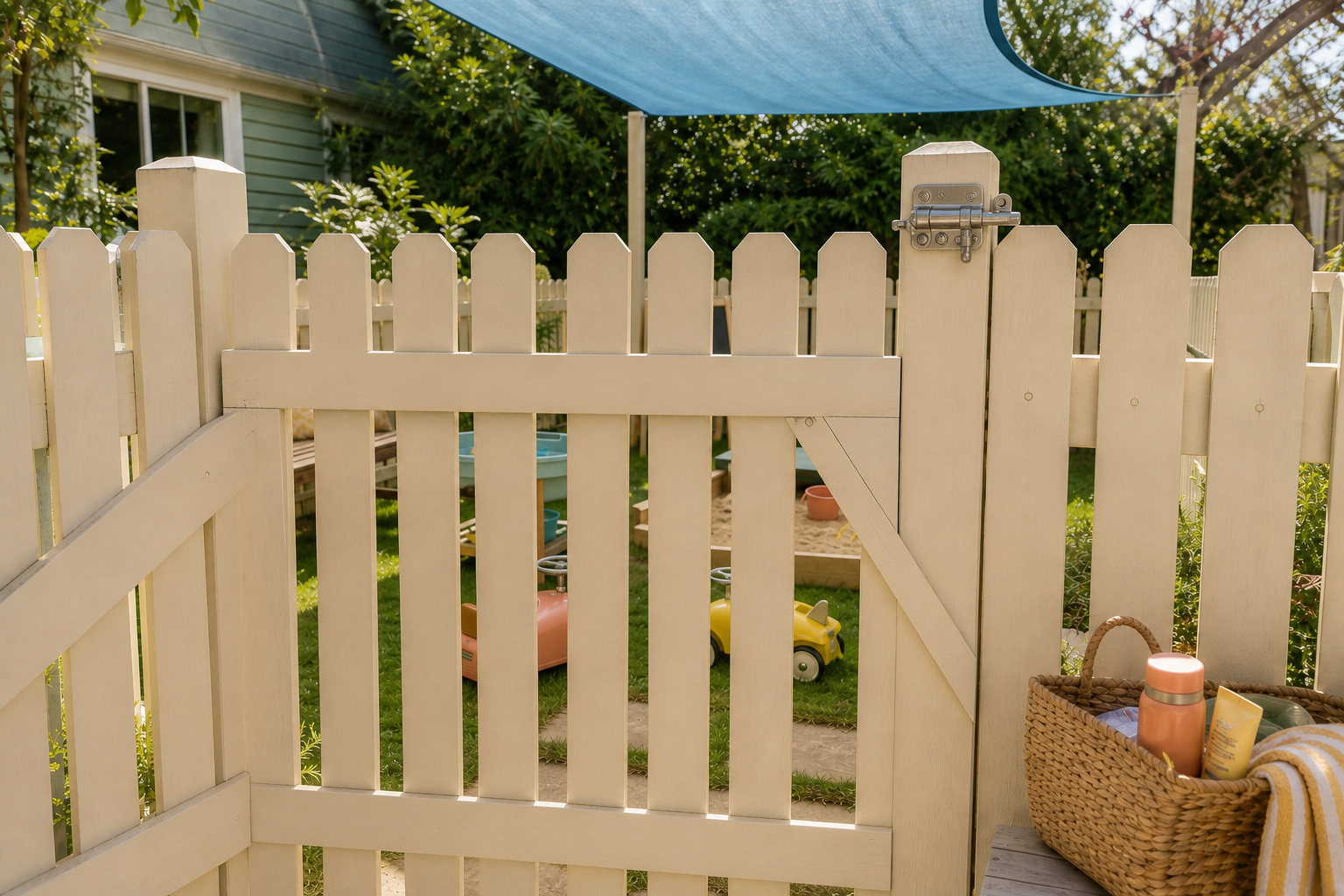
- Close and check the gate every time.
Use a child-resistant latch positioned out of reach. A gate reduces access; it does not replace an attentive adult. - Create one supervision seat.
Place it where you can see the entire zone. Bring your water, phone, sunscreen, and anything you need before the children go out. - Use simple repeatable play.
Chalk, bubbles, balls, digging, a ride-on toy, or watering plants require less setup than a new activity every day. - Treat all water as active-supervision territory.
Stay within reach around water tables, tubs, pools, ponds, or buckets. Empty water containers when play ends. - Have an indoor backup.
Bad weather does not need to destroy the day: hallway animal walks, music, couch-cushion stepping, or a short bath can fill the movement anchor.
A protection dog is not a toddler safety plan
A dog cannot supervise children, prevent wandering reliably, or replace locks, gates, alarms, and an adult. The AAP advises never leaving a young child alone with any animal—even a familiar, well-behaved family dog. Large or protection-trained dogs add training, management, cost, and bite risk to an already overloaded home.
If your family genuinely wants a pet, make that a separate decision with a veterinarian, pediatrician, and qualified trainer. Choose temperament and fit over intimidation, create dog-only and child-only zones, supervise every interaction, and never use the dog as childcare.
A designated playroom can reduce the size of the job
You do not need to make the entire house available all day. A gated family room or carefully childproofed playroom can create a predictable “yes space.” Anchor furniture, secure windows and cords, block stairs, remove choking hazards, and rotate a few toys instead of displaying everything.
An upstairs room requires extra caution. A gate is not enough if the child can climb it, access stairs, open windows, reach cords, or leave your hearing range. Match supervision to the youngest child’s abilities. A monitor can add information, but it does not replace checking and active supervision.
Ask for help by assigning ownership
“Let me know if you need anything” still leaves the mother doing the noticing, deciding, asking, and reminding. Turn vague help into recurring ownership.
- “You own bath and pajamas Monday through Thursday.”
- “Please take both children outside from 5:30 to 6:15 every weekday.”
- “You handle diapers, wipes, and grocery pickup before they run out.”
- “I need two protected hours Saturday morning. Please arrange the children’s breakfast and care.”
- “Can you be my call person when I feel close to shouting? I may need ten minutes of calm support.”
If there is another parent in the home, they are not “helping” with your job; they are parenting and maintaining their home. Divide full responsibilities, including planning and follow-through—not only the visible final task.
Real support may be closer than it looks
In the United States, eligibility varies, but these programs are worth checking:
When to get professional help
Talk with a primary-care clinician, OB-GYN, therapist, or your child’s pediatrician if exhaustion, rage, guilt, hopelessness, anxiety, sleep disruption, loss of pleasure, or difficulty functioning is persistent, worsening, or severe. Ask about medical causes, mental-health care, parenting programs, respite options, and developmental screening if your child’s behavior or communication concerns you.
If you feel you may hurt yourself or a child, place the child in a safe location, step away, and call another adult immediately. In the United States, call or text 988 for crisis support; call emergency services if there is immediate danger.
If you shouted, repair without removing the boundary
You can say: “I yelled. That was not okay, and I am sorry. The rule is still no hitting. I am going to say it again calmly.” Repair teaches accountability. It does not require pretending the behavior was acceptable or turning your apology into a long conversation the toddler must manage.
Reduce the mental load
Put the routine somewhere outside your head
The Mental Clarity Reset Workbook can help you gather open loops, decide what matters today, and assign realistic next actions—especially when every family task feels equally urgent.
Explore the Mental Clarity Reset WorkbookFrequently asked questions
What does stay-at-home mom burnout feel like?
It may include emotional and physical exhaustion, irritability, resentment, numbness, sensory overload, guilt, difficulty concentrating, feeling trapped, and losing pleasure in activities you usually enjoy. These symptoms can overlap with treatable health conditions, so persistent distress should not be dismissed.
Should a toddler nap for two or three hours?
Some do, but not every child needs that nap length. Focus on total sleep in 24 hours and the child’s age, behavior, and bedtime. A two-to-three-hour household quiet block may combine sleep and quiet play rather than forcing a long nap.
Is a five-minute bedtime book enough?
Yes. A short, repeatable connection can be valuable. On a depleted night, skip it, explain simply, and return to the routine tomorrow without guilt.
How do I stop yelling at my toddler?
Get close, gain attention, use one specific direction in a neutral tone, and follow through with a brief related consequence. Take a safe parent time-out when you feel escalation beginning, and arrange backup before you reach your limit.
Does calm parenting mean no consequences?
No. Calm parenting can include clear rules, immediate consequences, time-out when appropriate, and ending an activity. The difference is that the adult teaches and follows through without hitting, humiliating, threatening abandonment, or using fear as the main tool.
Keep reading
CDC: Tips for Relying on Routines and Rules
CDC: Steps for Giving Good Directions
CDC: Positive Parenting Tips for Toddlers
CDC: Sleep Recommendations by Age
American Academy of Pediatrics: Effective Discipline
American Academy of Pediatrics: Time-Outs
American Academy of Pediatrics: Choosing a Family Pet Safely
American Academy of Pediatrics: Brush, Book, Bed
Safety note: This article provides general education, not individualized medical, developmental, legal, or safety advice. Children differ in development and risk. Ask your pediatrician and follow product instructions, local regulations, and professional guidance for gates, sleep, pets, discipline, and supervision.
The Sunday Soft Reset
A calmer start to your week.
Get Lifvyt’s weekly collection of gentle wellness reads, nervous-system resets and practical tools — plus the free 5-Minute Nervous System Reset Guide.
By signing up, you’ll receive the free guide and one gentle Lifvyt email each week. Unsubscribe anytime.