
A Lifvyt reported herb feature · Body Wellness
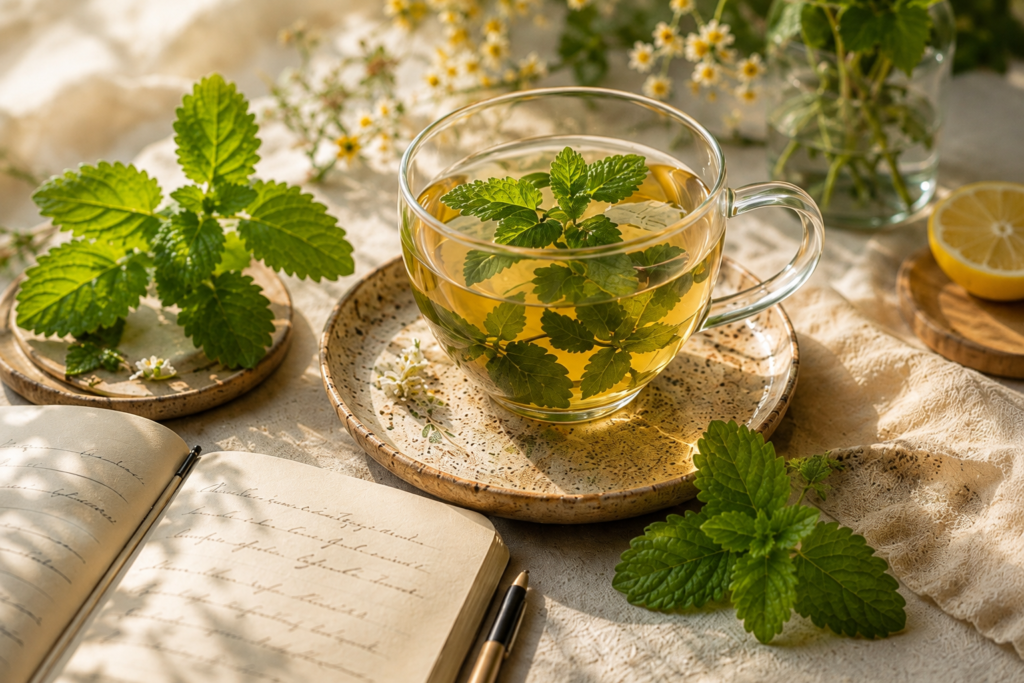
Lemon balm is what happens when a mint plant decides it would rather smell like a sunny kitchen.
Rub one soft green leaf between your fingers and the scent arrives before the science does: lemon peel, green garden, something almost sweet. It looks modest enough to disappear beside louder herbs, yet people across Europe, the Mediterranean and the Middle East have kept it close for centuries.
That old reputation is unusually specific. Lemon balm has been associated not only with rest and nervous tension, but also with a fluttery heart, a tight stomach, low spirits and the strange way stress can seem to move into several rooms of the body at once.
The modern research story is equally interesting because it refuses to stay inside one neat box. Researchers have tested lemon balm for laboratory stress, sleep, anxiety, palpitations, menstrual discomfort, depression, cognition and even aromatherapy during dialysis. Some findings are encouraging. Some are small. Some depend on a very specific extract. And that is exactly why the plant is worth understanding rather than simply calling it ‘calming.’
Say It With Confidence
Lemon balm LEM-un balm
Melissa officinalis approximately muh-LISS-uh oh-fiss-ih-NAL-iss
Rosmarinic acid rohz-muh-RIN-ik acid
Citral SIT-ral
Geranial juh-RAY-nee-ul
Neral NEER-ul
GABA GAB-uh
Carminative kar-MIN-uh-tiv
Botanical Latin varies across regions and traditions. This is an approachable English-language guide, not a pronunciation tribunal.
Meet Lemon Balm: A Bee-Loved Member of the Mint Family
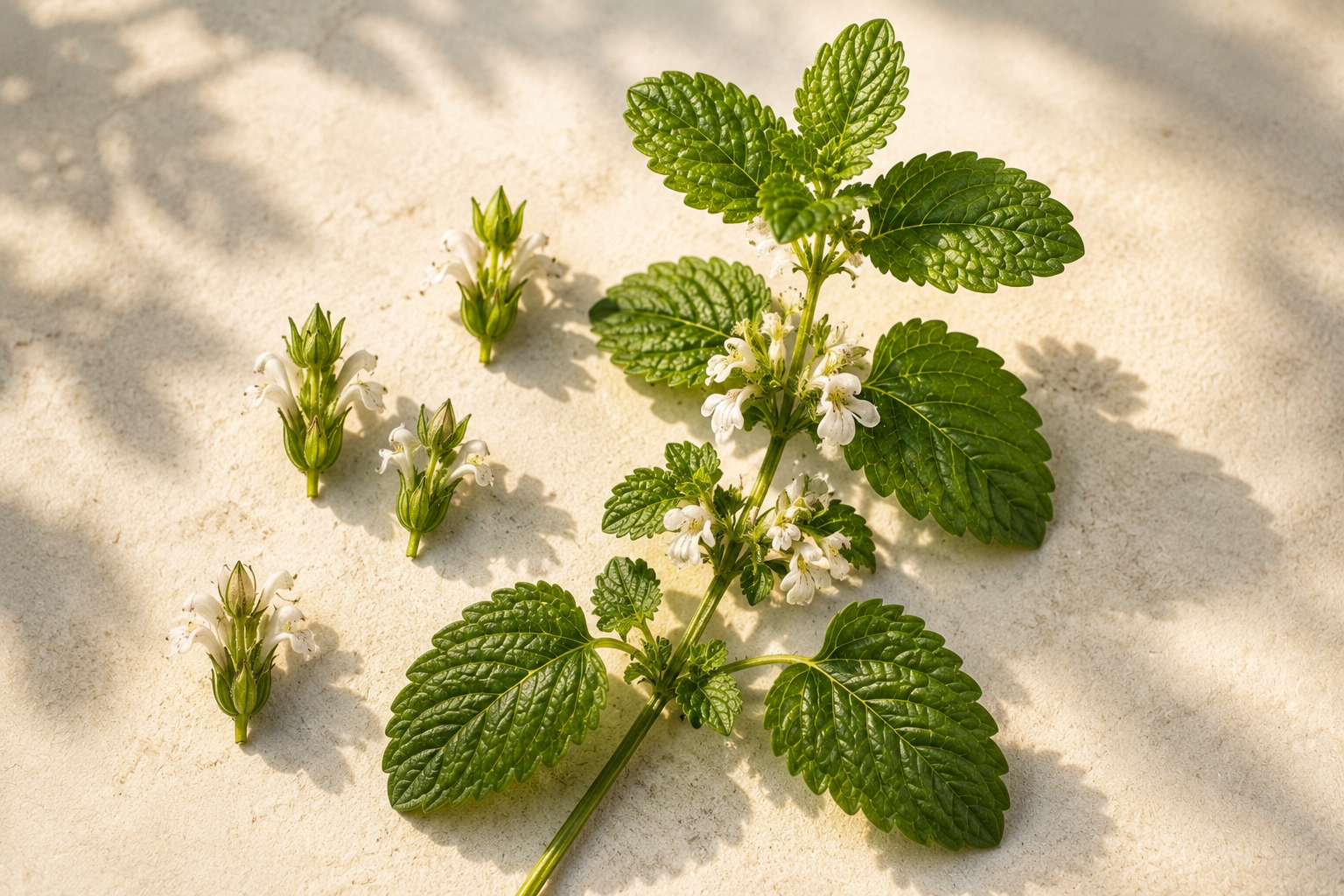
Melissa officinalis is a perennial in the mint family, Lamiaceae. Kew lists its native range from the Mediterranean into Central Asia, including parts of North Africa, Europe, Türkiye, Iran, Iraq and the Levant.1 It has since traveled widely enough that many gardeners now experience it mainly as the plant that politely arrives in one corner and then develops opinions about the rest of the yard.
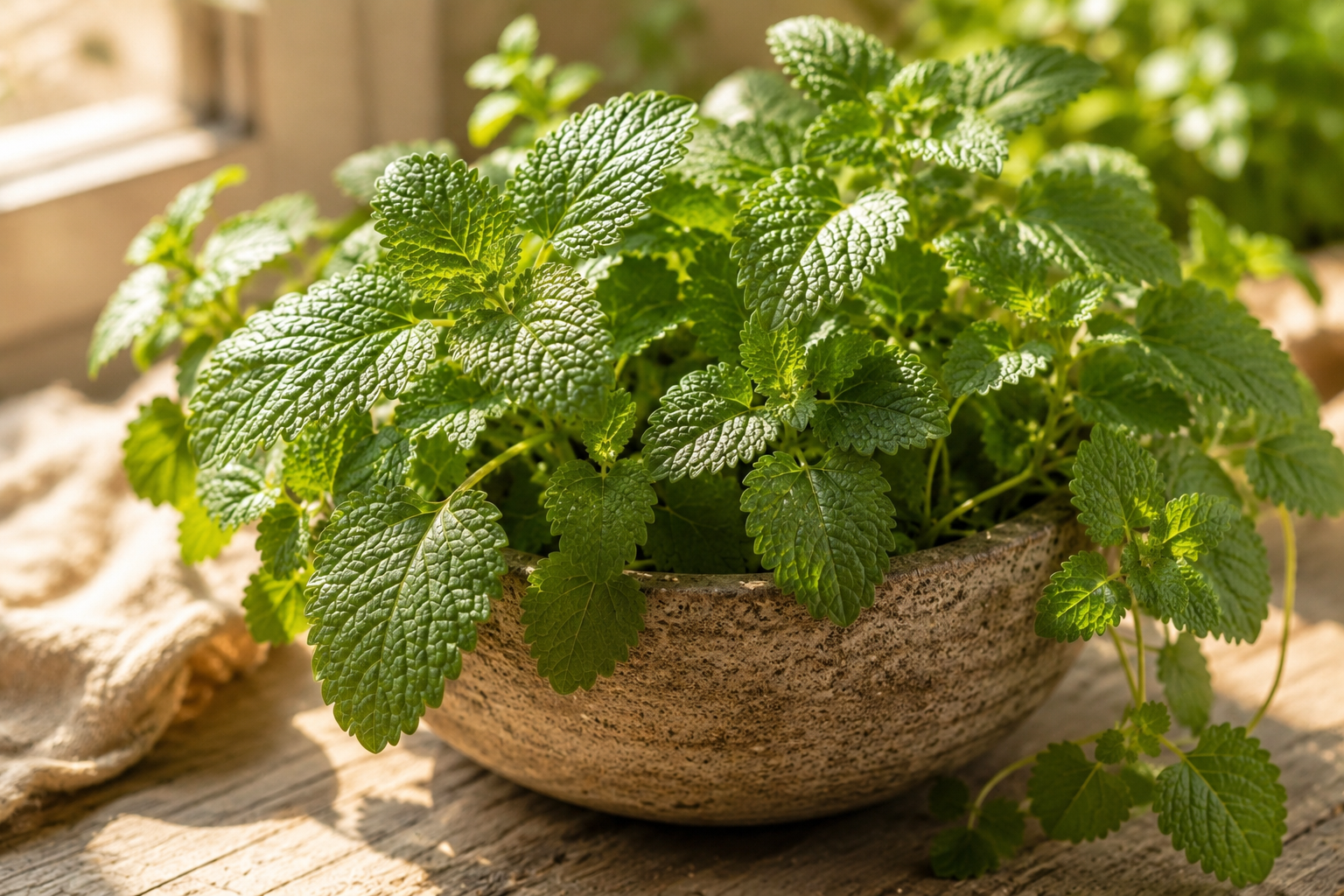
The leaf is the herbal star. Fresh leaves are culinary, aromatic and delicate. Dried leaves are used for tea. Tinctures and extracts concentrate different parts of the leaf chemistry. Essential oil captures a volatile fraction again. These forms share a plant name, but not an identical chemical experience.
What Herbalists Have Traditionally Said About Lemon Balm
In Western herbalism, lemon balm is often called both a nervine and a carminative. A nervine is traditionally chosen when the nervous system feels frayed, restless or unable to settle. A carminative is an aromatic digestive herb used when the abdomen feels gassy, tight or uncomfortable.
What makes lemon balm interesting is how often those two pictures overlap. Traditional practitioners did not necessarily imagine ‘stress’ as an emotion floating above the neck. They noticed the person whose worry came with a knotted stomach, fluttering chest, poor sleep or irritability. Lemon balm often lived in that intersection.
The traditional lemon balm picture
- Nervous tension and restlessness: used when someone feels keyed up, irritable, emotionally unsettled or simply unable to come down from the day.
- Sleep and evening settling: included in bedtime infusions and calming combinations rather than traditionally treated as a knockout herb.
- Digestive tension: used for mild gas, bloating and crampy discomfort, especially when the stomach seems to be participating in the stress response.
- Low or heavy mood: older European and Persian traditions often gave lemon balm an uplifting reputation alongside its calming one.
- Palpitations and a ‘nervous heart’: Traditional Iranian Medicine has a documented history of using Melissa officinalis around benign palpitations, a use modern Iranian researchers later put into a randomized trial.7
- Menstrual discomfort: its traditional antispasmodic reputation has also inspired modern Iranian studies of cramping and menstrual symptoms.
The European Medicines Agency recognizes melissa leaf on the basis of traditional use for relief of mild symptoms of mental stress, to aid sleep, and for mild digestive complaints including bloating and flatulence.2 That is not the same as saying a tea has been proven to treat an anxiety disorder or insomnia. It does tell us that this is a documented herbal tradition, not a wellness trend invented beside a ring light.
Inside Lemon Balm: The Compounds Behind the Scent and the Science
Lemon balm contains several chemical families: phenolic acids, flavonoids, triterpenes and aromatic volatile compounds. The balance depends on cultivar, climate, harvest, storage and extraction. A 2016 ethnopharmacology review identifies phenolic acids, flavonoids, triterpenoids and volatile compounds as important parts of the plant’s chemistry.3
Rosmarinic acid
Rosmarinic acid is a polyphenolic compound found in lemon balm and several other mint-family plants. Researchers often use it as a marker of lemon-balm extract quality. Laboratory work suggests it may influence GABA breakdown and antioxidant pathways. It is biologically interesting, but an isolated mechanism is not a promise that a cup of tea will behave like a standardized extract.
Citral
Citral is not one molecule but a fragrant pair: geranial and neral. Together they contribute much of the bright lemon character in the volatile oil. Their proportions are much more relevant to essential oil and aroma than to claims borrowed from oral leaf-extract trials.
Citronellal and terpenes
Citronellal and other terpenes contribute to the plant’s citrus-herbal aroma. Essential-oil chemistry can vary substantially, which is one reason true melissa oil is not equivalent to every bottle marketed with the words ‘lemon balm.’
Caffeic acid
Caffeic acid and related phenolic compounds are part of the leaf’s antioxidant chemistry. Laboratory antioxidant activity is useful for understanding the plant, but it does not mean tea ‘detoxes’ the body.
Luteolin and quercetin relatives
Lemon balm also contains flavonoids. Researchers study these plant compounds for multiple cellular effects, but human lemon-balm trials generally test whole extracts or leaf preparations rather than asking one flavonoid to take credit for everything.
No single magic molecule
A hot-water infusion, powdered leaf, alcoholic tincture, phospholipid-enhanced extract and essential oil all carry different chemistry. ‘Lemon balm’ is the beginning of the research question, not the end.
Why Researchers Keep Talking About GABA
GABA is one of the nervous system’s major inhibitory chemical messengers. In plain English, it is part of the brain’s braking system. Researchers have investigated whether compounds in lemon balm—especially rosmarinic acid-rich extracts—may slow the enzyme GABA transaminase, or GABA-T, which helps break GABA down.
That mechanism gives lemon balm’s old calming reputation a plausible scientific bridge. But bridges are not destinations. A laboratory effect on GABA-T does not tell us how sleepy, calm or less anxious a real person will feel. Modern trials have sometimes found calming effects, sometimes sleep effects, and sometimes neither—which is exactly why preparation and dose matter.1213
Lemon balm’s chemistry gives us a reason to investigate the traditional story. Human trials tell us whether that story survives contact with actual people.
Tea, Fresh Leaf, Tincture and Essential Oil: Different Versions of the Same Plant
Fresh leaf
Bright, tender and strongly aromatic when crushed. Fresh lemon balm is most at home in food, infused water and household tea. Its scent can fade quickly after harvesting.
Dried-leaf tea
Hot water extracts a mixture of water-soluble compounds plus some aromatic constituents. The EMA monograph includes herbal tea among traditional preparations, but direct large clinical trials of ordinary household tea are limited.
Tincture or liquid extract
Alcohol-and-water extraction changes which constituents are concentrated. Ratios and solvents matter, so one dropper bottle cannot automatically borrow the results of another extract.
Powdered leaf or capsule
Some Iranian trials have used measured amounts of powdered lemon-balm leaf. This is closer to whole dried plant material than a highly standardized extract, but dose and quality still matter.
Standardized extract
Several modern stress and sleep studies use extracts standardized or formulated to alter absorption. These are the preparations most likely to produce tidy milligram numbers—and the least appropriate to translate directly into ‘one cup of tea.’
Melissa essential oil
The volatile oil is intensely concentrated and chemically different from tea. Aromatherapy trials study inhalation as its own route. Do not treat essential oil as a stronger version of leaf infusion.
Around the World, Lemon Balm Research Keeps Changing the Question
The useful question is not ‘Does lemon balm calm you?’ It is: which preparation, at what dose, for which person, over what time, compared with what?
Small experiments, surprisingly specific dose effects
In 2002, researchers at Northumbria University studied 20 healthy young adults in a randomized, double-blind crossover experiment. Participants received single doses of 300, 600 or 900 mg of a standardized lemon-balm extract or placebo on different days. The results were not a simple ‘more herb, more calm’ story. The 600 mg dose improved accuracy of attention, the lowest dose increased calmness early on, and the highest dose reduced alertness while some memory measures worsened.4
Two years later, the same research group tested 18 healthy volunteers during a laboratory stress task. Single 300 mg and 600 mg doses were compared with placebo. The 600 mg dose increased self-rated calmness but also reduced alertness; the 300 mg dose improved speed on a mathematical-processing task without reducing accuracy.5
The ‘nervous heart’ became a clinical research question
Traditional Iranian Medicine has long associated lemon balm with palpitations. In a 2015 double-blind placebo-controlled trial, 71 adults with benign palpitations were recruited and 55 completed the study. Participants received 500 mg of a freeze-dried aqueous leaf extract twice daily for 14 days or placebo. The lemon-balm group reported fewer palpitation episodes and fewer participants met the study’s anxiety threshold after treatment.7
This is one of lemon balm’s most interesting studies because the research question came directly from a documented regional tradition. It does not mean lemon balm should be used to self-treat an unexplained irregular heartbeat. It means a traditional observation generated a testable modern hypothesis—and the small trial produced a signal worth investigating.
Stress and sleep in people with chronic stable angina
In 2018, an Iranian double-blind placebo-controlled study enrolled 80 people with chronic stable angina. The intervention group took 3 grams of lemon-balm supplement daily for eight weeks. Compared with placebo, scores for depression, anxiety, stress and sleep disturbance fell significantly in the lemon-balm group.8
The population matters. These were not healthy people casually having a stressful week; they had cardiovascular disease. The study therefore cannot tell us that 3 grams is the right dose for an otherwise healthy reader, but it adds another human signal to the calming/sleep story.
Menstrual pain and the body-wide stress picture
Iranian researchers have also studied lemon balm around menstruation. In one double-blind trial of 110 students with primary dysmenorrhea, 330 mg capsules were taken three times daily for three days beginning with menstruation. Pain fell in both groups, but the reduction was greater with lemon balm.10
Another randomized study followed 100 female adolescents with premenstrual syndrome over three menstrual cycles; participants took 600 mg twice daily. Anxiety/sleep disturbance, psychosomatic symptoms and social-function scores improved more in the lemon-balm group than placebo.9
A modern formulated extract—and much stronger-looking numbers
A 2023 double-blind placebo-controlled trial included 100 adults reporting moderate emotional distress or poor sleep. Participants took a phospholipid-carrier lemon-balm aqueous extract at 200 mg twice daily, for 400 mg per day, over three weeks. The extract group improved on depression, anxiety, stress, wellbeing, affect, sleep and quality-of-life scores compared with placebo.12
This trial is important, but so is the formulation. The product was designed specifically to improve delivery of lemon-balm compounds. It is not evidence that 400 mg of any random dried-leaf capsule will behave the same way, and certainly not proof that a cup of tea produces the same magnitude of effect.
Better sleep scores, but anxiety did not move
In 2024, Italian researchers enrolled 30 adults who reported unrefreshing sleep in a double-blind placebo-controlled crossover study. Participants used a standardized phospholipid-based lemon-balm preparation for two weeks and placebo for two weeks, separated by a washout. The lemon-balm phase produced a lower average Insomnia Severity Index score, and wearable-device data suggested more slow-wave sleep. Yet anxiety scores did not significantly change.13
That distinction is useful. A product can show a sleep signal without proving a broad anti-anxiety effect. The paper also disclosed that several authors had professional relationships with the company associated with the studied product. That does not invalidate the results, but it belongs in the context when a trial is small and product-specific.
Essential oil entered the dialysis ward
A 2025 Iranian study investigated inhaled lemon-balm essential oil in 68 people receiving hemodialysis. Aromatherapy was given during dialysis three times a week for one month; the comparison group inhaled refined sweet-almond oil. The investigators reported differences after treatment in state and trait anxiety and several dialysis-related symptoms, including trouble staying asleep.14
The route here is everything. This was inhaled essential oil during a highly structured clinical procedure, not tea and not an oral extract. The study also allocated odd and even dialysis days to different conditions to reduce scent contamination, which is practical but different from a classic individually randomized drug trial.
Research that asks what people are actually doing
An ethnopharmacological survey in northwestern Tunisia documented local use of Melissa officinalis particularly for digestive and nervous-system concerns, with decoction, infusion and maceration among the preparation methods reported.15
This is not proof that the preparations outperform placebo. It answers a different question: whether lemon balm still belongs to living regional practice. Kew’s botanical distribution also places the species’ native range across North Africa and the Mediterranean, including Tunisia, Algeria and Morocco.1
What Do the Bigger Reviews Say?
A 2021 systematic review and meta-analysis pooled randomized clinical trials involving anxiety and depression. Lemon balm favored placebo on both anxiety and depression scores, but the authors emphasized substantial heterogeneity, a small number of trials and major differences in study methods.6
That is important because a pooled number can look more certain than the studies underneath it. If one trial uses a short-term extract in healthy volunteers, another uses powdered leaf in cardiac patients, and another tests a specialized delivery system, ‘lemon balm’ becomes a very wide umbrella.
The responsible takeaway is not ‘the meta-analysis proves it.’ It is that the human literature contains a repeated signal around mood, stress and sleep—strong enough to deserve attention, but not standardized enough to promise that every preparation will reproduce it.
A Brief Detour Into Memory and Cognition
Lemon balm also has an older reputation around memory. In a 2003 Iranian trial, 42 adults aged 65 to 80 with mild-to-moderate Alzheimer’s disease were randomized to placebo or a fixed lemon-balm extract dose of 60 drops per day for four months. The lemon-balm group had better outcomes on cognitive and clinical dementia scales than placebo.16
The study is intriguing and historically important, but it is small, more than two decades old and not enough to position lemon balm as a treatment for dementia. It does, however, show why the plant’s cognitive story did not appear out of nowhere.
What Research Suggests, Benefit by Benefit
Stress and anxious feelings
Small UK acute-stress studies, Iranian clinical trials and the 2021 meta-analysis point toward a calming signal. Different products, populations and outcomes make the exact size of benefit uncertain.
Sleep quality
Several modern extracts have improved subjective sleep measures, including 2023 and 2024 trials. Ordinary tea has not been tested with the same precision, and one 2024 trial improved sleep without changing anxiety.
Digestive tension
European traditional use strongly includes bloating and flatulence. Mechanistic antispasmodic work supports plausibility, but the modern human literature is much thinner than for mood and sleep.
Benign palpitations
A 14-day Iranian randomized trial found fewer episodes with a specific aqueous leaf extract. Unexplained palpitations still require medical evaluation because an herb cannot tell you whether the cause is benign.
Menstrual discomfort
Iranian trials have reported reductions in dysmenorrhea pain and some premenstrual psychological symptoms. These studies are useful but not yet a large international evidence base.
Memory and cognition
Acute healthy-volunteer experiments produced dose-dependent cognitive effects, and a small Alzheimer’s trial reported benefit. That is not enough to claim lemon balm prevents cognitive decline or treats dementia.
What You Might Reasonably Expect
From a food-grade cup of tea: a bright lemony aroma, warmth, a quiet sensory cue and perhaps a gentle feeling of settling or digestive comfort. Clinical trials cannot assign a precise response rate to your mug.
From a standardized oral extract: some human studies suggest changes in stress, mood or sleep over hours to several weeks, but the result depends heavily on the extract and population.
From inhaled melissa oil: aromatherapy studies suggest a possible anxiety signal in particular clinical settings, but the evidence belongs to inhalation and not to swallowing essential oil.
What not to expect: a guaranteed sedative effect, a cure for anxiety or depression, a replacement for evaluation of palpitations, or the exact result of one proprietary-product trial from a different lemon-balm preparation.
Lemon Balm Tea: How to Keep the Ritual Simple
For an ordinary food-grade infusion, follow the directions on a reputable lemon-balm tea. If using loose dried leaf, many culinary-herbal preparations use roughly one to two teaspoons per mug, steeped covered in hot water for several minutes. Covering the cup helps hold onto the aroma rather than letting the volatile compounds take a small vacation into the kitchen.
Fresh leaves can also be infused. Because lemon balm’s scent is delicate, old or badly stored dried leaf can become disappointingly flat. Aroma is not a perfect potency test, but if the herb no longer smells remotely lemony, it has lost part of the experience that made it lemon balm in the first place.
This is ordinary tea guidance, not individualized medicinal dosing. Regular concentrated use is a different decision from occasionally drinking a food-grade infusion.
What I Would Not Tell You About Lemon Balm
I would not tell you lemon balm ‘boosts GABA’ in a predictable amount, cures anxiety, repairs the nervous system, balances hormones, prevents dementia or means you can ignore a fluttering heartbeat because someone on the internet called it a ‘nervous heart.’
I would not take the impressive-looking results of a specialized phospholipid extract and paste them onto a teabag. I would not turn a 30-person sleep study into a universal insomnia treatment. I would not let a cell-culture antioxidant experiment become a detox claim.
But I also would not shrug and say lemon balm is only a nice-smelling tea. Its traditional record stretches across Europe, the Mediterranean and the Middle East; its chemistry is biologically active; and human trials repeatedly return to some of the same old themes—calm, sleep, tension, the stomach, and the heart’s relationship with distress.
The grown-up version of herbalism is not less interesting. It is simply more specific.
A Lemon Balm Ritual for the Part of the Day That Has Had Enough

Make the cup because the day was loud.
Crush a fresh leaf if you have one and smell it before it touches the water. Cover the tea. Let it steep while you do absolutely nothing productive for several minutes. No wellness spreadsheet. No score for how calm you became. No requirement to emerge as a better woman by the bottom of the mug.
Then sit somewhere that is not your work chair. Warm your hands. Notice the lemon scent. If the ritual helps you mark the end of the demanding part of the day, that is already a useful thing.
Sometimes a plant does not need to carry every hope we have for it. Sometimes it can simply help us remember that the day is allowed to end.
Before You Use Lemon Balm: Practical Safety
- Pregnancy and breastfeeding: the EMA monograph notes that safety has not been established and does not recommend medicinal use in the absence of sufficient data.2
- Children: medicinal use in children under 12 has not been established in the EMA monograph. Age-appropriate use should be discussed with an appropriate clinician.
- Medication and health conditions: concentrated extracts may have pharmacologic effects. Ask a pharmacist or clinician before medicinal use alongside sedatives, psychiatric medicines, thyroid treatment or other regular medication, or when you have a significant medical condition.
- Drowsiness: some preparations or doses may reduce alertness. Learn how a product affects you before driving or doing anything requiring full attention.
- Essential oil: true melissa oil is concentrated. Do not swallow aromatherapy oil simply because lemon-balm leaf is used as tea. Use by the intended route and dilution.
- Allergy: stop use and seek appropriate care for rash, swelling, wheezing or other signs of an allergic reaction.
- Palpitations: new, persistent or severe palpitations—especially with chest pain, fainting, severe shortness of breath or neurologic symptoms—need medical evaluation rather than herbal self-treatment.
- Persistent anxiety, depression or insomnia: herbs can be part of supportive self-care, but symptoms that are severe, worsening, prolonged or affecting safety deserve professional assessment.
Sources & Further Reading
- Royal Botanic Gardens, Kew: Melissa officinalis L., Plants of the World Online.
- European Medicines Agency: Melissae folium / Melissa leaf herbal monograph and assessment materials.
- Shakeri A, Sahebkar A, Javadi B. Melissa officinalis L.—A review of its traditional uses, phytochemistry and pharmacology. Journal of Ethnopharmacology. 2016.
- Kennedy DO, et al. Modulation of mood and cognitive performance following acute administration of Melissa officinalis. 2002.
- Kennedy DO, Little W, Scholey AB. Attenuation of laboratory-induced stress in humans after acute administration of lemon balm. Psychosomatic Medicine. 2004.
- Ghazizadeh J, et al. The effects of lemon balm on depression and anxiety in clinical trials: systematic review and meta-analysis. 2021.
- Alijaniha F, et al. Heart palpitation relief with Melissa officinalis leaf extract: randomized placebo-controlled trial. Journal of Ethnopharmacology. 2015.
- Haybar H, et al. Lemon-balm supplementation and depression, anxiety, stress and sleep disturbance in chronic stable angina. 2018.
- Heydari N, et al. Effect of Melissa officinalis capsule on mental health of female adolescents with premenstrual syndrome. 2018.
- Mirabi P, et al. Effect of Melissa officinalis on severity of primary dysmenorrhea. Iranian Journal of Pharmaceutical Research. 2017.
- Araj-Khodaei M, et al. Randomized pilot comparison of lemon balm, lavender and fluoxetine for mild-to-moderate depression. 2020. The study did not include a placebo group.
- Bano A, et al. Standardized phospholipid-carrier lemon-balm extract in adults with emotional distress and poor sleep: randomized placebo-controlled trial. 2023.
- Di Pierro F, et al. Effects of a Melissa officinalis Phytosome on sleep quality: double-blind placebo-controlled crossover study. 2024.
- Pasyar N, et al. Lemon-balm essential-oil inhalation and anxiety/symptom burden during hemodialysis. BMC Complementary Medicine and Therapies. 2025.
- Ethnopharmacological survey of Melissa officinalis in northwestern Tunisia.
- Akhondzadeh S, et al. Melissa officinalis extract in mild-to-moderate Alzheimer’s disease: double-blind randomized placebo-controlled trial. 2003.
This Lifvyt article is provided for general educational and informational purposes only. It is not medical advice, diagnosis, treatment or prescribing and does not establish a clinician–patient relationship. Traditional herbal uses described here are historical, cultural or practice-based information—not promises that lemon balm will diagnose, treat, cure or prevent disease.
Herbs, teas, tinctures, extracts, supplements, essential oils and topical preparations can cause side effects, allergic reactions and medication interactions. Plant identity, product purity, concentration, extraction method, formulation and individual response vary. Before medicinal internal use—especially during pregnancy or breastfeeding, for a child, before surgery, alongside prescription or over-the-counter medication, or when you have a medical condition—consult an appropriately qualified physician, pharmacist or healthcare professional.
Essential oils require particular caution. Essential oil is not interchangeable with tea or culinary leaf. Do not ingest or otherwise use one by a route not intended on the specific product label.
You are responsible for your own purchasing, preparation and personal-use decisions. Lifvyt cannot assess your allergies, diagnoses, medications, product quality, dose or individual risk. Seek appropriate medical care for severe, persistent, worsening, unusual or emergency symptoms rather than relying on an herbal remedy or this website.
The Sunday Soft Reset
A calmer start to your week.
Get Lifvyt’s weekly collection of gentle wellness reads, nervous-system resets and practical tools — plus the free 5-Minute Nervous System Reset Guide.
By signing up, you’ll receive the free guide and one gentle Lifvyt email each week. Unsubscribe anytime.