
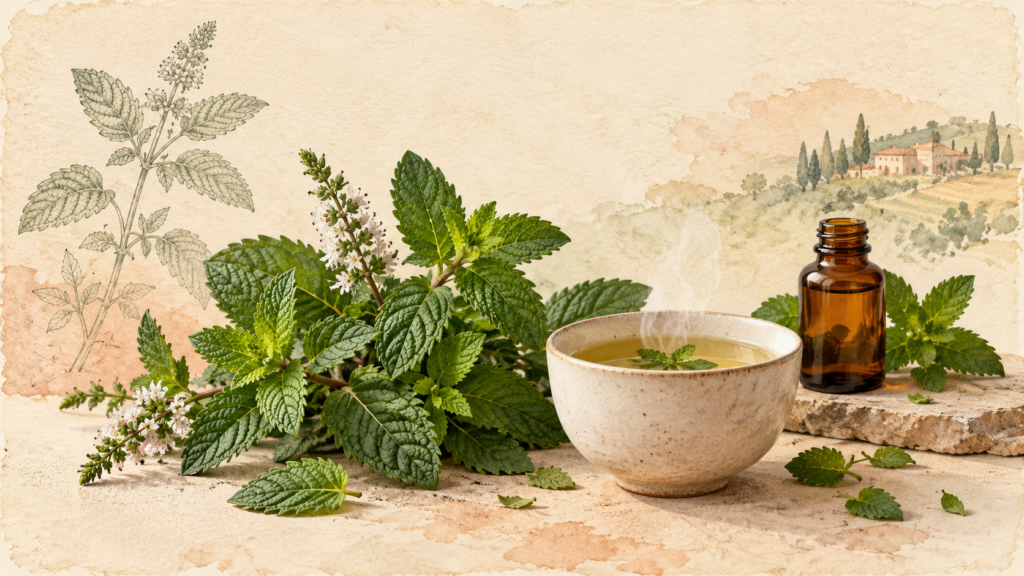
A Lifvyt reported herb feature
Peppermint is not a quiet herb. Crush one leaf and it announces itself immediately—cool, bright, sharp enough to feel as though the air changed.
It also has the confidence of a plant that already knows it is in your toothpaste, your tea drawer and at least one lonely candy at the bottom of a handbag.
That familiarity makes peppermint easy to underestimate. We say “mint” as though we are discussing one simple thing. But the peppermint in a covered cup of tea is not chemically identical to the concentrated oil sealed inside an enteric-coated capsule. The oil rubbed on a forehead is not the same intervention as an aroma inhaled during chemotherapy. And the mint poured from a silver teapot in Morocco may be a different Mentha species altogether.
To understand peppermint benefits honestly, we have to follow the plant through kitchens, herbal traditions, chemistry laboratories and clinical studies—and keep asking one quietly important question: which peppermint preparation are we actually talking about?
The useful question is not simply, “Does peppermint work?” It is: “Which preparation, for which problem, in which person—and what did the study actually test?”
Say It With Confidence
Peppermint PEP-er-mint
Mentha × piperita approximately MEN-thuh pie-PAIR-ih-tuh
Menthol MEN-thawl
Menthone MEN-thohn
Menthyl acetate MEN-thil ASS-uh-tate
Rosmarinic acid rohz-muh-RIN-ik acid
Eriocitrin air-ee-oh-SIT-rin
Carminative kar-MIN-uh-tiv
Botanical Latin is pronounced differently across languages and traditions. This is an approachable English-language guide, not a pronunciation courtroom.
Meet Peppermint: A Botanical Love Story
The small multiplication sign in Mentha × piperita is not decorative. It tells us peppermint is a hybrid: a botanical meeting of watermint, Mentha aquatica, and spearmint, Mentha spicata. Kew lists its native range from Europe into Central Asia, although it is now cultivated much more widely.1
That parentage helps explain peppermint’s character. It carries the familiar sweetness of mint, but with a colder, more penetrating aromatic force. The plant spreads enthusiastically by underground stems. Gardeners often learn that peppermint does not merely join a garden; it begins making long-term plans for it.
The leaves are the part most familiar in tea and food. Peppermint essential oil is generally steam-distilled from the fresh above-ground parts of the flowering plant. European regulators assess the leaf and the oil separately because they are not the same medicine in different-sized outfits.23

What Herbalists Have Traditionally Said About Peppermint
Long before researchers measured receptors or randomized capsules, herbalists paid attention to patterns: what a plant tasted like, how it felt in the mouth, what kind of discomfort it seemed to suit and when it made a person feel worse.
In Western herbalism, peppermint is commonly described as an aromatic carminative. That phrase sounds fancier than the experience. It means a fragrant herb traditionally used when digestion feels full, gassy, stagnant or tense. The scent is not incidental; the volatile aromatic compounds are part of the preparation.
The traditional peppermint picture
- After-meal heaviness: a leaf infusion has traditionally been taken when food seems to sit heavily or the abdomen feels uncomfortably full.
- Gas and bloating: herbalists have used peppermint when pressure and trapped wind are part of the digestive picture.
- Crampy, gripping discomfort: peppermint is especially associated with tension that feels spasmodic—tightening, gripping or coming in waves.
- Nausea and queasiness: peppermint’s taste and aroma have long been used around unsettled stomachs, although modern research shows that the cause of nausea and the route of use make an enormous difference.
- Head tension: diluted topical preparations have a European history of use for mild tension-type headache.
- Cold-season aromatic use: the cooling sensation of menthol-rich preparations has made mint popular in chest rubs, lozenges and inhaled products.
- Heat, irritability and mental fog: some herbal traditions experience peppermint as cooling yet mentally brightening—a curious combination that makes more sense once we meet menthol.
Traditional herbalism also makes a distinction that an ordinary list of “benefits” often misses: a crampy belly is not the same as a burning belly. Peppermint may fit the first picture better than the second. A person whose main complaint is reflux may discover that relaxing digestive smooth muscle is not the gift they were hoping for.
The European Medicines Agency recognizes peppermint leaf as a traditional herbal medicine for digestive complaints such as indigestion and flatulence. It recognizes certain peppermint-oil medicines more strongly for minor intestinal spasms, flatulence and abdominal pain, especially in irritable bowel syndrome.23
This is where tradition and modern physiology begin to nod at one another across the table—but they are still not the same kind of evidence.
Inside the Leaf: Peppermint Chemistry Without the Lab Coat
Peppermint does not contain one magical “active ingredient.” It contains families of naturally occurring compounds. Some are volatile, meaning they readily lift into the air and reach your nose. Others remain more quietly in the leaf or extract. Their proportions change with the plant variety, climate, harvest time, storage and extraction method.45
Menthol
Menthol is a major contributor to peppermint’s cool taste and smell. It activates cold-sensing channels in nerves, especially a channel called TRPM8. The tissue does not have to become colder for the brain to receive a convincing “cool” message.
Menthone
Menthone helps create peppermint’s penetrating aroma. It belongs to the volatile-oil portion of the plant and is chemically related to menthol, but it has far less direct human outcome research of its own.
Menthyl acetate
Menthyl acetate contributes a sweeter, rounder fragrance. It is part of the aromatic supporting cast—not a compound we should crown with clinical benefits it has not earned.
Rosmarinic acid
This phenolic compound appears in peppermint and several other mint-family plants. It shows antioxidant and inflammatory-pathway activity in laboratory work. That makes it scientifically interesting; it does not turn peppermint tea into a treatment for inflammatory disease.
Eriocitrin
Eriocitrin is one of peppermint leaf’s notable flavonoids. Plants use flavonoids in their own defense and stress responses. Researchers study them for antioxidant effects, but direct human evidence for isolated eriocitrin from ordinary peppermint tea is limited.
Why the blend matters
An essential oil, a hot-water infusion and an alcohol extract capture different chemical proportions. “Peppermint” on a label tells us the plant. It does not yet tell us the chemistry delivered to the body.
Why Peppermint Feels Cold—and Why the Gut May Unclench
Menthol rings the body’s cold doorbell.
The technical name on the doorbell is TRPM8, a protein channel on sensory nerves. Cool temperatures can activate it, and menthol can activate it too. Your brain receives a cooling message even when the actual temperature has barely moved. This is why peppermint can feel wonderfully fresh in a hot mouth and slightly theatrical in toothpaste. The toothpaste is not creating winter. Your nerves are reporting one.
In digestive tissue, peppermint oil and menthol have also been studied for effects on calcium movement. Smooth muscles use calcium signals as part of contraction. Interfering with those signals may help certain intestinal muscles relax, which offers a plausible explanation for peppermint’s antispasmodic tradition and its use in IBS research.36
That same relaxing tendency helps explain the plot twist: if peppermint relaxes the lower esophageal sphincter in a susceptible person, stomach contents may travel upward more easily and heartburn can worsen. Plants are rarely “good” or “bad” in a vacuum. Their actions meet the situation already present in the body.
The important bridge: a plausible mechanism tells us why a traditional observation may make biological sense. It does not tell us how many real people will feel better, how large the change will be or whether tea behaves like a capsule. For that, we need human studies.
Tea, Oil and Capsules: The Same Plant With Different Passports
Leaf infusion
Hot water draws aromatic and water-soluble compounds from fresh or dried food-grade leaves. Tea is variable, usually gentle and closely tied to culinary and traditional use. Direct clinical research on peppermint tea itself is sparse.4
Tincture or liquid extract
Alcohol-and-water extraction can capture a different spectrum of constituents and in a different concentration. Products vary in plant-to-liquid ratio and chemical profile, so “one dropper” is not a universal scientific unit.
Enteric-coated oil capsule
This is the form used in much of the IBS research. The coating is designed to delay release until farther down the digestive tract, rather than opening immediately in the stomach. It is not equivalent to swallowing loose essential oil.
Specific topical preparation
European headache evidence concerns a particular preparation containing peppermint oil in ethanol applied to the forehead and temples—not every homemade dilution and not oral use.3
Aromatic inhalation
Researchers have explored peppermint aroma for nausea in pregnancy and cancer care. Results differ by study and clinical situation. Smelling an oil and swallowing an extract are different interventions.
Combination product
Some indigestion studies used peppermint oil together with caraway oil. When two plants enter a trial together, peppermint cannot take all the applause on the way out.18
Around the World, Researchers Asked Different Questions
Scientific research does not happen in one neutral room called “the evidence.” Researchers in different countries have studied different preparations, symptoms, populations and cultural uses. Put those studies beside one another and peppermint begins to look less like a verdict and more like a travel story.
Europe: Can a Traditional Plant Become a Standardized Medicine?
Europe has given peppermint one of its most formal modern roles. The EMA separates peppermint leaf from steam-distilled peppermint oil, distinguishes traditional use from well-established use and ties conclusions to specific routes and preparations.23
A 2019 meta-analysis brought together 12 randomized trials involving 835 adults with IBS from several regions. In the pooled data, enteric-coated peppermint oil performed better than placebo for overall symptoms and abdominal pain. The authors calculated that roughly three people would need treatment for one additional person to experience global symptom improvement, and roughly four for one additional person to improve in abdominal pain.7
Those are meaningful-looking numbers. They are also not the end of the story. Six of the 12 trials had high risk of attrition bias, many did not clearly report how randomization was handled, and formulations and definitions of improvement varied.
A 2022 review of 10 randomized trials with 1,030 participants again found peppermint oil better than placebo for overall IBS symptoms and abdominal pain, but side effects were more common and the authors rated the certainty of the evidence very low.8
The signal: pooled trials generally lean toward short-term benefit for some adults with IBS.
The lesson: “better than placebo on average” is not the same as “works reliably for everyone,” and the product’s coating, dose and release location matter.
The Netherlands and the United States: What Happens When the Placebo Also Improves?
Large pooled reviews can look impressive, but newer individual trials have made the story more interesting.
In a Dutch randomized trial, researchers compared placebo with peppermint oil designed to release either in the small intestine or later in the ileocolonic region. The primary outcomes were not met. The small-intestinal-release product did improve some secondary measures, including abdominal pain, discomfort and IBS severity, while the later-release version did not deliver the hoped-for advantage.10
Then a 2021 U.S. trial gave adults with moderate-to-severe IBS either 180 mg of enteric-coated peppermint oil three times daily or placebo for six weeks. Both groups improved substantially. Peppermint oil did not outperform placebo on the primary or secondary outcomes.9
That does not prove IBS is imaginary, and it does not erase every earlier positive trial. Gut symptoms naturally fluctuate and are influenced by attention, expectation, food, stress, sleep and the nervous system. A strong placebo response is not a moral failure by the participant or a prank played by science. It is information about how responsive the gut–brain system can be.
This is also why one negative trial should not cancel a meta-analysis—and one positive meta-analysis should not silence a rigorous negative trial. Good reporting keeps both in the room.
Japan: A High Improvement Rate—and One Missing Comparison Group
In 2024, Japanese investigators reported a multicenter study of an enteric-coated peppermint-oil capsule in people with IBS. Sixty-nine participants received 187 mg before meals three times a day for four weeks. Among those assessed, 71.6% reported global improvement at week two and 85.1% at week four. Abdominal pain, distension, rumbling, flatulence, urgency and several other symptoms decreased from baseline.11
Those results sound joyful—and for participants who felt better, they may have been. But the trial was open-label and had no placebo group. Everyone knew they were receiving peppermint oil. Without a comparison group, the study cannot separate the product’s effect from expectation, natural symptom changes, study attention or other influences. The authors explicitly advised careful interpretation.
The Japanese study tells us the preparation was usable in that population and that improvement was commonly reported. It does not tell us how much more improvement occurred than would have happened with a placebo or with time.
Iran and Turkey: Nausea Turns Out to Be Several Different Stories
People often speak of nausea as one symptom with one switch. Research does not support that simplicity. Pregnancy-related nausea, chemotherapy-related nausea, postoperative nausea and motion sickness arise in different biological and emotional settings.
In an Iranian randomized placebo-controlled trial, 56 pregnant women with mild-to-moderate nausea and vomiting used inhaled peppermint oil or placebo for four days. Symptoms improved in both groups, but peppermint did not produce a statistically significant advantage over placebo.12
Another Iranian trial studied oral peppermint extract as an addition to usual care in 84 people with breast cancer receiving chemotherapy. The peppermint group reported lower nausea, vomiting and loss of appetite at the measured time points than the control group. It was a modest, short study, but it offered a reason for further investigation.13
In Turkey, an open-label, quasi-randomized pilot study added a peppermint aromatic application to routine anti-nausea medicines after chemotherapy. Nausea and related symptoms improved for several chemotherapy regimens, but not for cisplatin. Because participants knew what they received and assignment was not fully randomized, the study is better treated as a useful signal than a final answer.14
The pattern is more informative than a slogan: peppermint aroma did not beat placebo in one pregnancy trial; an oral extract looked encouraging in one Iranian cancer study; and an aromatic preparation appeared helpful alongside standard antiemetics for some—but not all—chemotherapy regimens in Turkey.
“Peppermint helps nausea” is therefore too broad. Which nausea, which route, which preparation and what other care was being used? That is the honest question.
Morocco: Research That Begins by Listening
Not all valuable research begins with a capsule and a placebo. Ethnobotanical work asks communities which plants they actually use, which parts they prepare and what knowledge has survived in homes, markets and local practice.
In a survey in Morocco’s Taounate region, peppermint was frequently cited for digestive concerns. Across the documented medicinal-plant practices, leaves, oral preparations, tea and decoction were prominent. This does not prove clinical effectiveness. It documents something different: peppermint and related mints remain part of living digestive culture, not merely an idea revived by modern wellness marketing.15
A broader review of Moroccan Mentha species found a rich patchwork of regional uses and chemistry—but also a taxonomic warning. Moroccan “mint tea” is not automatically Mentha × piperita. Spearmint and other mint species are deeply important, and their chemistry cannot be silently reassigned to peppermint.16
What ethnobotany can tell us: what people value, how a plant is prepared, which symptoms are culturally associated with it and whether a practice is genuinely longstanding.
What it cannot tell us by itself: how much better the preparation works than a comparison treatment, how often it causes harm or whether the same result would appear in a different population.
China and East Asia: Sometimes the First Research Question Is the Plant’s Name
Traditional Chinese materia medica includes Bo He, a cooling aromatic mint used in patterns involving the head, throat and what Chinese medicine describes as wind-heat. But Bo He is commonly identified as Chinese mint or field mint—often Mentha canadensis or the closely related name Mentha haplocalyx—not necessarily the European peppermint hybrid Mentha × piperita.17
This is not pedantry. Related mints can overlap in aroma and chemistry while differing in proportions, preparation and traditional theory. “Used in Asia for centuries” is not a coupon that lets any mint species claim every Asian tradition.
That taxonomic honesty actually makes the global story richer. It shows that humans in many regions noticed the cooling, aromatic character of mints—but developed distinct plants, preparations and explanatory systems around them.

The Bigger Argument: What Should Count as Evidence?
Herbal conversations often become a tug-of-war. One side says, “People have used it for centuries, so it works.” The other says, “There is no perfect clinical trial, so it is meaningless.” Neither position gives us the whole plant.
What did people observe?
Shows how communities selected, prepared and understood a plant over time. It can reveal patterns worth preserving and studying.
What can the compounds do?
Can reveal receptor activity, smooth-muscle effects, antioxidant chemistry or antimicrobial activity under controlled conditions.
Did people actually feel or function better?
Randomized trials can compare outcomes, but their answer belongs to the product, population, dose and duration actually tested.
What happens outside a perfect trial?
Open studies and observational work can reveal usability and patterns, but they are more vulnerable to expectation, selection and confounding.
The strongest peppermint argument is not that all evidence types are equal. They are not. It is that they answer different questions.
A Moroccan survey can tell us that digestive mint use is alive in households. A receptor experiment can help explain the cooling sensation. A randomized IBS trial can estimate whether a particular capsule beats placebo. One should not impersonate another.
Once we stop demanding that every piece of evidence do every job, the conversation becomes calmer—and much more intelligent.
What Research Suggests, Benefit by Benefit
Irritable Bowel Syndrome and Spasmodic Abdominal Pain
Best-studied use
Among peppermint uses, the clearest human research signal belongs to enteric-coated peppermint oil for short-term IBS symptom relief in adults. Multiple pooled reviews favor peppermint oil over placebo, particularly for overall symptoms and abdominal pain. However, study quality varies, side effects such as reflux occur, and at least two rigorous modern trials failed to meet their primary endpoints.78910
What that means in human language: some adults with diagnosed IBS may experience a noticeable short-term reduction in cramping, pain or overall symptom burden from a properly formulated product. It is not a dependable cure, does not identify the cause of undiagnosed abdominal pain and does not mean a cup of tea produces the same effect.
Gas, Bloating and After-Meal Discomfort
Tradition + indirect clinical support
Peppermint leaf has longstanding traditional use for indigestion and flatulence. IBS capsule trials often include bloating and discomfort among measured symptoms, which supports the plausibility of the digestive tradition, but direct modern trials of ordinary peppermint tea are scarce.24
For functional indigestion, some positive research concerns a proprietary peppermint-oil-and-caraway-oil combination. That evidence belongs to the combination, not peppermint alone.18
Nausea
Mixed and context-specific
Research around nausea is not one tidy answer. A pregnancy inhalation trial found peppermint no better than placebo. Small oncology studies in Iran and Turkey reported encouraging results when peppermint preparations were added to standard care, although study limitations prevent a broad conclusion.121314
Reasonable interpretation: peppermint aroma or extract may be worth studying as supportive care in specific settings. It should not be presented as a replacement for prescribed anti-nausea treatment, evaluation of persistent vomiting or pregnancy care.
Tension-Type Headache
Limited preparation-specific evidence
European assessment includes evidence for a 10% peppermint-oil preparation in ethanol applied to the forehead and temples for mild headache. That is more specific than “peppermint helps headaches.” It identifies a route, concentration and use.3
Peppermint Tea Itself
Long tradition, thin clinical trial record
A major scientific review found extensive laboratory research on peppermint leaf and tea chemistry but a striking lack of direct human clinical trials of the tea. The U.S. National Center for Complementary and Integrative Health similarly notes that very little research has been done on peppermint leaf.419
This does not make the tea “nothing.” A warm aromatic infusion can be pleasurable, hydrating and part of a meaningful after-meal ritual. It carries compounds from the leaf and centuries of culinary-herbal use. But the exact response rates from high-dose, enteric-coated oil cannot be pasted onto a teacup.
Antimicrobial, Antioxidant and Anti-Inflammatory Headlines
Mostly laboratory evidence
Peppermint extracts, essential oil and individual compounds have shown antimicrobial and antioxidant effects in laboratory systems. These findings help researchers understand the plant and may inspire future products. They do not demonstrate that drinking peppermint tea treats an infection, “detoxes” the body or controls an inflammatory disease in people.45
What You Might Reasonably Expect
From an ordinary cup of leaf tea: a cooling aroma, a pleasant after-meal pause and possibly gentle relief of fullness or gas for some people. Human trial data cannot promise a particular effect.
From a professionally formulated enteric-coated product studied for IBS: a real possibility of short-term improvement in cramping, abdominal pain or overall symptoms—but also a real possibility of little change or more reflux.
From peppermint aroma for nausea: an experience that some people find settling, with mixed clinical evidence that depends on the cause of nausea and the study setting.
What no study can promise: that an average result will become your personal result, that every product contains the same chemistry or that symptom relief explains why the symptom was happening.
Peppermint Tea: A Simple Preparation With a Complicated Reputation
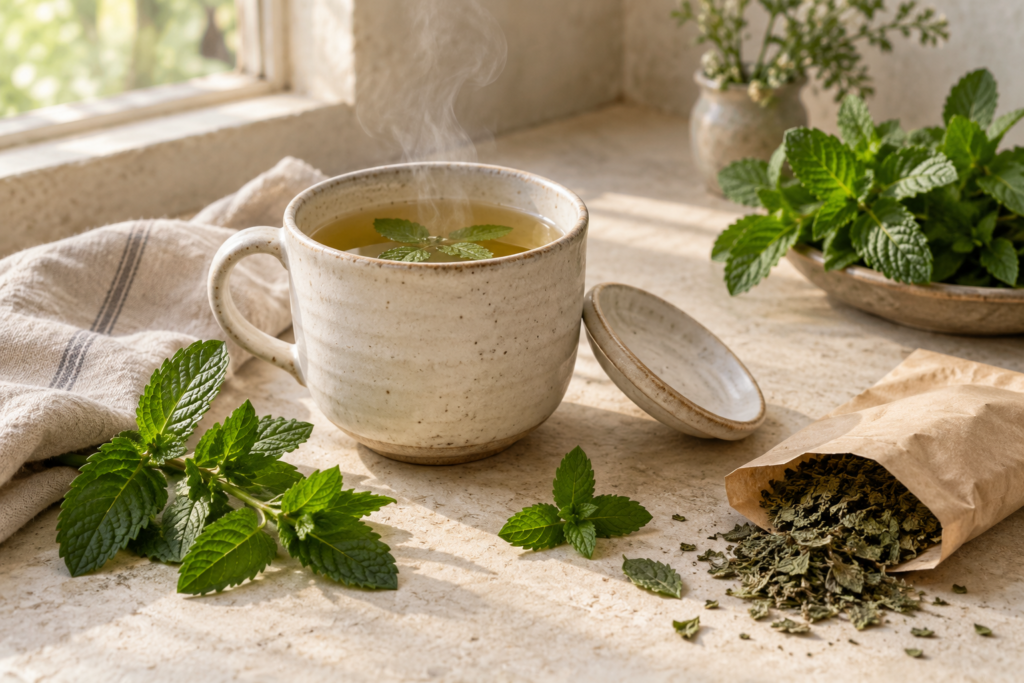
For an ordinary food-grade infusion, place about one to two teaspoons of dried peppermint leaf—or a small, loosely packed handful of fresh leaves—in a mug. Add hot water, cover the cup and steep for roughly five to ten minutes before straining. A commercial tea’s package directions are also a sensible guide.
Why cover it? Peppermint’s aromatic compounds are eager to leave. A lid helps keep more of the fragrant steam near the infusion instead of perfuming the kitchen and abandoning the assignment.
Fresh leaves tend to taste bright and green. Properly dried leaves can make a deeper, more convenient infusion. In either form, aroma is useful information. A peppermint tea that smells like old cardboard has probably lost some of the volatile character that made you choose peppermint in the first place.
This is culinary preparation guidance, not a standardized medicinal dose. Stronger tea is not automatically better tea, and daily medicinal use deserves more thought than an occasional after-meal cup.
What About Extracts, Tinctures and Capsules?
A tincture can extract and concentrate a different balance of compounds than hot water. Products vary in extraction ratio, solvent, serving size and quality testing. Capsules may contain powdered leaf, a dry extract or concentrated oil; those are not interchangeable categories.
When an IBS study reports a result from an enteric-coated capsule containing a measured amount of peppermint oil, the most faithful interpretation belongs to a product with a comparable formulation—not any supplement that happens to place a green leaf on the label.
What I Would Not Tell You About Peppermint
I would not tell you peppermint “heals the gut lining,” kills an infection inside the body, melts inflammation, fixes every form of nausea or performs a detox while you sleep. Peppermint has enough personality without giving it a fictional résumé.
I would not borrow the results of an enteric-coated capsule trial and use them to promise what a teabag will do. I would not let a peppermint-and-caraway study quietly become a peppermint-alone claim. And I would not describe a related Chinese or Moroccan mint as Mentha × piperita simply because the English word “mint” appears nearby.
But I also would not call peppermint tea “just flavored water” or dismiss generations of digestive use as foolish. Peppermint contains identifiable compounds with measurable effects on sensory nerves and smooth muscle. Its concentrated oil has produced a meaningful—though imperfect—clinical signal in IBS. Its leaf remains part of living food and herbal traditions.
The honest middle is not less exciting. It is where the actual story is.
A Peppermint Ritual That Does Not Need to Prove Anything
Make a cup after a meal because you enjoy it, not because every mug must become a medical intervention.
Cover it while it steeps. Notice the first cool breath of aroma when you lift the lid. Put the phone down for the length of one cup. Let your jaw unclench. Give your stomach ten quiet minutes before asking it to process both dinner and the entire internet.
Perhaps the tea settles you. Perhaps it simply tastes good. Pleasure, pause and attention do not need to impersonate a cure to belong in a life.
When Stress and Digestion Keep Sharing the Same Room
Peppermint is only one small part of digestive wellbeing. Lifvyt’s guide to why stress can make your stomach hurt and the deeper Gut–Brain Axis guide explore how the nervous system can shape nausea, cramping and bowel changes.
For a gentle, structured resource, The Anatomy of a Calm Gut offers education, reflection and nervous-system practices without promising a quick fix.
Before You Use Peppermint: Practical Safety
- Reflux and heartburn: peppermint oil can worsen burning, reflux or indigestion in some people. Enteric coating may reduce—but does not eliminate—this problem.
- Gallbladder, bile-duct or liver conditions: concentrated oral peppermint-oil medicines may be unsuitable. Discuss them with a physician or pharmacist.
- Essential oil is not tea concentrate: do not casually swallow aromatherapy oil or add drops to a drink. Use products only by their intended route and label.
- Skin and allergy: topical preparations can irritate skin or trigger an allergic reaction. Use an appropriate formulation and stop for rash, burning, swelling or breathing symptoms.
- Infants and young children: concentrated menthol or peppermint oil should not be placed on or near the face because inhalation can cause serious breathing problems.
- Pregnancy and breastfeeding: food amounts are different from medicinal amounts. Ask an obstetric clinician, pharmacist or other appropriate professional before concentrated or regular medicinal use.
- Medications, surgery and medical conditions: speak with an appropriate clinician before medicinal internal use when you take prescription or over-the-counter medicine, are preparing for surgery or have a significant condition.
- Symptoms that need evaluation: severe or persistent abdominal pain, repeated vomiting, blood in stool or vomit, fever, fainting, dehydration, unintentional weight loss, a rigid or swollen abdomen or a major change in bowel habits should not be managed only with an herb.
Sources & Further Reading
- Royal Botanic Gardens, Kew. Mentha × piperita L., Plants of the World Online.
- European Medicines Agency. European assessment of peppermint leaf (Menthae piperitae folium).
- European Medicines Agency. European assessment of peppermint oil (Menthae piperitae aetheroleum).
- McKay DL, Blumberg JB. A review of the bioactivity and potential health benefits of peppermint tea. Phytotherapy Research. 2006.
- Hudz N, et al. Mentha piperita: Essential oil and extracts, their biological activities, and perspectives on the development of new medicinal and cosmetic products. Molecules. 2023.
- Amato A, et al. Effects of menthol on circular smooth muscle of human colon. 2014.
- Alammar N, et al. The impact of peppermint oil on irritable bowel syndrome: a meta-analysis of pooled clinical data. BMC Complementary Medicine and Therapies. 2019.
- Ingrosso MR, et al. Systematic review and meta-analysis: efficacy of peppermint oil in irritable bowel syndrome. Alimentary Pharmacology & Therapeutics. 2022.
- Nee J, et al. Peppermint oil treatment for irritable bowel syndrome: a randomized placebo-controlled trial. American Journal of Gastroenterology. 2021.
- Weerts ZZRM, et al. Efficacy and safety of peppermint oil in a randomized, double-blind trial of patients with IBS. Gastroenterology. 2020.
- Matsueda K, et al. Efficacy and safety of peppermint oil in Japanese patients with irritable bowel syndrome. BioPsychoSocial Medicine. 2024.
- Joulaeerad N, et al. Effect of aromatherapy with peppermint oil on nausea and vomiting in pregnancy. Journal of Reproduction & Infertility. 2018.
- Jafarimanesh H, et al. The effect of peppermint extract on nausea, vomiting and anorexia in patients with breast cancer undergoing chemotherapy. 2020.
- Ertürk NE, Taşcı S. The effects of peppermint oil on nausea, vomiting and retching in cancer patients undergoing chemotherapy. Complementary Therapies in Medicine. 2021.
- Chraibi M, et al. Ethnobotanical survey of medicinal plants used in the Taounate region of Morocco. 2018.
- El Hassani FZ. Characterization, activities and ethnobotanical uses of Moroccan Mentha species. Heliyon. 2020.
- Tang X, et al. A review of the traditional uses, phytochemistry and pharmacology of Chinese mint. 2024.
- Madisch A, et al. Peppermint oil and caraway oil combination for functional gastrointestinal complaints: systematic review and meta-analysis. Digestive Diseases. 2023.
- National Center for Complementary and Integrative Health. Peppermint Oil: Usefulness and Safety. Updated May 2025.
This Lifvyt article is provided for general educational and informational purposes only. It is not medical advice, diagnosis, treatment or prescribing and does not establish a clinician–patient relationship. Traditional herbal uses described here are historical, cultural or practice-based information—not promises that peppermint will diagnose, treat, cure or prevent disease.
Herbs, teas, tinctures, extracts, supplements, essential oils and topical preparations can cause side effects, allergic reactions and medication interactions. Plant identity, product purity, concentration, formulation and individual response vary. Before medicinal internal use—especially during pregnancy or breastfeeding, for a child, before surgery, alongside prescription or over-the-counter medication, or when you have a medical condition—consult an appropriately qualified physician, pharmacist or healthcare professional.
Essential oils require particular caution. An essential oil is not interchangeable with tea or culinary leaf. Do not ingest or otherwise use one by a route not intended on the specific product label.
You are responsible for your own purchasing, preparation and personal-use decisions. Lifvyt cannot assess your allergies, diagnoses, medications, product quality, dose or individual risk. Seek appropriate medical care for severe, persistent, worsening, unusual or emergency symptoms rather than relying on an herbal remedy or this website.
The Sunday Soft Reset
A calmer start to your week.
Get Lifvyt’s weekly collection of gentle wellness reads, nervous-system resets and practical tools — plus the free 5-Minute Nervous System Reset Guide.
By signing up, you’ll receive the free guide and one gentle Lifvyt email each week. Unsubscribe anytime.